• 文献检索
  • 文档翻译
  • 深度研究
  • 学术资讯
  • Suppr Zotero 插件Zotero 插件
  • 邀请有礼
  • 套餐&价格
  • 历史记录
应用&插件
Suppr Zotero 插件Zotero 插件浏览器插件Mac 客户端Windows 客户端微信小程序
定价
高级版会员购买积分包购买API积分包
服务
文献检索文档翻译深度研究API 文档MCP 服务
关于我们
关于 Suppr公司介绍联系我们用户协议隐私条款
关注我们

Suppr 超能文献

核心技术专利:CN118964589B侵权必究
粤ICP备2023148730 号-1Suppr @ 2026

文献检索

告别复杂PubMed语法,用中文像聊天一样搜索,搜遍4000万医学文献。AI智能推荐,让科研检索更轻松。

立即免费搜索

文件翻译

保留排版,准确专业,支持PDF/Word/PPT等文件格式,支持 12+语言互译。

免费翻译文档

深度研究

AI帮你快速写综述,25分钟生成高质量综述,智能提取关键信息,辅助科研写作。

立即免费体验

肌肉在预摆阶段对生物力学任务的贡献会影响脑卒中患者行走时摆动腿的力学。

Muscle contributions to pre-swing biomechanical tasks influence swing leg mechanics in individuals post-stroke during walking.

机构信息

Walker Department of Mechanical Engineering, The University of Texas at Austin, Austin, TX, USA.

Ralph H Johnson VA Medical Center, Charleston, SC, USA.

出版信息

J Neuroeng Rehabil. 2022 Jun 3;19(1):55. doi: 10.1186/s12984-022-01029-z.

DOI:10.1186/s12984-022-01029-z
PMID:35659252
原文链接:https://pmc.ncbi.nlm.nih.gov/articles/PMC9166530/
Abstract

BACKGROUND

Successful walking requires the execution of the pre-swing biomechanical tasks of body propulsion and leg swing initiation, which are often impaired post-stroke. While excess rectus femoris activity during swing is often associated with low knee flexion, previous work has suggested that deficits in propulsion and leg swing initiation may also contribute. The purpose of this study was to determine underlying causes of propulsion, leg swing initiation and knee flexion deficits in pre-swing and their link to stiff knee gait in individuals post-stroke.

METHODS

Musculoskeletal models and forward dynamic simulations were developed for individuals post-stroke (n = 15) and healthy participants (n = 5). Linear regressions were used to evaluate the relationships between peak knee flexion, braking and propulsion symmetry, and individual muscle contributions to braking, propulsion, knee flexion in pre-swing, and leg swing initiation.

RESULTS

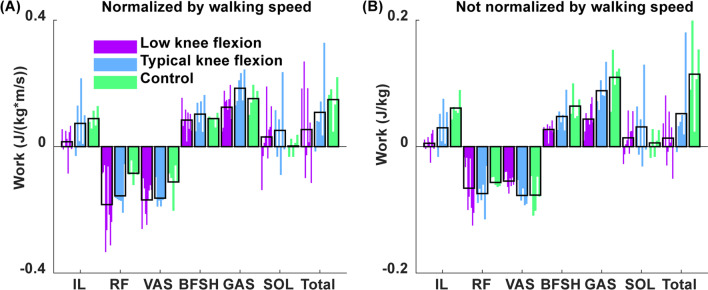
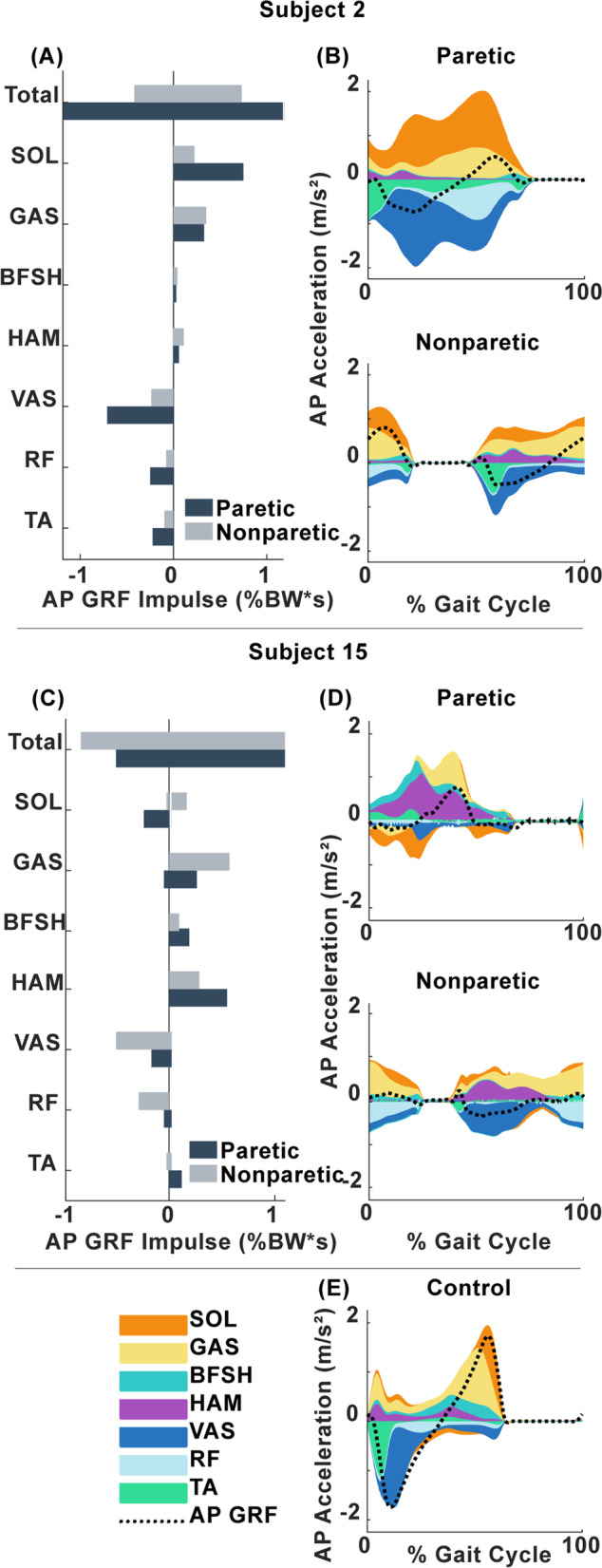
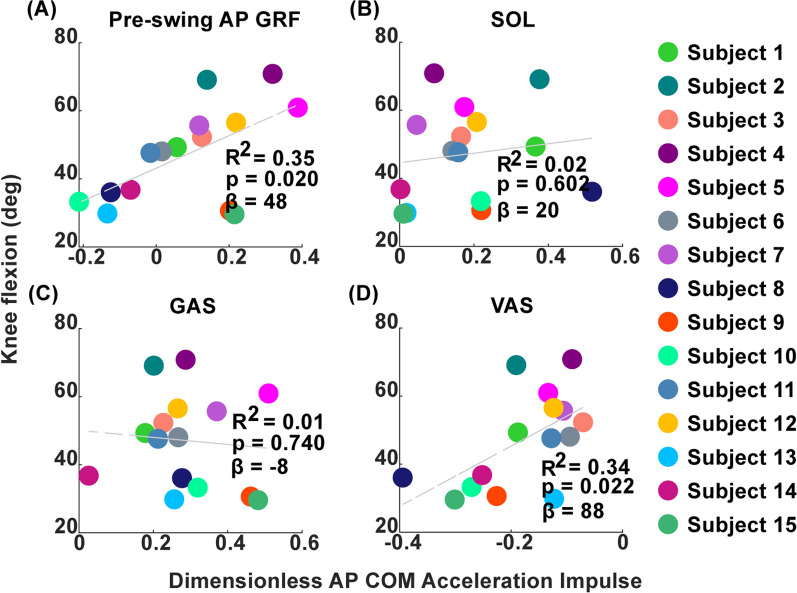
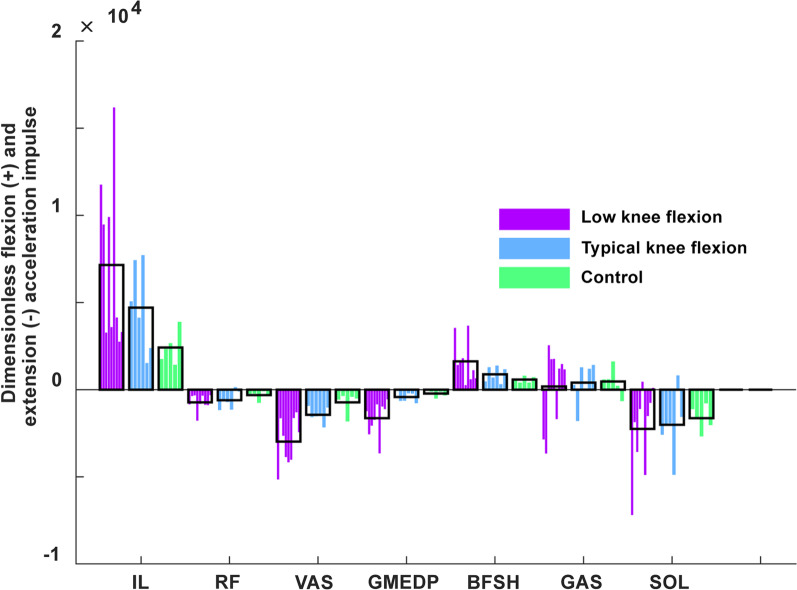
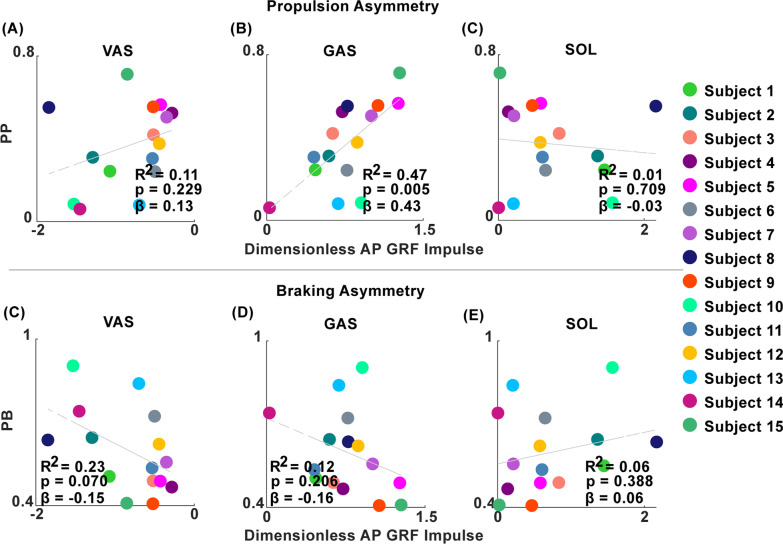
Four out of fifteen of individuals post-stroke had higher plantarflexor contributions to propulsion and seven out of fifteen had higher vasti contributions to braking on their paretic leg relative to their nonparetic leg. Higher gastrocnemius contributions to propulsion predicted paretic propulsion symmetry (p = 0.005) while soleus contributions did not. Higher vasti contributions to braking in pre-swing predicted lower knee flexion (p = 0.022). The rectus femoris had minimal contributions to lower knee flexion acceleration in pre-swing compared to contributions from the vasti. However, for some individuals with low knee flexion, during pre-swing the rectus femoris absorbed more power and the iliopsoas contributed less power to the paretic leg. Total musculotendon work done on the paretic leg in pre-swing did not predict knee flexion during swing.

CONCLUSIONS

These results emphasize the multiple causes of propulsion asymmetry in individuals post-stroke, including low plantarflexor contributions to propulsion, increased vasti contributions to braking and reliance on compensatory mechanisms. The results also show that the rectus femoris is not a major contributor to knee flexion in pre-swing, but absorbs more power from the paretic leg in pre-swing in some individuals with stiff knee gait. These results highlight the need to identify individual causes of propulsion and knee flexion deficits to design more effective rehabilitation strategies.

摘要

背景

成功行走需要执行身体推进和腿摆动启动的摆动前生物力学任务,这些任务在中风后通常会受到损害。虽然摆动时股直肌过度活跃通常与膝关节屈曲度低有关,但之前的研究表明,推进和腿摆动启动的缺陷也可能导致这种情况。本研究旨在确定摆动前推进、腿摆动启动和膝关节屈曲度缺陷的根本原因,并探讨其与中风后个体僵硬膝关节步态的关系。

方法

为中风后个体(n=15)和健康参与者(n=5)建立了肌肉骨骼模型和正向动力学模拟。使用线性回归评估了峰值膝关节屈曲度、制动和推进对称性以及个体肌肉对制动、推进、摆动前膝关节屈曲度和腿摆动启动的贡献之间的关系。

结果

在 15 名中风后个体中,有 4 名个体的患侧推进时的比目鱼肌贡献更高,有 7 名个体的患侧制动时的股四头肌贡献更高。推进时的比目鱼肌贡献越高,预示着患侧推进对称性越好(p=0.005),而腓肠肌的贡献则没有。摆动前的股四头肌贡献越高,预示着膝关节屈曲度越低(p=0.022)。与股四头肌相比,股直肌在摆动前对膝关节下膝加速度的贡献较小。然而,对于一些膝关节屈曲度较低的个体,在摆动前,股直肌吸收了更多的力量,而髂腰肌对患侧的贡献较少。摆动前患侧的总肌肉肌腱做功并不能预测摆动时的膝关节屈曲度。

结论

这些结果强调了中风后个体推进不对称的多种原因,包括推进时比目鱼肌贡献不足、制动时股四头肌贡献增加以及依赖代偿机制。结果还表明,股直肌在摆动前不是膝关节屈曲的主要贡献者,但在一些僵硬膝关节步态的个体中,在摆动前会从患侧吸收更多的力量。这些结果突出了识别推进和膝关节屈曲缺陷的个体原因以设计更有效的康复策略的必要性。
https://cdn.ncbi.nlm.nih.gov/pmc/blobs/d172/9166530/331ca96e04d0/12984_2022_1029_Fig5_HTML.jpg
https://cdn.ncbi.nlm.nih.gov/pmc/blobs/d172/9166530/1d53af8a80bd/12984_2022_1029_Fig1_HTML.jpg
https://cdn.ncbi.nlm.nih.gov/pmc/blobs/d172/9166530/5d9abd286643/12984_2022_1029_Fig2_HTML.jpg
https://cdn.ncbi.nlm.nih.gov/pmc/blobs/d172/9166530/45338805c828/12984_2022_1029_Fig3_HTML.jpg
https://cdn.ncbi.nlm.nih.gov/pmc/blobs/d172/9166530/6ab458d54f5c/12984_2022_1029_Fig4_HTML.jpg
https://cdn.ncbi.nlm.nih.gov/pmc/blobs/d172/9166530/331ca96e04d0/12984_2022_1029_Fig5_HTML.jpg
https://cdn.ncbi.nlm.nih.gov/pmc/blobs/d172/9166530/1d53af8a80bd/12984_2022_1029_Fig1_HTML.jpg
https://cdn.ncbi.nlm.nih.gov/pmc/blobs/d172/9166530/5d9abd286643/12984_2022_1029_Fig2_HTML.jpg
https://cdn.ncbi.nlm.nih.gov/pmc/blobs/d172/9166530/45338805c828/12984_2022_1029_Fig3_HTML.jpg
https://cdn.ncbi.nlm.nih.gov/pmc/blobs/d172/9166530/6ab458d54f5c/12984_2022_1029_Fig4_HTML.jpg
https://cdn.ncbi.nlm.nih.gov/pmc/blobs/d172/9166530/331ca96e04d0/12984_2022_1029_Fig5_HTML.jpg

相似文献

1
Muscle contributions to pre-swing biomechanical tasks influence swing leg mechanics in individuals post-stroke during walking.肌肉在预摆阶段对生物力学任务的贡献会影响脑卒中患者行走时摆动腿的力学。
J Neuroeng Rehabil. 2022 Jun 3;19(1):55. doi: 10.1186/s12984-022-01029-z.
2
Relationships between muscle contributions to walking subtasks and functional walking status in persons with post-stroke hemiparesis.中风后偏瘫患者肌肉对步行子任务的贡献与功能性步行状态之间的关系。
Clin Biomech (Bristol). 2011 Jun;26(5):509-15. doi: 10.1016/j.clinbiomech.2010.12.010. Epub 2011 Jan 20.
3
Altered post-stroke propulsion is related to paretic swing phase kinematics.脑卒中后推进力改变与瘫痪摆动相运动学有关。
Clin Biomech (Bristol). 2020 Feb;72:24-30. doi: 10.1016/j.clinbiomech.2019.11.024. Epub 2019 Nov 29.
4
Pre-swing deficits in forward propulsion, swing initiation and power generation by individual muscles during hemiparetic walking.偏瘫步行时个体肌肉在摆动前期的前向推进、摆动启动和产生功率的不足。
J Biomech. 2010 Aug 26;43(12):2348-55. doi: 10.1016/j.jbiomech.2010.04.027. Epub 2010 May 13.
5
The influence of merged muscle excitation modules on post-stroke hemiparetic walking performance.合并的肌肉兴奋模块对中风后偏瘫步行表现的影响。
Clin Biomech (Bristol). 2013 Jul;28(6):697-704. doi: 10.1016/j.clinbiomech.2013.06.003. Epub 2013 Jul 2.
6
Forward propulsion asymmetry is indicative of changes in plantarflexor coordination during walking in individuals with post-stroke hemiparesis.向前推进不对称表明中风后偏瘫个体在行走过程中跖屈协调性发生了变化。
Clin Biomech (Bristol). 2014 Aug;29(7):780-6. doi: 10.1016/j.clinbiomech.2014.06.001. Epub 2014 Jun 8.
7
Muscle and prosthesis contributions to amputee walking mechanics: a modeling study.截肢者行走力学中肌肉和假肢的贡献:建模研究。
J Biomech. 2012 Aug 31;45(13):2271-8. doi: 10.1016/j.jbiomech.2012.06.008. Epub 2012 Jul 25.
8
Contributions to the understanding of gait control.对步态控制理解的贡献。
Dan Med J. 2014 Apr;61(4):B4823.
9
Gait differences between individuals with post-stroke hemiparesis and non-disabled controls at matched speeds.中风后偏瘫患者与非残疾对照组在匹配速度下的步态差异。
Gait Posture. 2005 Aug;22(1):51-6. doi: 10.1016/j.gaitpost.2004.06.009.
10
Articulated ankle-foot-orthosis improves inter-limb propulsion symmetry during walking adaptability task post-stroke.踝足矫形器改善了卒中后行走适应任务中的肢体间推进对称性。
Clin Biomech (Bristol). 2024 Jun;116:106268. doi: 10.1016/j.clinbiomech.2024.106268. Epub 2024 May 18.

引用本文的文献

1
Deficit in intersegmental torques drives post-stroke stiff-knee gait.节段间扭矩不足导致中风后膝关节僵硬步态。
medRxiv. 2025 May 19:2025.05.19.25327905. doi: 10.1101/2025.05.19.25327905.
2
Heteronymous feedback from quadriceps onto soleus in stroke survivors.中风幸存者中股四头肌对比目鱼肌的异侧反馈。
J Neuroeng Rehabil. 2025 Feb 26;22(1):39. doi: 10.1186/s12984-025-01572-5.
3
Within-session propulsion asymmetry changes have a limited effect on gait asymmetry post-stroke.会话内推进不对称性变化对中风后步态不对称性的影响有限。

本文引用的文献

1
Soft tissue vibration: a biologically-inspired mechanism for stabilizing bipedal locomotion.软组织振动:一种稳定双足运动的仿生机制。
Bioinspir Biomim. 2021 Jan 25;16(2). doi: 10.1088/1748-3190/abd624.
2
These legs were made for propulsion: advancing the diagnosis and treatment of post-stroke propulsion deficits.这些腿是为推进而生的:推进中风后推进缺陷的诊断和治疗。
J Neuroeng Rehabil. 2020 Oct 21;17(1):139. doi: 10.1186/s12984-020-00747-6.
3
Rectus femoris hyperreflexia contributes to Stiff-Knee gait after stroke.股直肌反射亢进导致脑卒中后出现僵直步态。
J Neuroeng Rehabil. 2025 Jan 22;22(1):9. doi: 10.1186/s12984-025-01553-8.
4
Comparative electromyography analysis of subphase gait disorder in chronic stroke survivors.慢性脑卒中幸存者亚相步态障碍的比较肌电图分析。
PeerJ. 2024 Nov 14;12:e18473. doi: 10.7717/peerj.18473. eCollection 2024.
5
Alpha and beta/low-gamma frequency bands may have distinct neural origin and function during post-stroke walking.在脑卒中后行走期间,alpha 和 beta/低 gamma 频段可能具有不同的神经起源和功能。
Exp Brain Res. 2024 Oct;242(10):2309-2327. doi: 10.1007/s00221-024-06906-8. Epub 2024 Aug 6.
6
Heteronymous feedback from quadriceps onto soleus in stroke survivors.中风幸存者中股四头肌对比目鱼肌的异侧反馈。
Res Sq. 2024 Jun 27:rs.3.rs-4540327. doi: 10.21203/rs.3.rs-4540327/v1.
7
Hip and Knee Joint Kinematics Predict Quadriceps Hyperreflexia in People with Post-stroke Stiff-Knee Gait.髋关节和膝关节运动学预测脑卒中后僵直步态患者的股四头肌反射亢进。
Ann Biomed Eng. 2023 Sep;51(9):1965-1974. doi: 10.1007/s10439-023-03217-x. Epub 2023 May 3.
J Neuroeng Rehabil. 2020 Aug 26;17(1):117. doi: 10.1186/s12984-020-00724-z.
4
Altered Achilles tendon morphology in individuals with chronic post-stroke hemiparesis: a case report.慢性脑卒中偏瘫患者跟腱形态改变:病例报告。
BMC Med Imaging. 2020 Apr 3;20(1):34. doi: 10.1186/s12880-020-00431-0.
5
Heart Disease and Stroke Statistics-2020 Update: A Report From the American Heart Association.《心脏病与卒中统计-2020 更新:来自美国心脏协会的报告》。
Circulation. 2020 Mar 3;141(9):e139-e596. doi: 10.1161/CIR.0000000000000757. Epub 2020 Jan 29.
6
Central Drive to the Paretic Ankle Plantarflexors Affects the Relationship Between Propulsion and Walking Speed After Stroke.中枢驱动对瘫痪踝关节跖屈肌的影响与中风后推进力和行走速度的关系。
J Neurol Phys Ther. 2020 Jan;44(1):42-48. doi: 10.1097/NPT.0000000000000299.
7
Altered post-stroke propulsion is related to paretic swing phase kinematics.脑卒中后推进力改变与瘫痪摆动相运动学有关。
Clin Biomech (Bristol). 2020 Feb;72:24-30. doi: 10.1016/j.clinbiomech.2019.11.024. Epub 2019 Nov 29.
8
Muscle contributions to mediolateral and anteroposterior foot placement during walking.行走时足部内外侧和前后向的足部放置的肌肉贡献。
J Biomech. 2019 Oct 11;95:109310. doi: 10.1016/j.jbiomech.2019.08.004. Epub 2019 Aug 9.
9
Merged plantarflexor muscle activity is predictive of poor walking performance in post-stroke hemiparetic subjects.合并的跖屈肌活动可预测中风后偏瘫患者的步行能力不佳。
J Biomech. 2019 Jan 3;82:361-367. doi: 10.1016/j.jbiomech.2018.11.011. Epub 2018 Nov 15.
10
Paretic propulsion as a measure of walking performance and functional motor recovery post-stroke: A review.偏瘫推进作为中风后步行能力和功能性运动恢复的一项指标:综述
Gait Posture. 2019 Feb;68:6-14. doi: 10.1016/j.gaitpost.2018.10.027. Epub 2018 Oct 25.