Department of Hematology and Oncology, Stavanger University Hospital, Stavanger, Norway.
Department of Chemistry, Bioscience and Environmental Technology, Faculty of Science and Technology, University of Stavanger, Stavanger, Norway.
BMC Cancer. 2022 Jun 3;22(1):609. doi: 10.1186/s12885-022-09714-x.
Although pancreatic ductal adenocarcinoma (PDAC) rarely metastasizes to the skeleton, disseminated tumor cells have been detected in bone marrow samples from patients with this disease. The prognostic value of such findings is currently unclear. Thus, the current study aimed to clarify the prognostic information associated with disseminated tumor cell detection in samples from patients with PDAC.
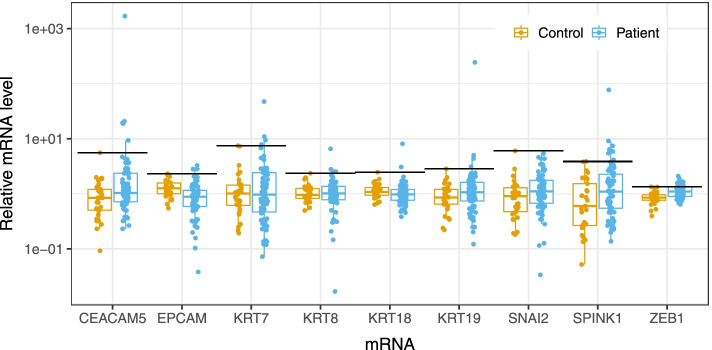
Bone marrow aspirates were obtained from 48 patients with locally advanced (n = 11) or metastatic (n = 37) PDAC, before and after 2 months of chemotherapy. Disseminated tumor cells were detected with an mRNA panel and quantitative reverse transcription PCR. We used the highest levels measured in healthy bone marrow (n = 30) as a threshold to define the positive detection of disseminated tumor cells. Progression-free and overall survival were analyzed with Kaplan-Meier and Cox proportional hazards regression analyses.
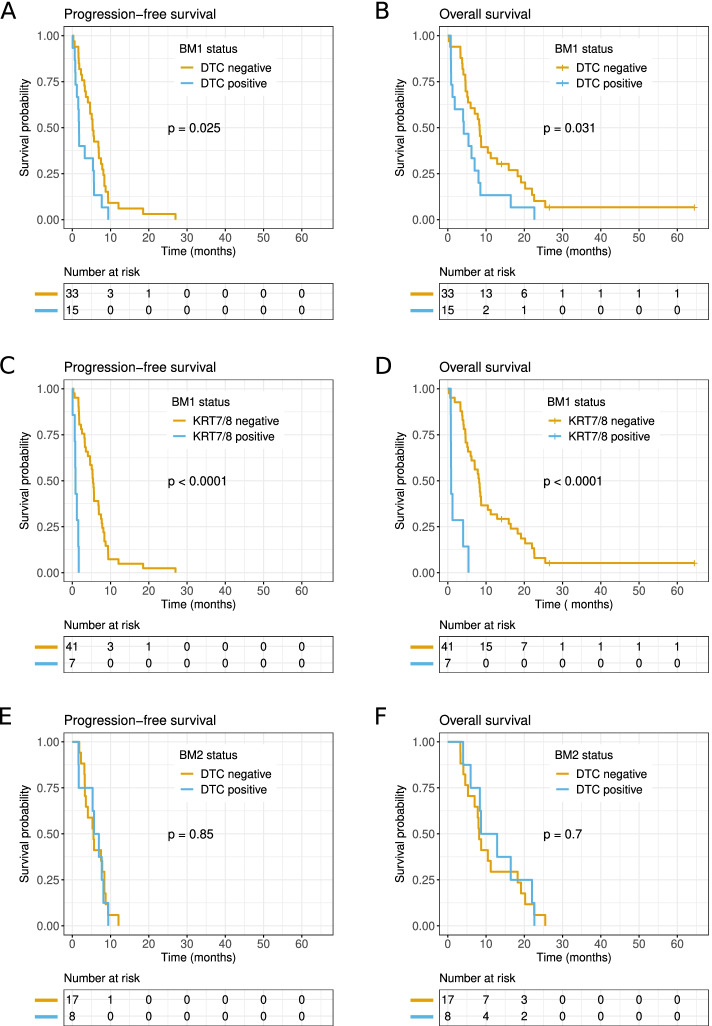
Disseminated tumor cells were detected in 15/48 (31%) bone marrow samples obtained before starting chemotherapy and in 8/25 (32%) samples obtained during chemotherapy. Patients with disseminated tumor cells detected before therapy had significantly shorter progression-free (p = 0.03; HR = 2.0) and overall survival (p = 0.03; HR = 2.0), compared to those without disseminated tumor cells in the bone marrow. When restricting disseminated tumor cell detection to keratins KRT7 and KRT8, the prognostic information was substantially stronger (p = 1 × 10; HR = 22, and p = 2 × 10; HR = 7.7, respectively). The multivariable Cox regression analysis demonstrated that disseminated tumor cell detection prior to treatment had independent prognostic value. In contrast, disseminated tumor cells detected during treatment did not have prognostic value.
Disseminated tumor cells detected before commencing chemotherapy had prognostic value in patients with inoperable PDAC.
尽管胰腺导管腺癌(PDAC)很少转移到骨骼,但在患有这种疾病的患者的骨髓样本中已经检测到播散的肿瘤细胞。这些发现的预后价值目前尚不清楚。因此,本研究旨在阐明与 PDAC 患者骨髓样本中播散肿瘤细胞检测相关的预后信息。
在接受 2 个月化疗之前和之后,从 48 名局部晚期(n=11)或转移性(n=37)PDAC 患者中获取骨髓抽吸物。使用 mRNA 面板和定量逆转录 PCR 检测播散的肿瘤细胞。我们使用健康骨髓(n=30)中测量的最高水平作为阈值来定义播散肿瘤细胞的阳性检测。使用 Kaplan-Meier 和 Cox 比例风险回归分析来分析无进展生存期和总生存期。
在开始化疗前获得的 48 份骨髓样本中,有 15/48(31%)检测到播散的肿瘤细胞,在化疗期间获得的 25 份样本中,有 8/25(32%)检测到播散的肿瘤细胞。在治疗前检测到播散肿瘤细胞的患者无进展生存期(p=0.03;HR=2.0)和总生存期(p=0.03;HR=2.0)明显较短,与骨髓中未检测到播散肿瘤细胞的患者相比。当将播散肿瘤细胞检测限制在角蛋白 KRT7 和 KRT8 时,预后信息要强得多(p=1×10;HR=22,p=2×10;HR=7.7)。多变量 Cox 回归分析表明,治疗前检测到播散肿瘤细胞具有独立的预后价值。相比之下,治疗期间检测到的播散肿瘤细胞没有预后价值。
在无法手术的 PDAC 患者中,化疗前检测到播散的肿瘤细胞具有预后价值。