Department of Allergy and Clinical Immunology, Graduate School of Medicine, Chiba University, Chiba, Japan.
Department of Orthopedic Surgery, Graduate School of Medicine, Chiba University, Chiba, Japan.
Arthritis Res Ther. 2022 Jun 4;24(1):134. doi: 10.1186/s13075-022-02817-7.
Methotrexate (MTX) is an anchor drug for the treatment of rheumatoid arthritis (RA). However, the precise mechanisms by which MTX stalls RA progression and alleviates the ensuing disease effects remain unknown. The aim of the present study was to identify novel therapeutic target molecules, the expression patterns of which are affected by MTX in patients with RA.
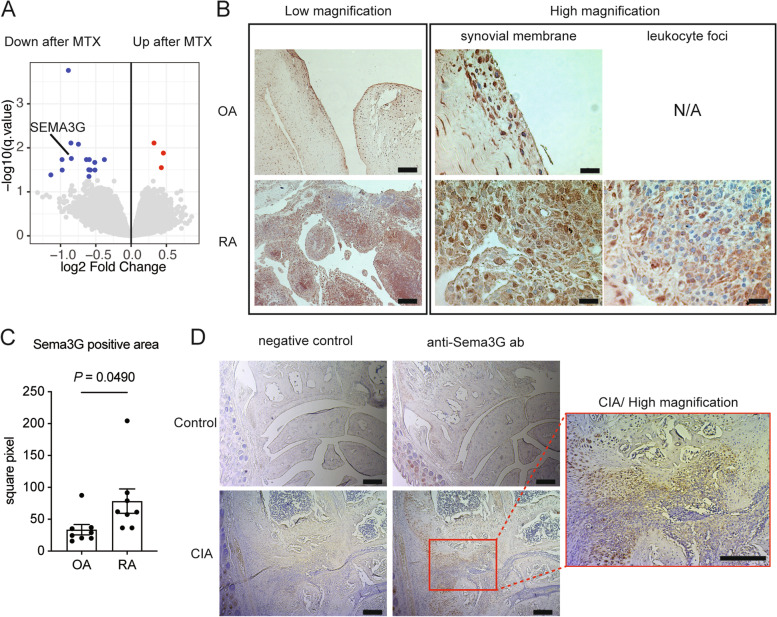
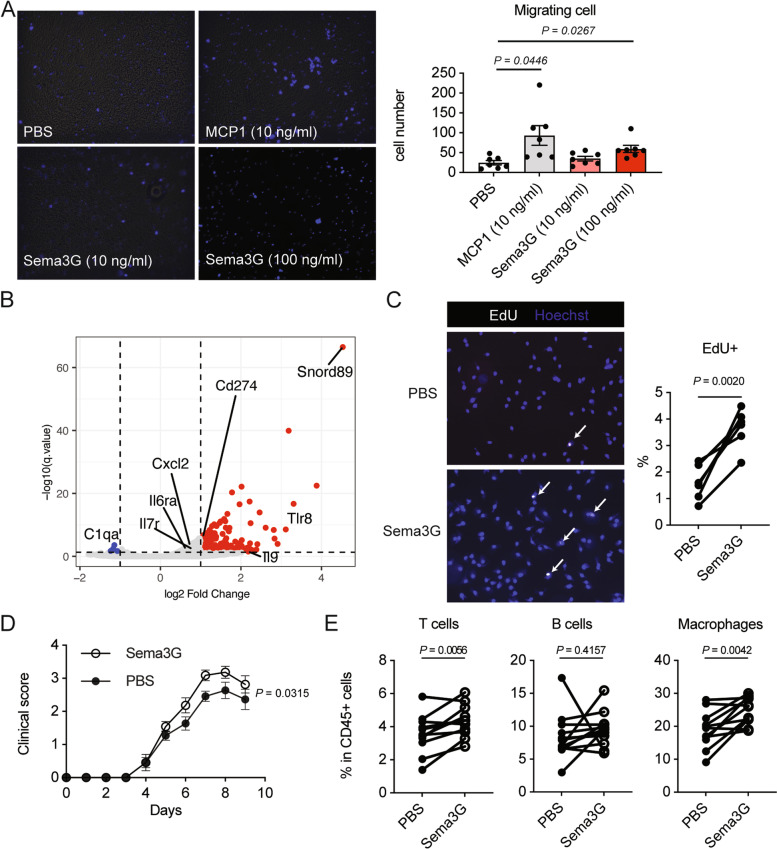
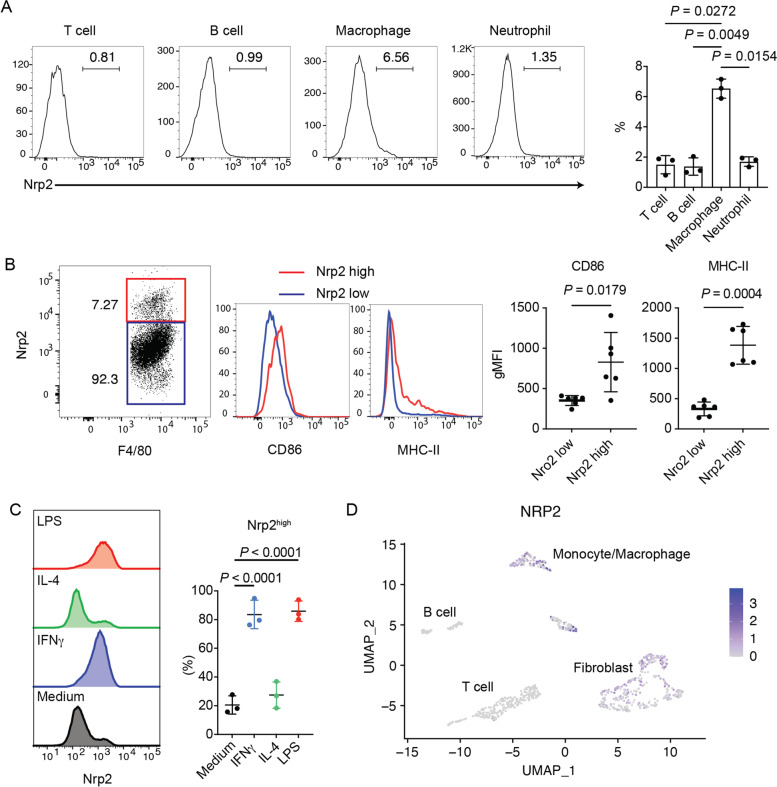
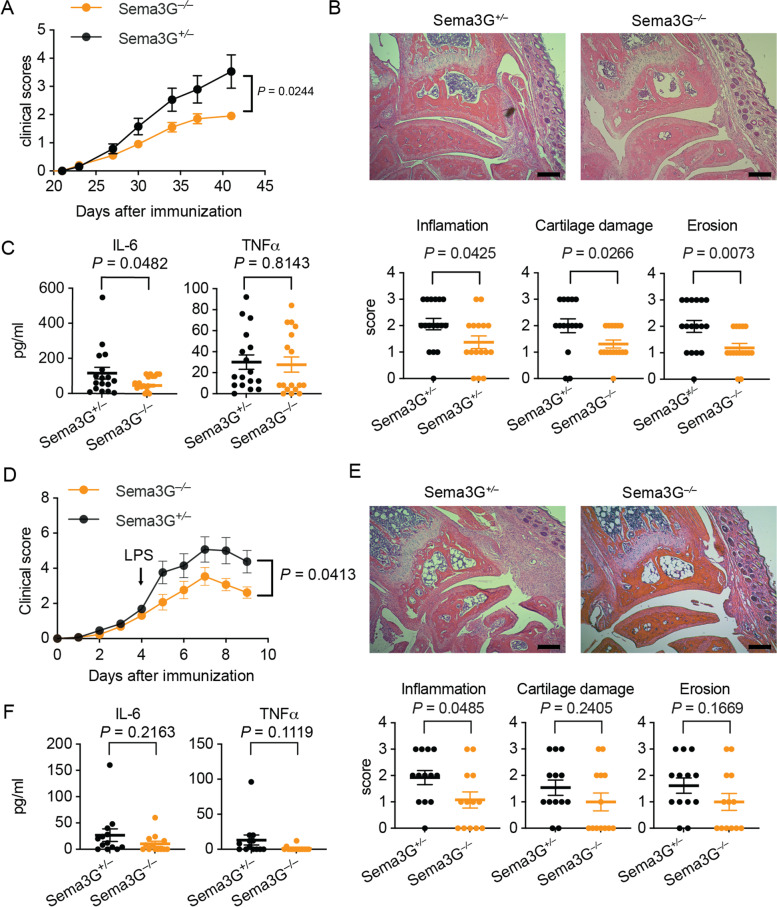
CD4 T cells from 28 treatment-naïve patients with RA before and 3 months after the initiation of MTX treatment were subjected to DNA microarray analyses. The expression levels of semaphorin 3G, a differentially expressed gene, and its receptor, neuropilin-2, were evaluated in the RA synovium and collagen-induced arthritis synovium. Collagen-induced arthritis and collagen antibody-induced arthritis were induced in semaphorin3G-deficient mice and control mice, and the clinical score, histological score, and serum cytokines were assessed. The migration and proliferation of semaphorin 3G-stimulated bone marrow-derived macrophages were analyzed in vitro. The effect of local semaphorin 3G administration on the clinical score and number of infiltrating macrophages during collagen antibody-induced arthritis was evaluated.
Semaphorin 3G expression in CD4 T cells was downregulated by MTX treatment in RA patients. It was determined that semaphorin 3G is expressed in RA but not in the osteoarthritis synovium; its receptor neuropilin-2 is primarily expressed on activated macrophages. Semaphorin3G deficiency ameliorated collagen-induced arthritis and collagen antibody-induced arthritis. Semaphorin 3G stimulation enhanced the migration and proliferation of bone marrow-derived macrophages. Local administration of semaphorin 3G deteriorated collagen antibody-induced arthritis and increased the number of infiltrating macrophages.
Upregulation of semaphorin 3G in the RA synovium is a novel mechanism that exacerbates joint inflammation, leading to further deterioration, through macrophage accumulation.
甲氨蝶呤(MTX)是治疗类风湿关节炎(RA)的基础药物。然而,MTX 阻止 RA 进展并缓解随后的疾病效应的确切机制尚不清楚。本研究旨在确定新的治疗靶点分子,这些分子的表达模式受 MTX 影响。
对 28 例初治 RA 患者在 MTX 治疗前和治疗 3 个月后的 CD4 T 细胞进行 DNA 微阵列分析。评估 RA 滑膜和胶原诱导性关节炎滑膜中差异表达基因神经纤毛蛋白-2及其受体 semaphorin 3G 的表达水平。在 semaphorin3G 缺陷小鼠和对照小鼠中诱导胶原诱导性关节炎和胶原抗体诱导性关节炎,并评估临床评分、组织学评分和血清细胞因子。分析 semaphorin 3G 刺激骨髓来源巨噬细胞的迁移和增殖。评估局部 semaphorin 3G 给药对胶原抗体诱导性关节炎期间临床评分和浸润巨噬细胞数量的影响。
MTX 治疗可下调 RA 患者 CD4 T 细胞中 semaphorin 3G 的表达。确定 semaphorin 3G 在 RA 中表达,而不在骨关节炎滑膜中表达;其受体神经纤毛蛋白-2主要表达在活化的巨噬细胞上。semaphorin3G 缺陷可改善胶原诱导性关节炎和胶原抗体诱导性关节炎。semaphorin 3G 刺激增强了骨髓来源巨噬细胞的迁移和增殖。局部给予 semaphorin 3G 可加重胶原抗体诱导性关节炎并增加浸润巨噬细胞的数量。
RA 滑膜中 semaphorin 3G 的上调是一种通过巨噬细胞积累加重关节炎症的新机制,导致疾病进一步恶化。