Fuhrmann Julia D, Valkova Kristyna, von Moos Seraina, Wüthrich Rudolf P, Müller Thomas F, Schachtner Thomas
Division of Nephrology, University Hospital Zurich, Zurich, Switzerland.
Clin Kidney J. 2022 Jan 13;15(6):1152-1159. doi: 10.1093/ckj/sfac013. eCollection 2022 Jun.
Cancer risk is increased by 2- to 4-fold in kidney transplant recipients (KTRs) compared with the general population. Little attention, however, has been given to KTRs with ultra long-term survival >20 years.
We studied 293 of 1241 KTRs (23.6%), transplanted between 1981 and 1999, who showed kidney allograft survival >20 years. These long-term survivors were analysed for cancer development, cancer type, cancer-associated risk factors and patient and allograft outcomes.
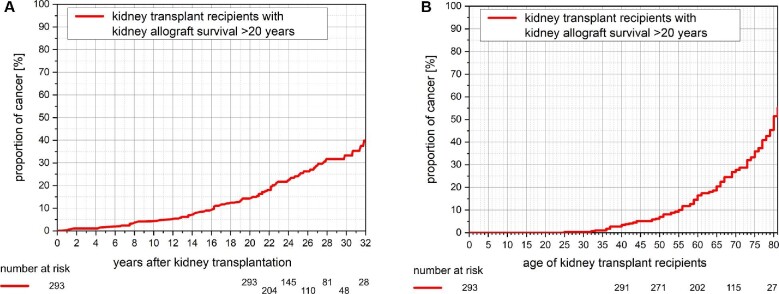
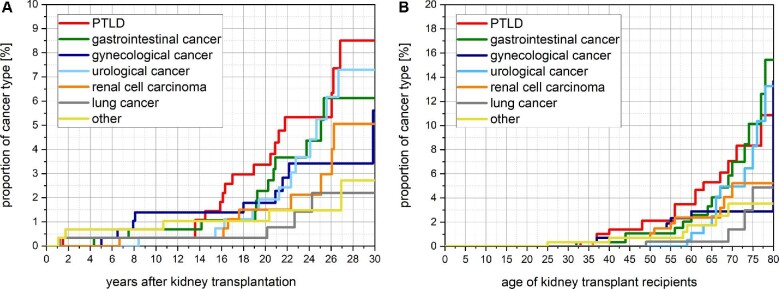
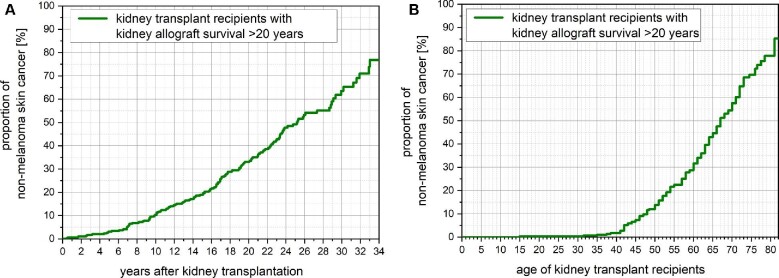
By 10, 20 and 30 years post-transplantation, these long-term KTRs showed a cancer rate of 4.4%, 14.6% and 33.2%, and a non-melanoma skin cancer (NMSC) rate of 10.3%, 33.5% and 76.8%, respectively. By recipients' ages of 40, 60 and 80 years, KTRs showed a cancer rate of 3.4%, 14.5% 55.2%, and a NMSC rate of 1.7%, 31.6% and 85.2%, respectively. By 30 years post-transplantation, post-transplant lymphoproliferative disorder (PTLD) showed the highest incidence of 8.5%, followed by renal cell carcinoma (RCC) with 5.1%. Risk factors associated with the development of cancer were only recipient age (P = 0.016). Smoking history was associated with the risk of lung cancer (P = 0.018). Risk factors related to the development of NMSC included recipient age (P = 0.001) and thiazide diuretics (P = 0.001). Cancer increased the risk of death by 2.4-fold (P = 0.002), and PTLD increased the risk of kidney allograft loss by 6.5-fold (P = 0.001). No differences were observed concerning the development of donor-specific antibodies (P > 0.05).
In long-term KTRs, cancer is a leading cause of death. PTLD remains the most common cancer type followed by RCC. These results emphasize the need for focused long-term cancer surveillance protocols.
与普通人群相比,肾移植受者(KTRs)患癌风险增加了2至4倍。然而,对于长期存活超过20年的KTRs关注甚少。
我们研究了1981年至1999年间接受移植的1241例KTRs中的293例(23.6%),这些患者的肾移植存活时间超过20年。对这些长期存活者的癌症发生情况、癌症类型、癌症相关危险因素以及患者和移植肾结局进行了分析。
移植后10年、20年和30年时,这些长期KTRs的癌症发生率分别为4.4%、14.6%和33.2%,非黑色素瘤皮肤癌(NMSC)发生率分别为10.3%、33.5%和76.8%。在受者年龄达到40岁、60岁和80岁时,KTRs的癌症发生率分别为3.4%、14.5%和55.2%,NMSC发生率分别为1.7%、31.6%和85.2%。移植后30年时,移植后淋巴细胞增生性疾病(PTLD)的发生率最高,为8.5%,其次是肾细胞癌(RCC),发生率为5.1%。与癌症发生相关的危险因素仅为受者年龄(P = 0.016)。吸烟史与肺癌风险相关(P = 0.018)。与NMSC发生相关的危险因素包括受者年龄(P = 0.001)和噻嗪类利尿剂(P = 0.001)。癌症使死亡风险增加2.4倍(P = 0.002),PTLD使移植肾丢失风险增加6.5倍(P = 0.001)。在供者特异性抗体的产生方面未观察到差异(P > 0.05)。
在长期KTRs中,癌症是主要死因。PTLD仍然是最常见的癌症类型,其次是RCC。这些结果强调了制定针对性长期癌症监测方案的必要性。