Chang Sheng, Liu Gang, Zhao Lewei, Zheng Weili, Yan Di, Chen Peter, Li Xiangpan, Yang Kunyu, Deraniyagala Rohan, Stevens Craig, Grills Inga, Chinnaiyan Prakash, Li Xiaoqiang, Ding Xuanfeng
Department of Radiation Oncology, Renmin Hospital, Wuhan University, Wuhan, China.
Department of Radiation Oncology, Beaumont Health System, Royal Oak, MI, United States.
Front Oncol. 2022 May 19;12:804036. doi: 10.3389/fonc.2022.804036. eCollection 2022.
To explore the role of using Pencil Beam Scanning (PBS) proton beam therapy in single lesion brain stereotactic radiosurgery (SRS), we developed and validated a dosimetric in silico model to assist in the selection of an optimal treatment approach among the conventional Volumetric Modulated Arc Therapy (VMAT), Intensity Modulated Proton Therapy (IMPT) and Spot-scanning Proton Arc (SPArc).
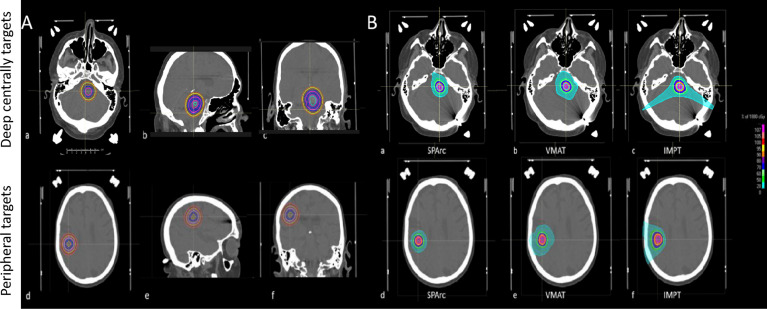
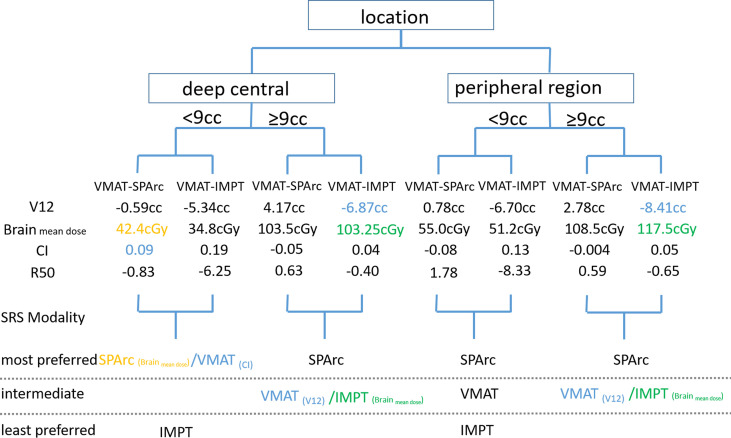
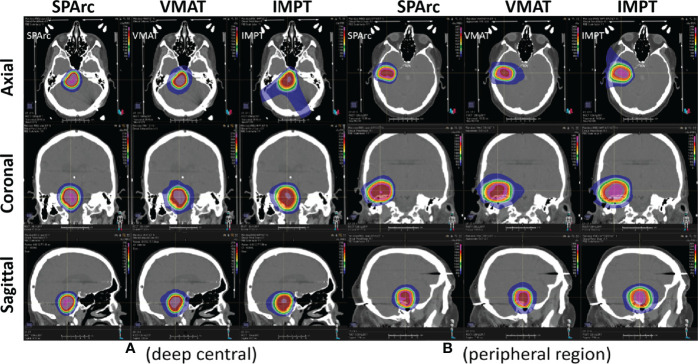
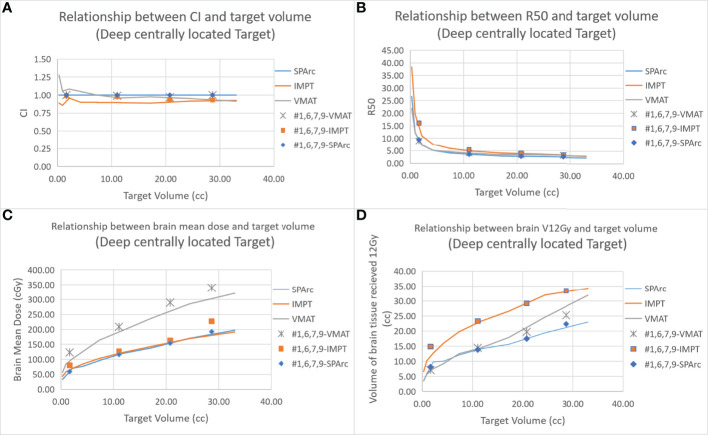
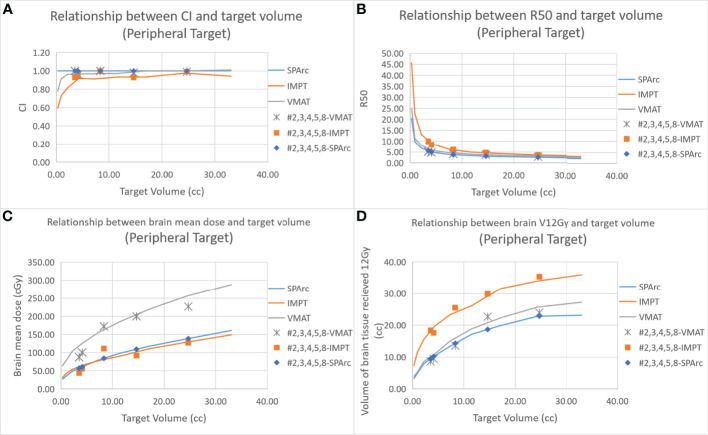
A patient's head CT data set was used as an in model. A series of targets (volume range from 0.3 cc to 33.03 cc) were inserted in the deep central and peripheral region, simulating targets with different sizes and locations. Three planning groups: IMPT, VMAT, and SPArc were created for dosimetric comparison purposes and a decision tree was built based on this in model. Nine patients with single brain metastases were retrospectively selected for validation. Multiple dosimetric metrics were analyzed to assess the plan quality, such as dose Conformity Index (CI) (ratio of the target volume to 100% prescription isodose volume); R50 (ratio of 50% prescription isodose volume to the target volume); V (volume of brain tissue minus GTV receiving 12 Gy), and mean dose of the normal brain. Normal tissue complication probability (NTCP) of brain radionecrosis (RN) was calculated using the Lyman-Kutcher-Burman (LKB) model and total treatment delivery time was calculated. Six physicians from different institutions participated in the blind survey to evaluate the plan quality and rank their choices.
The study showed that SPArc has a dosimetric advantage in the V and R50 with target volumes > 9.00 cc compared to VMAT and IMPT. A significant clinical benefit can be found in deep centrally located lesions larger than 20.00 cc using SPArc because of the superior dose conformity and mean dose reduction in healthy brain tissue. Nine retrospective clinical cases and the blind survey showed good agreement with the in dosimetric model and decision tree. Additionally, SPArc significantly reduced the treatment delivery time compared to VMAT (SPArc 184.46 ± 59.51s vs. VMAT: 1574.78 ± 213.65s).
The study demonstrated the feasibility of using Proton beam therapy for single brain metastasis patients utilizing the SPArc technique. At the current stage of technological development, VMAT remains the current standard modality of choice for single lesion brain SRS. The dosimetric model and decision tree presented here could be used as a practical clinical decision tool to assist the selection of the optimal treatment modality among VMAT, IMPT, and SPArc in centers that have both photon and proton capabilities.
为了探究笔形束扫描(PBS)质子束治疗在单病灶脑立体定向放射外科手术(SRS)中的作用,我们开发并验证了一种计算机模拟剂量学模型,以协助在传统容积调强弧形放疗(VMAT)、调强质子治疗(IMPT)和点扫描质子弧形放疗(SPArc)中选择最佳治疗方法。
将一名患者的头部CT数据集用作计算机模拟模型。在深部中央和周边区域插入一系列靶区(体积范围从0.3立方厘米至33.03立方厘米),模拟不同大小和位置的靶区。为进行剂量学比较创建了三个计划组:IMPT、VMAT和SPArc,并基于此计算机模拟模型构建了决策树。回顾性选择9例单发脑转移瘤患者进行验证。分析了多个剂量学指标以评估计划质量,如剂量适形指数(CI)(靶区体积与100%处方等剂量体积的比值);R50(50%处方等剂量体积与靶区体积的比值);V(接受12 Gy照射的脑组织体积减去大体肿瘤体积)以及正常脑组织的平均剂量。使用莱曼-库彻-伯曼(LKB)模型计算脑放射性坏死(RN)的正常组织并发症概率(NTCP),并计算总治疗交付时间。来自不同机构的六名医生参与了盲法评估,以评估计划质量并对他们的选择进行排名。
研究表明,与VMAT和IMPT相比,当靶区体积>9.00立方厘米时,SPArc在V和R50方面具有剂量学优势。对于深部中央位置大于20.00立方厘米的病灶,使用SPArc可发现显著的临床益处,因为其在健康脑组织中的剂量适形性更好且平均剂量降低。九例回顾性临床病例和盲法评估与计算机模拟剂量学模型和决策树显示出良好的一致性。此外,与VMAT相比,SPArc显著缩短了治疗交付时间(SPArc:184.46±59.51秒 vs. VMAT:1574.78±213.65秒)。
该研究证明了利用SPArc技术对单发脑转移瘤患者使用质子束治疗的可行性。在当前技术发展阶段,VMAT仍然是单病灶脑SRS的当前标准选择方式。此处呈现的计算机模拟剂量学模型和决策树可作为一种实用的临床决策工具,以协助在同时具备光子和质子治疗能力的中心在VMAT、IMPT和SPArc中选择最佳治疗方式。