Siwicka-Gieroba Dorota, Terpilowska Sylwia, Robba Chiara, Barud Małgorzata, Kubik-Komar Agnieszka, Dabrowski Wojciech
Department of Anaesthesiology and Intensive Care, Medical University of Lublin, Lublin, Poland.
Collegium Medicum, Jan Kochanowski University in Kielce, Kielce, Poland.
Front Neurol. 2022 May 19;13:796238. doi: 10.3389/fneur.2022.796238. eCollection 2022.
The interaction between the brain and lungs has been the subject of many clinical reports, while the exact impact of brain injury on the physiology of the respiratory system is still subject to numerous experimental studies. The purpose of this study was to investigate the activation of selected caspases levels in bronchoalveolar lavage fluid (mini BALF) of patients after isolated brain injury and their correlation with the severity of the injury.
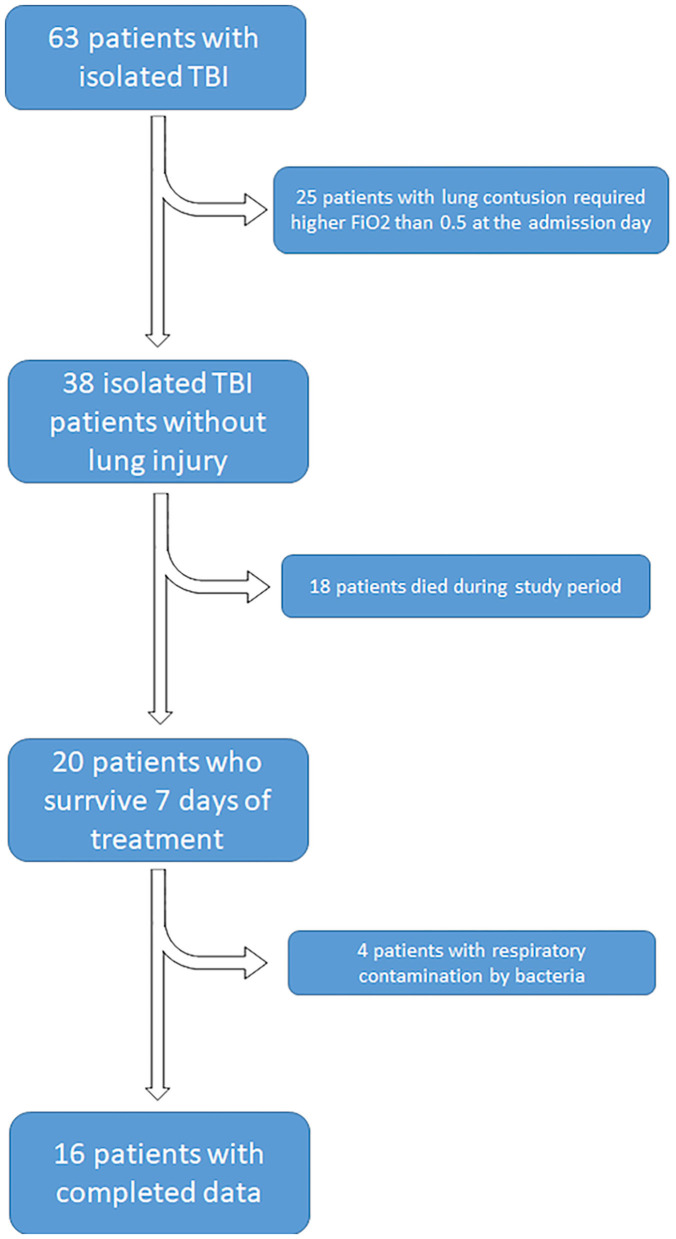
The analysis was performed on patients who were admitted to the intensive care unit (ICU) for severe isolated brain injury from March 2018 to April 2020. All patients were intubated and mechanically ventilated. Mini BALF was collected within the first 6-8 h after trauma and on days 3 and 7 after admission. The concentrations of selected caspases were determined and correlated with the severity of brain injury evaluated by the Rotterdam CT Score, Glasgow Coma Score, and 28-day mortality.
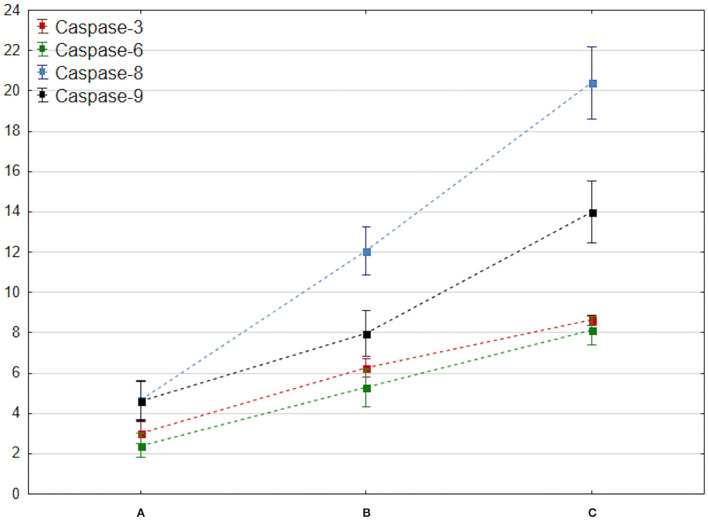
Our results showed significantly elevated levels of selected caspases on days 3 and 7 after brain injury, and revealed apoptosis activation during the first 7 days after brain trauma. We found a significant different correlation between the elevation of selected caspases 3, 6, 8, and 9, and the Glasgow Coma Score, Rotterdam CT scale, and 28-day mortality.
The increased levels of selected caspases in the mini BALF in our patients indicate an intensified activation of apoptosis in the lungs, which is related to brain injury itself various apoptotic pathways and correlates with the severity of brain injury.
脑与肺之间的相互作用一直是许多临床报告的主题,而脑损伤对呼吸系统生理的确切影响仍需大量实验研究。本研究的目的是调查单纯脑损伤患者支气管肺泡灌洗液(微型BALF)中特定半胱天冬酶水平的激活情况及其与损伤严重程度的相关性。
对2018年3月至2020年4月因严重单纯脑损伤入住重症监护病房(ICU)的患者进行分析。所有患者均行气管插管并机械通气。在创伤后最初6 - 8小时内以及入院后第3天和第7天收集微型BALF。测定特定半胱天冬酶的浓度,并将其与通过鹿特丹CT评分、格拉斯哥昏迷评分和28天死亡率评估的脑损伤严重程度相关联。
我们的数据显示,脑损伤后第3天和第7天特定半胱天冬酶水平显著升高,表明脑创伤后第1个7天内存在凋亡激活。我们发现特定半胱天冬酶3、6、8和9的升高与格拉斯哥昏迷评分、鹿特丹CT量表和28天死亡率之间存在显著的不同相关性。
我们患者微型BALF中特定半胱天冬酶水平的升高表明肺中凋亡激活增强,这与脑损伤本身有关,涉及各种凋亡途径,并与脑损伤的严重程度相关。