Choo Yoo Jin, Kim Du Hwan, Chang Min Cheol
Department of Physical Medicine and Rehabilitation, College of Medicine, Yeungnam University, Daegu 705-717, South Korea.
Department of Physical Medicine and Rehabilitation, College of Medicine, Chung-Ang University, Seoul 06973, South Korea.
World J Clin Cases. 2022 May 6;10(13):3981-3988. doi: 10.12998/wjcc.v10.i13.3981.
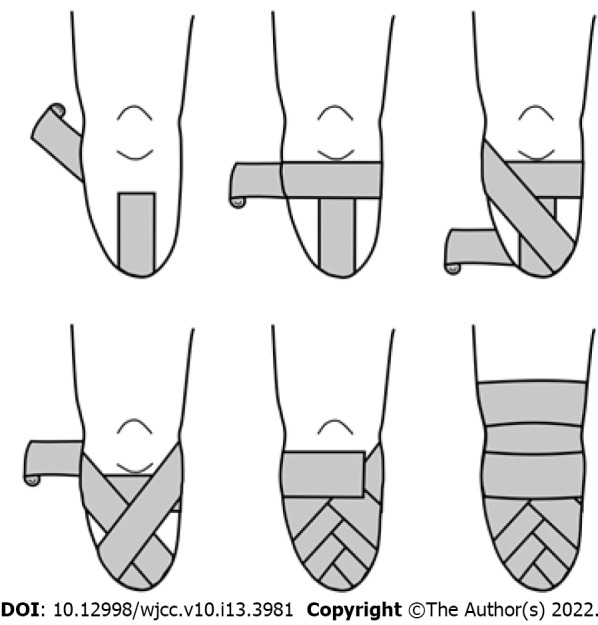
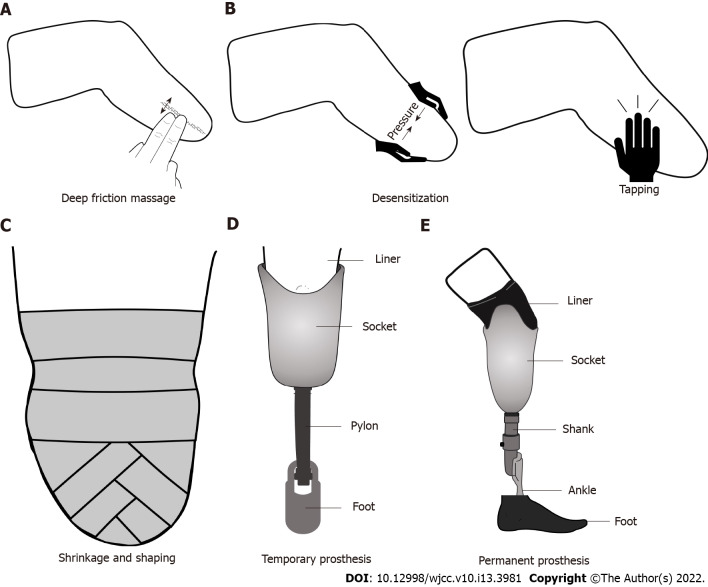
In this review intended for medical staff involved in patient rehabilitation, we provided an overview of the basic methods for managing amputation stumps. After the amputation surgery, it is imperative to optimize the remaining physical abilities of the amputee through rehabilitation processes, including postoperative rehabilitation, desensitization, and continuous application of soft or rigid dressings for pain reduction and shaping of the stump. Depending on the situation, a prosthesis may be worn in the early stage of recovery or an immediate postoperative prosthesis may be applied to promote stump maturation. Subsequently, to maintain the range of motion of the stump and to prevent deformation, the remaining portion of the limb should be positioned to prevent contracture. Continuous exercises should also be performed to improve muscle strength to ensure that the amputee is able to perform activities of daily living, independently. Additionally, clean wound or edema management of the stump is necessary to prevent problems associated with wearing the prosthesis. Our review is expected to contribute to the establishment of basic protocols that will be useful for stump management from the time of completion of amputation surgery to the fitting of a prosthesis to optimize patient recovery.
在这篇面向参与患者康复的医务人员的综述中,我们概述了截肢残端处理的基本方法。截肢手术后,必须通过康复过程来优化截肢者剩余的身体能力,包括术后康复、脱敏,以及持续应用软敷料或硬敷料以减轻疼痛和塑造残端。根据具体情况,可在恢复早期佩戴假肢,或应用术后即刻假肢以促进残端成熟。随后,为保持残端的活动范围并防止变形,应放置肢体的剩余部分以防止挛缩。还应持续进行锻炼以增强肌肉力量,确保截肢者能够独立进行日常生活活动。此外,对残端进行伤口清洁或水肿管理对于预防与佩戴假肢相关的问题很有必要。我们的综述有望有助于制定基本方案,这些方案从截肢手术完成到假肢装配期间对残端管理都将有用,从而优化患者的康复效果。