Division of Hospital Medicine Outreach (LG Shankar), Ann & Robert H. Lurie Children's Hospital of Chicago, Chicago, Ill; Department of Pediatrics (LG Shankar), Northwestern Medicine Central DuPage Hospital, Winfield, Ill.
Department of Professional Practice (M Habich), Northwestern Medicine Central DuPage Hospital, Winfield, Ill.
Acad Pediatr. 2022 Sep-Oct;22(7):1127-1132. doi: 10.1016/j.acap.2022.05.022. Epub 2022 Jun 3.
To describe pediatric mental health emergency department (ED) visit rates and visit characteristics before and during the COVID-19 pandemic.
We conducted a cross-sectional study of ED visits by children 5-17 years old with a primary mental health diagnosis from March 2018 to February 2021 at a 10-hospital health system and a children's hospital in the Chicago area. We compared demographic and clinical characteristics of children with mental health ED visits before and during the pandemic. We conducted an interrupted time series analysis to determine changes in visit rates.
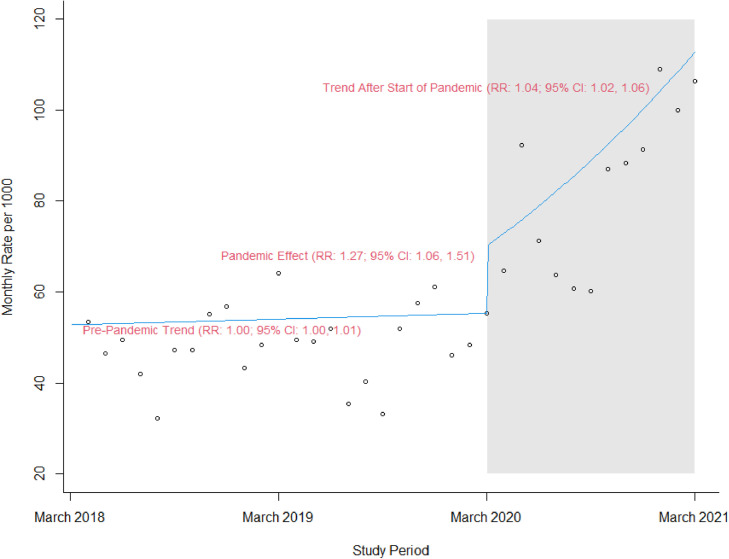
We identified 8,127 pediatric mental health ED visits (58.5% female, 54.3% White, Not Hispanic/Latino and 42.4% age 13-15). During the pandemic, visits for suicide or self-injury increased 6.69% (95% CI 4.73, 8.65), and visits for disruptive, impulse control, conduct disorders increased 1.94% (95% CI 0.85, 3.03). Mental health ED visits by children with existing mental health diagnoses increased 2.29% (95% CI 0.34, 4.25). Mental health ED visits that resulted in medical admission increased 4.32% (95% CI 3.11, 5.53). The proportion of mental health ED visits at community hospitals increased by 5.49% (95% CI 3.31, 7.67). Mental health ED visit rates increased at the onset of the pandemic (adjusted incidence rate ratio [aIRR] 1.27, 95% CI 1.06, 1.50), followed by a monthly increase thereafter (aIRR 1.04, 95% CI 1.02, 1.06).
Mental health ED visit rates by children increased during the COVID-19 pandemic. Changes in mental health ED visit characteristics during the pandemic may inform interventions to improve children's mental health.
描述 COVID-19 大流行前后儿科精神科急诊就诊率和就诊特征。
我们对芝加哥地区一个 10 家医院医疗系统和一家儿童医院的 5-17 岁儿童进行了一项横断面研究,这些儿童的主要精神科诊断为精神科急诊就诊。我们比较了大流行前后儿童精神科急诊就诊的人口统计学和临床特征。我们进行了中断时间序列分析,以确定就诊率的变化。
我们共确定了 8127 例儿科精神科急诊就诊(58.5%为女性,54.3%为白人,非西班牙裔/拉丁裔,42.4%年龄为 13-15 岁)。在大流行期间,自杀或自残就诊增加了 6.69%(95%CI 4.73,8.65),而破坏、冲动控制、行为障碍就诊增加了 1.94%(95%CI 0.85,3.03)。有现有精神健康诊断的儿童的精神科急诊就诊增加了 2.29%(95%CI 0.34,4.25)。需要医疗入院的精神科急诊就诊增加了 4.32%(95%CI 3.11,5.53)。社区医院的精神科急诊就诊比例增加了 5.49%(95%CI 3.31,7.67)。精神科急诊就诊率在大流行开始时增加(调整后的发病率比[aIRR]1.27,95%CI 1.06,1.50),此后每月增加(aIRR 1.04,95%CI 1.02,1.06)。
儿童精神科急诊就诊率在 COVID-19 大流行期间增加。大流行期间精神科急诊就诊特征的变化可能为改善儿童心理健康的干预措施提供信息。