Neurocritical Care Division, Department of Neurosurgery, Icahn School of Medicine at Mount Sinai, 1 Gustave L, Levy Place, New York, NY 10029, USA; Department of Neurology, Icahn School of Medicine at Mount Sinai, 1 Gustave L, Levy Place, New York, NY 10029, USA.
University Division of Anaesthesia, Department of Medicine, University of Cambridge, Box 93, Addenbrooke's Hospital, Hills Road, Cambridge CB2 0QQ, United Kingdom.
Crit Care Clin. 2022 Jul;38(3):553-570. doi: 10.1016/j.ccc.2022.03.002. Epub 2022 Mar 23.
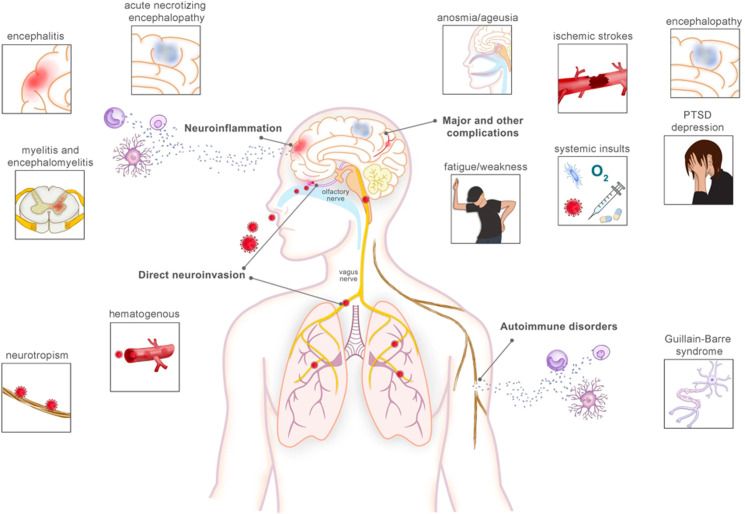
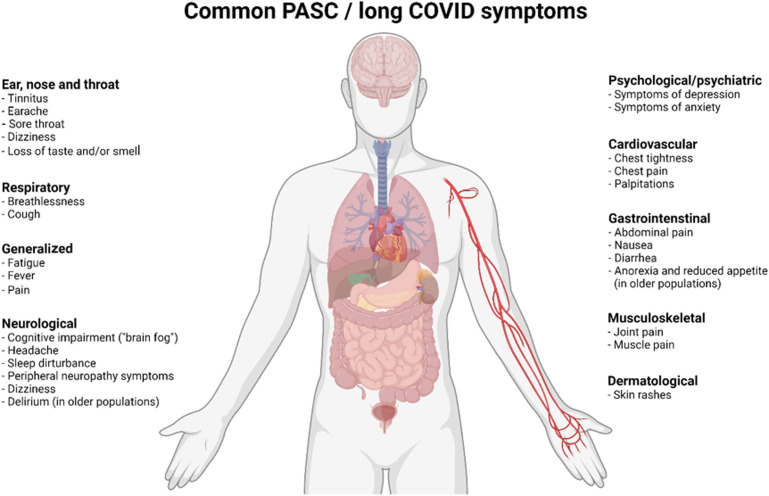
Neurologic complications can be seen in mild to severe COVID-19 with a higher risk in patients with severe COVID-19. These can occur as a direct consequence of viral infection or consequences of treatments. The spectrum ranges from non-life-threatening, like headache, fatigue, malaise, anosmia, dysgeusia, to life-threatening complications, like stroke, encephalitis, coma, Guillain-Barre syndrome. A high index of suspicion can aid in early recognition and treatment. Outcomes depend on severity of underlying COVID-19, patient age, comorbidities, and severity of the complication. Postacute sequelae of COVID-19 range from fatigue, headache, dysosmia, brain fog, anxiety, depression to an overlap with postintensive care syndrome.
神经并发症可在轻症至重症 COVID-19 中出现,重症 COVID-19 患者风险更高。这些并发症可由病毒感染直接引起,也可由治疗引起。其范围从无生命危险的头痛、疲劳、不适、嗅觉丧失、味觉障碍,到危及生命的并发症如中风、脑炎、昏迷、吉兰-巴雷综合征。高度怀疑可以帮助早期识别和治疗。结局取决于基础 COVID-19 的严重程度、患者年龄、合并症和并发症的严重程度。COVID-19 的急性后期后遗症从疲劳、头痛、嗅觉异常、脑雾、焦虑、抑郁到与重症监护后综合征重叠。