Arya Gulab Chand, Dong Yonghui, Heinig Uwe, Shahaf Nir, Kazachkova Yana, Aviv-Sharon Elinor, Nomberg Gal, Marinov Ofir, Manasherova Ekaterina, Aharoni Asaph, Cohen Hagai
Department of Vegetable and Field Crops, Institute of Plant Sciences, Agricultural Research Organization (ARO), Volcani Center, Rishon Lezion 7505101, Israel.
Department of Plant and Environmental Sciences, Weizmann Institute of Science, Rehovot 7610001, Israel.
Hortic Res. 2022 Apr 22;9:uhac092. doi: 10.1093/hr/uhac092. eCollection 2022.
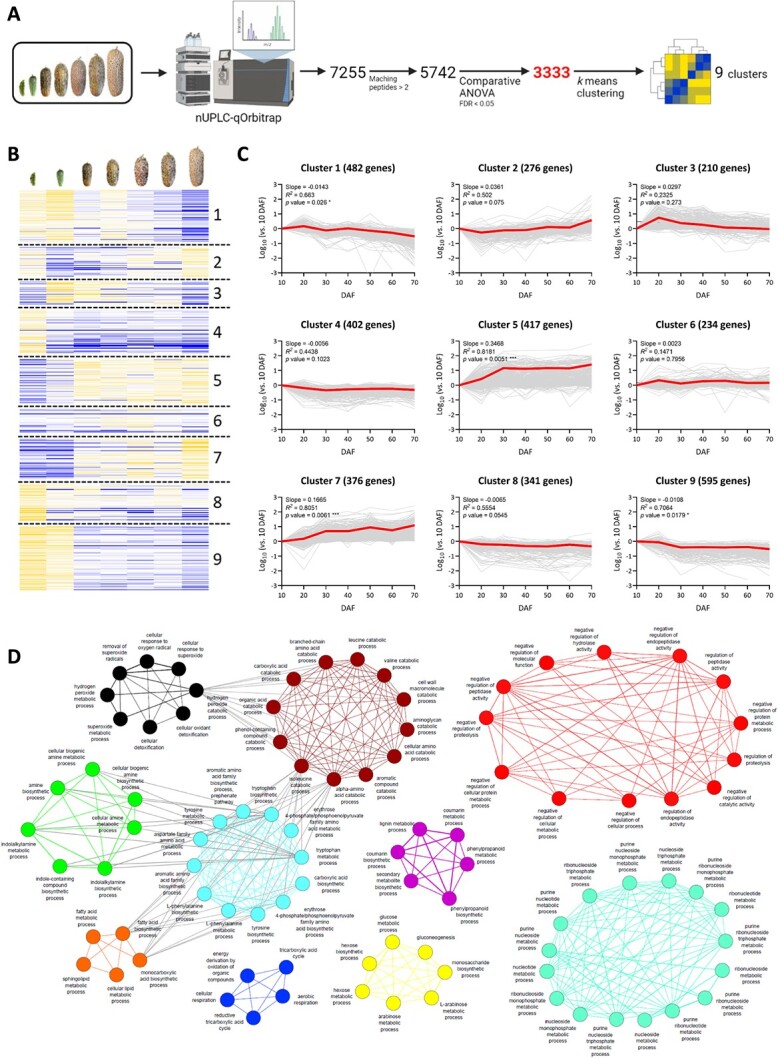
Suberized and/or lignified (i.e. lignosuberized) periderm tissue appears often on surface of fleshy fruit skin by mechanical damage caused following environmental cues or developmental programs. The mechanisms underlying lignosuberization remain largely unknown to date. Here, we combined an assortment of microscopical techniques with an integrative multi-omics approach comprising proteomics, metabolomics and lipidomics to identify novel molecular components involved in fruit skin lignosuberization. We chose to investigate the corky Sikkim cucumber ( var. ) fruit. During development, the skin of this unique species undergoes massive cracking and is coated with a thick corky layer, making it an excellent model system for revealing fundamental cellular machineries involved in fruit skin lignosuberization. The large-scale data generated provides a significant source for the field of skin periderm tissue formation in fleshy fruit and suberin metabolism.
栓质化和/或木质化(即木栓质化)的周皮组织常常因环境线索或发育程序引发的机械损伤而出现在肉质果实的表皮上。迄今为止,木栓质化背后的机制在很大程度上仍不为人知。在这里,我们将一系列显微镜技术与包括蛋白质组学、代谢组学和脂质组学在内的综合多组学方法相结合,以鉴定参与果实表皮木栓质化的新分子成分。我们选择研究具栓皮的锡金黄瓜(变种)果实。在发育过程中,这种独特物种的表皮会出现大量开裂,并覆盖有一层厚厚的栓皮层,使其成为揭示参与果实表皮木栓质化的基本细胞机制的绝佳模型系统。所生成的大规模数据为肉质果实表皮周皮组织形成和木栓质代谢领域提供了重要资源。