Haußmann R, Homeyer P, Brandt M D, Donix M
Klinik und Poliklinik für Psychiatrie und Psychotherapie, Universitätsklinikum Carl Gustav Carus, Technische Universität Dresden, Fetscherstr. 74, 01307, Dresden, Deutschland.
Klinik und Poliklinik für Neurologie, Universitätsklinikum Carl Gustav Carus, Technische Universität Dresden, Fetscherstr. 74, 01307, Dresden, Deutschland.
Nervenarzt. 2022 Dec;93(12):1236-1242. doi: 10.1007/s00115-022-01339-6. Epub 2022 Jun 7.
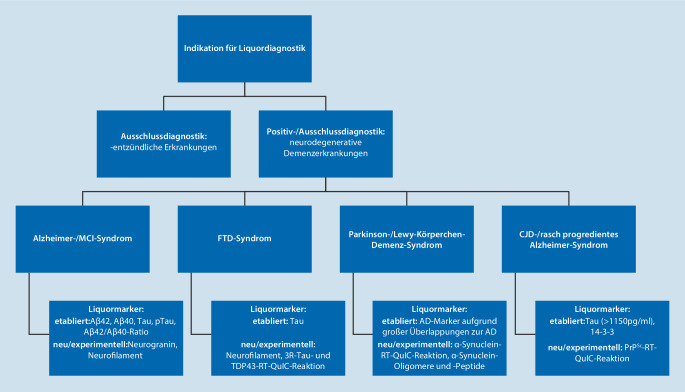
Cerebrospinal fluid (CSF) analysis is an important diagnostic tool in the assessment of dementia. For the differentiation of Alzheimer's disease from other etiologies of dementia syndromes, established biological markers could be helpful to confirm a distinctive neuropathology. Whereas negative CSF findings can rule out the majority of primarily neurodegenerative disorders, overlapping biomarker profiles remain a diagnostic challenge. Therefore, it is important to interpret CSF results within a specific clinical context. Furthermore, atypical CSF data can be challenging and require profound knowledge of preanalytics, biomarker profiles and the broad spectrum of diseases associated with cognitive decline. Beyond the Alzheimer's disease clinical spectrum, current studies aim at investigating CSF biomarkers to better differentiate tauopathies, TDP43(Transactive response DNA binding protein 43 kDa)-proteinopathies and synucleinopathies.
脑脊液(CSF)分析是评估痴呆症的一项重要诊断工具。对于将阿尔茨海默病与痴呆综合征的其他病因相鉴别,已确立的生物标志物有助于确认独特的神经病理学特征。虽然脑脊液检查结果为阴性可排除大多数原发性神经退行性疾病,但生物标志物谱存在重叠仍是一个诊断挑战。因此,在特定的临床背景下解读脑脊液结果很重要。此外,非典型脑脊液数据可能具有挑战性,需要对分析前情况、生物标志物谱以及与认知衰退相关的广泛疾病有深入了解。除了阿尔茨海默病临床谱外,目前的研究旨在调查脑脊液生物标志物,以更好地区分tau蛋白病、TDP43(反式作用DNA结合蛋白43 kDa)蛋白病和α-突触核蛋白病。