
帕帕尼科拉乌细胞病理学协会胰腺胆管细胞学报告系统:风险分层与细胞学范围——2.5年研究
Papanicolaou society of cytopathology system for reporting pancreaticobiliary cytology: Risk stratification and cytology scope - 2.5-year study.
作者信息
Ilyas Abeer M, Bohra Mamta, More Nilam M, Naik Leena P
机构信息
Department of Pathology and Lab Medicine, All India Institute of Medical Sciences, Bhopal, Madhya Pradesh, India.
Department of Pathology, Lokmanya Tilak Municipal General Hospital and Medical College, Mumbai, Maharashtra, India.
出版信息
Cytojournal. 2022 May 11;19:33. doi: 10.25259/Cytojournal_46_2020. eCollection 2022.
OBJECTIVES
Diagnosis of pancreatic lesions remains a clinical challenge. Early and accurate diagnosis is extremely important for improving the therapeutic usefulness of pancreatic cancers and Endoscopic ultrasonography - fine needle aspiration (EUS-FNA) cytology has come up with this advantage. For current study the authors evaluated the diagnostic accuracy of EUS-FNAC by applying PSC system for reporting pancreaticobiliary cytology and Calculated the malignancy risk associated with the diagnostic categories.
MATERIAL AND METHODS
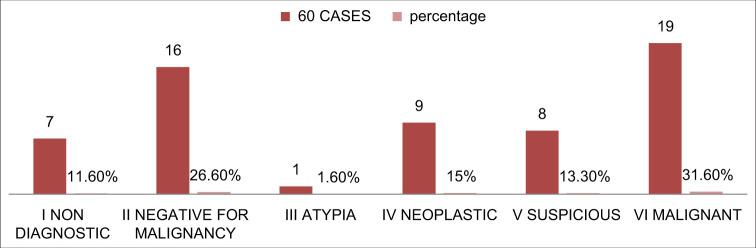
A retrospective study over the period of 2.5 years (April 2017 to Oct 2019) 60 patients in our cohort EUS-FNAC guided unstained fixed and unfixed slides received of pancreatic lesion and were stained with Papanicolau and Giemsa using standard technique and immunocytochemistry, where required Application of Papanicolaou Society of Cytopathology system for reporting pancreaticobiliary cytology Histopathological and clinical follow-up were retrieved.
RESULTS
Our study has comparable results with sensitivity, specificity, PPV, and NPV of 92.8%, 100%, 100%, and 92.59%, respectively. Fuurthermore, a diagnostic accuracy of 96.2%. Risk of malignancy is lower for benign and indeterminate category whereas it is higher for suspicious and malignant categories.
CONCLUSION
The application of the new proposed terminology for pancreaticobiliary cytology brings standardization. Final diagnosis can be reached by the multidisciplinary approach of EUS-FNA cytology, cell block preparation, immunocytochemistry, and immunohistochemistry; if required, can be adopted as an alternative approach to biopsy. The present study showed high sensitivity and specificity for EUS-FNA in the diagnosis of pancreatic carcinoma, which may influence the treatment plans of both surgeons and oncologists.
目的
胰腺病变的诊断仍然是一项临床挑战。早期准确诊断对于提高胰腺癌的治疗效果极为重要,而超声内镜引导下细针穿刺抽吸(EUS-FNA)细胞学检查就具有这一优势。在本研究中,作者通过应用PSC系统报告胰胆管细胞学检查来评估EUS-FNAC的诊断准确性,并计算与诊断类别相关的恶性风险。
材料与方法
一项为期2.5年(2017年4月至2019年10月)的回顾性研究,我们队列中的60例患者接受了EUS-FNA引导的胰腺病变未染色固定和未固定玻片检查,并使用标准技术和免疫细胞化学方法进行巴氏染色和吉姆萨染色,必要时应用细胞病理学学会的PSC系统报告胰胆管细胞学检查,检索组织病理学和临床随访结果。
结果
我们的研究结果具有可比性,敏感性、特异性、阳性预测值和阴性预测值分别为92.8%、100%、100%和92.59%。此外,诊断准确率为96.2%。良性和不确定类别的恶性风险较低,而可疑和恶性类别的恶性风险较高。
结论
新提出的胰胆管细胞学术语的应用带来了标准化。通过EUS-FNA细胞学、细胞块制备、免疫细胞化学和免疫组织化学的多学科方法可以得出最终诊断;如有需要,可作为活检的替代方法。本研究显示EUS-FNA在胰腺癌诊断中具有较高的敏感性和特异性,这可能会影响外科医生和肿瘤学家的治疗方案。
 Zotero 插件