Universidade Federal do Ceará, Faculdade de Medicina, Pós-Graduação em Saúde Pública, Fortaleza, CE, Brasil.
NHR Brasil - Nederlandse Stichting voor Leprabestrijding, Fortaleza, CE, Brasil.
Rev Soc Bras Med Trop. 2022 Jun 6;55:e0431. doi: 10.1590/0037-8682-0431-2021. eCollection 2022.
We analyzed the trends and spatial patterns of schistosomiasis-related mortality in Northeast Brazil in 2000-2019.
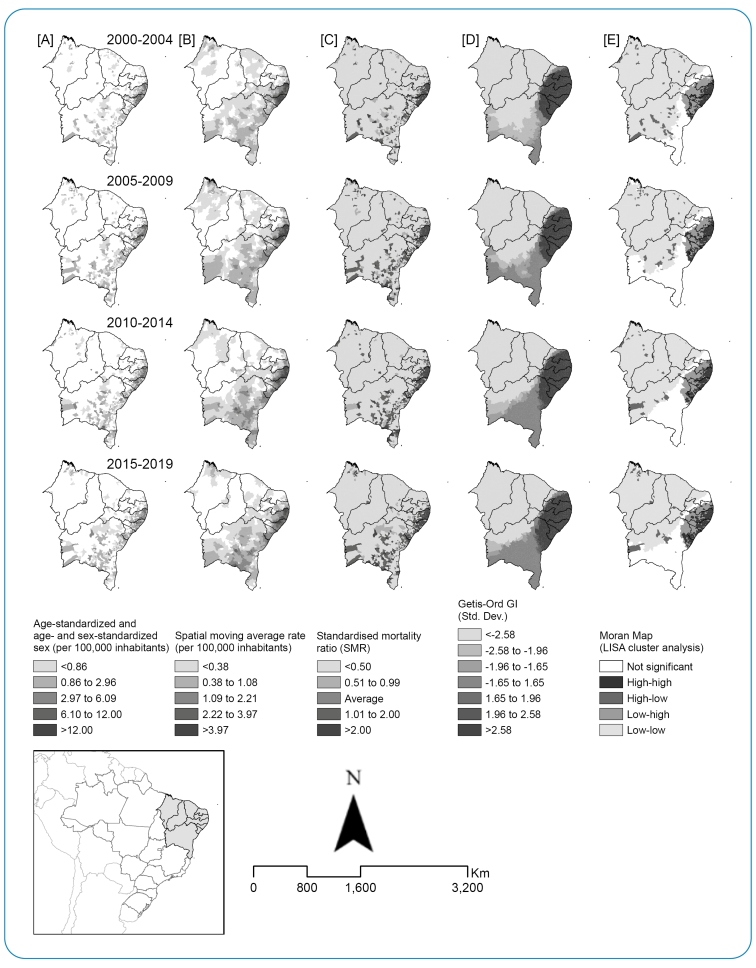
A mixed population-based ecological study was conducted, using information on the underlying or associated causes of death. We used Joinpoint regression analysis to calculate the trends. The spatial analysis included rates, spatial moving averages, and standardized mortality rates. The spatial dependence analysis was based on Getis-Ord's G and Gi* indices (Gi star) and local Moran's index to check for autocorrelation.
A total of 5,814,268 deaths were recorded, of which 9,276 (0.16%) were schistosomiasis-related; 51.0% (n=4,732, adjusted rate 0.90/100,000 inhabitants [95% confidence interval (CI) 0.88-0.93]) were males; 40.0% (n=3,715, adjusted rate 7.40/100.000 inhabitants [95%CI: 7.16-7.64]) were ≥70 years old; 54.8% (n=5,087, crude rate 0.80/100,000 inhabitants) were of mixed/Pardo-Brazilian ethnicity; and 77.9% (n=7,229, adjusted rate 0.86/100,000 inhabitants [95%CI: 0.84-0.88]) lived outside state capitals. The highest proportion of deaths was in the state of Pernambuco (53.9%, n=4,996, adjusted rate 2.72/100,000 inhabitants [95%CI: 2.64-2.79]). Increasing mortality rate was verified in the state of Sergipe. On the coast of the state of Rio Grande do Norte and Bahia, there was spatial dependence of spatio-temporal risk patterns with clusters. Throughout the study period, we found positive spatial autocorrelation and cluster formation.
In Northeast Brazil, schistosomiasis persists with a high mortality rate, especially in the coastal region, with heterogeneous spatial and temporal patterns. To eliminate schistosomiasis by 2030, it is necessary to strengthen the financing and management of the unified health system (SUS).
我们分析了 2000-2019 年巴西东北部与血吸虫病相关的死亡率趋势和空间模式。
采用基于人群的混合生态学研究方法,使用潜在或相关死亡原因的信息。我们使用 Joinpoint 回归分析来计算趋势。空间分析包括率、空间移动平均值和标准化死亡率。空间相关性分析基于 Getis-Ord 的 G 和 Gi*指数(Gi 星)和局部 Moran 指数,以检查自相关性。
共记录了 5814268 例死亡,其中 9276 例(0.16%)与血吸虫病相关;51.0%(n=4732,调整率 0.90/100000 居民[95%置信区间(CI)0.88-0.93])为男性;40.0%(n=3715,调整率 7.40/100000 居民[95%CI:7.16-7.64])年龄≥70 岁;54.8%(n=5087,粗率 0.80/100000 居民)为混血/帕尔多-巴西人;77.9%(n=7229,调整率 0.86/100000 居民[95%CI:0.84-0.88])居住在州府之外。死亡比例最高的是伯南布哥州(53.9%,n=4996,调整率 2.72/100000 居民[95%CI:2.64-2.79])。塞尔希培州的死亡率呈上升趋势。在北里奥格兰德州和巴伊亚州的海岸地区,存在时空风险模式的空间依赖和集群。在整个研究期间,我们发现存在正向空间自相关和集群形成。
在巴西东北部,血吸虫病死亡率仍然很高,特别是在沿海地区,具有异质的时空模式。为了在 2030 年前消除血吸虫病,有必要加强统一卫生系统(SUS)的融资和管理。