Inria, HeKA, PariSantéCampus, 10 Rue d'Oradour-sur-Glane, 75015, Paris, France.
Inserm, Centre de Recherche des Cordeliers, Sorbonne Université, Université de Paris Cité, 75006, Paris, France.
BMC Med Res Methodol. 2022 Jun 8;22(1):166. doi: 10.1186/s12874-022-01628-3.
Real-life data consist of exhaustive data which are not subject to selection bias. These data enable to study drug-safety profiles but are underused because of their temporality, necessitating complex models (i.e., safety depends on the dose, timing, and duration of treatment). We aimed to create a data-driven pipeline strategy that manages the complex temporality of real-life data to highlight the safety profile of a given drug.
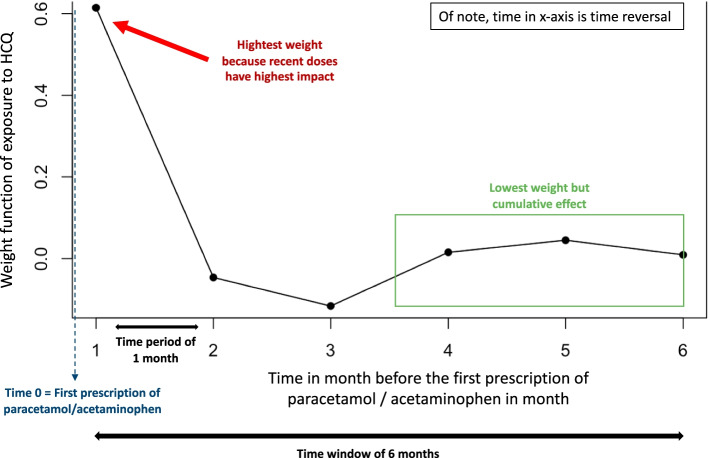
We proposed to apply the weighted cumulative exposure (WCE) statistical model to all health events occurring after a drug introduction (in this paper HCQ) and performed bootstrap to select relevant diagnoses, drugs and interventions which could reflect an adverse drug reactions (ADRs). We applied this data-driven pipeline on a French national medico-administrative database to extract the safety profile of hydroxychloroquine (HCQ) from a cohort of 2,010 patients.
The proposed method selected eight drugs (metopimazine, anethole trithione, tropicamide, alendronic acid & colecalciferol, hydrocortisone, chlormadinone, valsartan and tixocortol), twelve procedures (six ophthalmic procedures, two dental procedures, two skin lesions procedures and osteodensitometry procedure) and two medical diagnoses (systemic lupus erythematous, unspecified and discoid lupus erythematous) to be significantly associated with HCQ exposure.
We provide a method extracting the broad spectrum of diagnoses, drugs and interventions associated to any given drug, potentially highlighting ADRs. Applied to hydroxychloroquine, this method extracted among others already known ADRs.
真实世界数据包含详尽的数据,不受选择偏倚的影响。这些数据可用于研究药物安全性概况,但由于其时间性,需要复杂的模型(即安全性取决于剂量、治疗时间和持续时间),因此未得到充分利用。我们旨在创建一个数据驱动的管道策略,以管理真实世界数据的复杂时间性,突出给定药物的安全性概况。
我们建议将加权累积暴露(WCE)统计模型应用于药物引入后发生的所有健康事件(本文为 HCQ),并进行自举以选择可能反映药物不良反应(ADR)的相关诊断、药物和干预措施。我们将此数据驱动的管道应用于法国国家医疗管理数据库,从 2010 名患者的队列中提取羟氯喹(HCQ)的安全性概况。
所提出的方法选择了八种药物(二甲嗪、茴三硫、托品酰胺、阿仑膦酸钠和骨化三醇、氢化可的松、氯米酮、缬沙坦和替克索醇)、十二种程序(六种眼科程序、两种牙科程序、两种皮肤病变程序和骨密度测量程序)和两种医学诊断(系统性红斑狼疮,未特指和盘状红斑狼疮)与 HCQ 暴露显著相关。
我们提供了一种从任何给定药物中提取广泛相关诊断、药物和干预措施的方法,可能突出药物不良反应。将该方法应用于羟氯喹,提取了已知的药物不良反应。