Faculty of Veterinary Medicine, University of Calgary, Calgary, Canada.
School of Public Health, University of Alberta, Edmonton, Canada.
Scand J Public Health. 2023 Nov;51(7):1016-1022. doi: 10.1177/14034948221092185. Epub 2022 Jun 8.
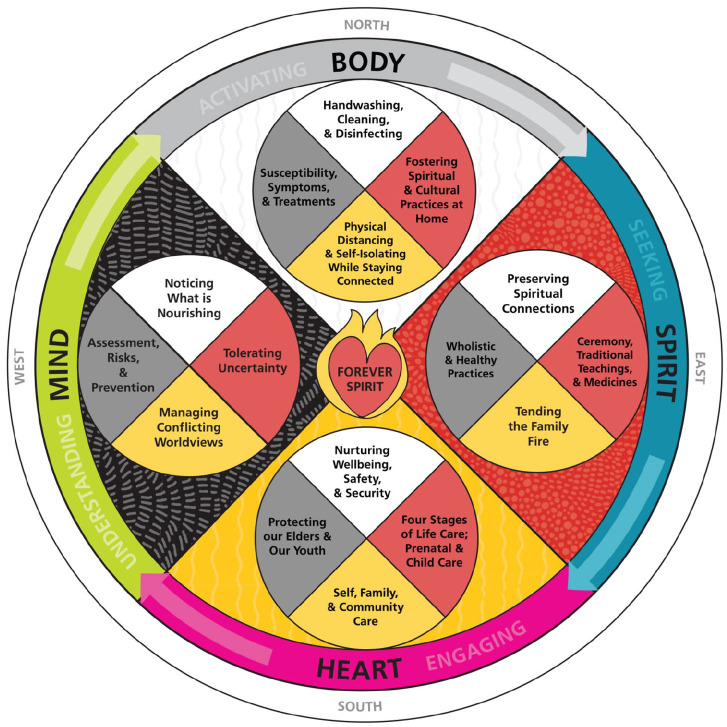
This study aimed to compare COVID-19 health policy and programme responses in 16 Northern and Indigenous regions in Canada. The goal was to summarise strategies used to mitigate the initial spread of the pandemic while highlighting aspects that reflect Indigenous values. A scoping review of grey literature was completed, focusing on territorial, regional health authority, and community level websites. Further media analysis was conducted to reach saturation regarding policy changes and programmes implemented to prevent transmission, improve health communication, access testing, provide health services effectively, secure borders, and provide financial assistance. Common responses were mapped on the Women's College Hospital's Wholistic Framework for Safe Wellness to identify aspects that reflected Indigenous values. This framework utilises the medicine wheel to discuss physical health (body), ceremony (spirit), community health (heart), and assessment (mind). The Women's College Hospital's Wholistic Framework for Safe Wellness quadrants of the body, spirit and heart were covered by most regions via health communication efforts, adaptations to traditional practices, and continuation of care during the pandemic, respectively. It was found that 13 regions had pandemic responses adapted for Indigenous populations.
本研究旨在比较加拿大 16 个北部和原住民地区的 COVID-19 卫生政策和计划应对措施。目的是总结用于减轻大流行初始传播的策略,同时强调反映原住民价值观的方面。完成了对灰色文献的范围审查,重点是领土、区域卫生当局和社区一级的网站。进一步进行了媒体分析,以达到政策变化和实施计划的饱和,以防止传播、改善健康沟通、获得检测、有效提供卫生服务、确保边界安全以及提供财政援助。常见的应对措施被映射到妇女学院医院的整体安全健康框架上,以确定反映原住民价值观的方面。该框架利用药轮讨论身体健康(身体)、仪式(精神)、社区健康(心脏)和评估(思想)。妇女学院医院的安全健康整体框架的身体、精神和心脏部分,通过卫生沟通努力、对传统做法的适应以及大流行期间的护理延续,分别得到了大多数地区的覆盖。发现 13 个地区针对原住民人口调整了大流行应对措施。