Division of Endocrinology and Metabolism and Diabetes Center, First Department of Internal Medicine, Medical School, Aristotle University of Thessaloniki, AHEPA University Hospital, 1 St. Kiriakidi Street, 54636, Thessaloniki, Greece.
Department of Diabetes, King's College Hospital, London, UK.
Drugs. 2022 Jun;82(9):949-955. doi: 10.1007/s40265-022-01730-2. Epub 2022 Jun 9.
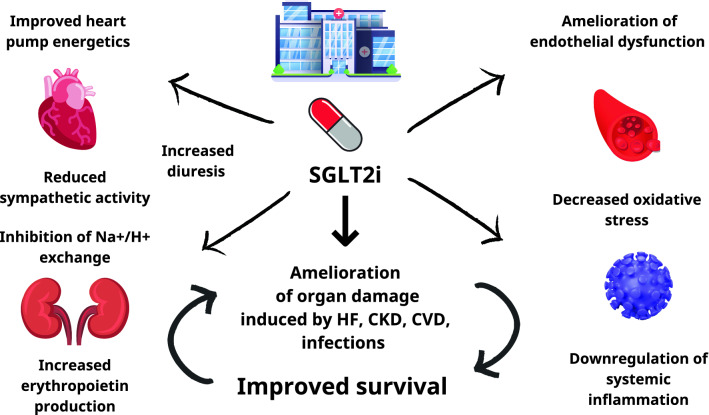
The management of hyperglycemia in patients admitted to hospital is mainly based on insulin therapy. However, the positive and rapid effects of sodium-glucose cotransporter 2 inhibitors (SGLT2i) on cardiorenal outcomes raises the possibility that they might confer benefits to hospitalized patients. In recent, well designed, randomized trials (SOLOIST-WHF and EMPULSE) recruiting inpatients with heart failure (HF), SGLT2i demonstrated the potential to improve survival and quality of life and reduce the number of HF events, time to first HF event, hospitalizations, and urgent visits for HF compared with placebo. They were also well tolerated, whereas incidence of diabetic ketoacidosis was low. In EMBODY, empagliflozin was shown to be protective against the deleterious effects of cardiac injury in patients with acute myocardial infarction. In DARE-19, the administration of dapagliflozin to inpatients with cardiometabolic risk factors and COVID-19 was based on the hypothesis that the anti-inflammatory properties of SGLT2i could alleviate organ damage. Although the findings did not reach statistical significance, the efficacy and safety profiles of the drug were encouraging. These promising findings in the field of cardiometabolic medicine set the stage for future research to explore whether the benefits of gliflozins can expand to inpatients with non-cardiometabolic disorders, including sepsis, cirrhotic ascites, and malignancies. The concept of inpatient use of SGLT2i has evolved greatly over the past few years. The latest evidence suggests that SGLT2i may be effective and safe in the hospital setting, provided patients are carefully selected and closely monitored. Real-world data will prove whether present hope about inpatient use of gliflozins will transform into future confidence.
住院患者高血糖的管理主要基于胰岛素治疗。然而,钠-葡萄糖共转运蛋白 2 抑制剂(SGLT2i)对心肾结局的积极和快速作用提出了这样一种可能性,即它们可能使住院患者获益。最近,精心设计的随机试验(SOLOIST-WHF 和 EMPULSE)招募了心力衰竭(HF)住院患者,SGLT2i 显示出有可能改善生存率和生活质量,减少 HF 事件、首次 HF 事件时间、住院和 HF 紧急就诊的次数,与安慰剂相比。它们也具有良好的耐受性,而糖尿病酮症酸中毒的发生率较低。在 EMBODY 中,恩格列净被证明可以预防急性心肌梗死患者心脏损伤的有害影响。在 DARE-19 中,基于 SGLT2i 的抗炎特性可以减轻器官损伤的假设,给具有心脏代谢危险因素和 COVID-19 的住院患者给予达格列净。尽管研究结果没有达到统计学意义,但该药物的疗效和安全性特征令人鼓舞。这些在心脏代谢医学领域的有希望的发现为未来的研究奠定了基础,以探索是否 gliflozins 的益处可以扩展到非心脏代谢疾病的住院患者,包括败血症、肝硬化腹水和恶性肿瘤。过去几年中,住院患者使用 SGLT2i 的概念发生了很大变化。最新证据表明,只要患者经过精心选择和密切监测,SGLT2i 在医院环境中可能是有效和安全的。真实世界的数据将证明,目前对住院患者使用 gliflozins 的希望是否会转化为未来的信心。