, Plauen, Germany.
Institute for Genomics and Evolutionary Medicine, Department of Biology, Temple University, Philadelphia, PA, 19122, USA.
Cell Stress Chaperones. 2022 Jul;27(4):309-323. doi: 10.1007/s12192-022-01268-y. Epub 2022 Jun 9.
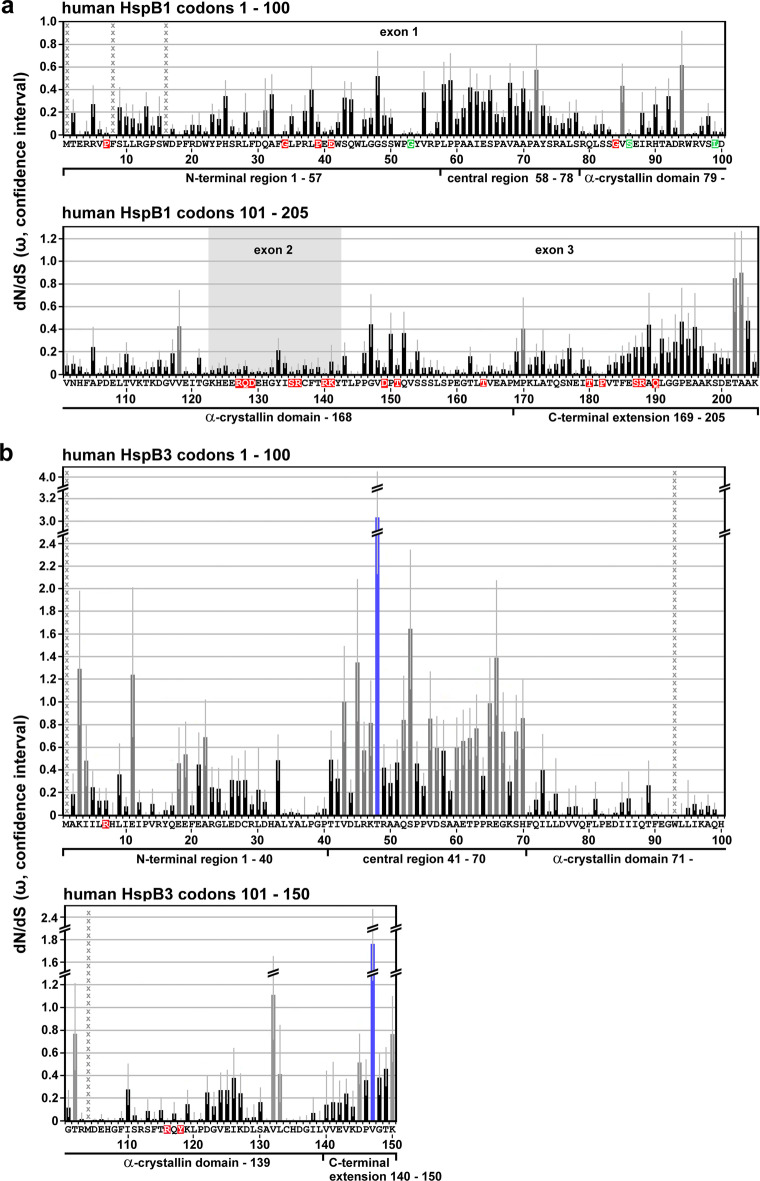
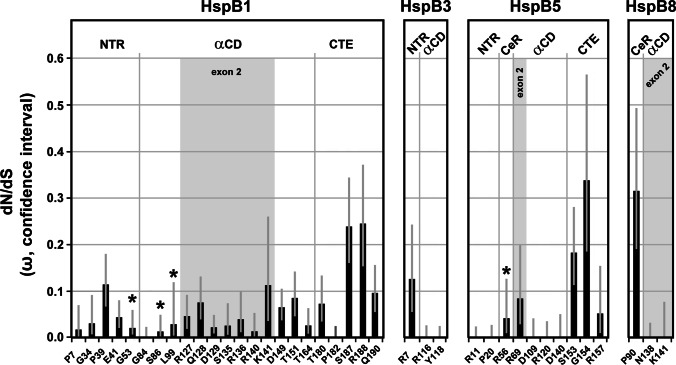
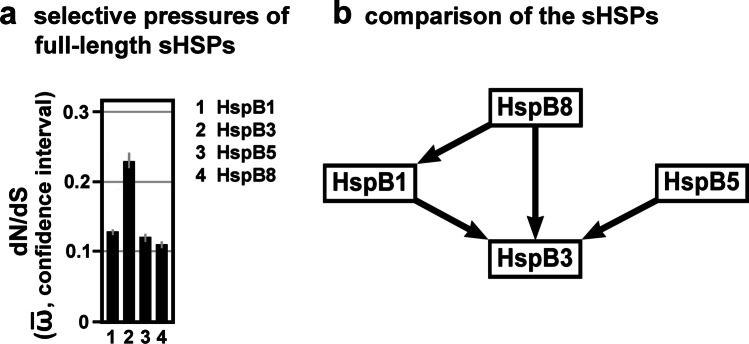
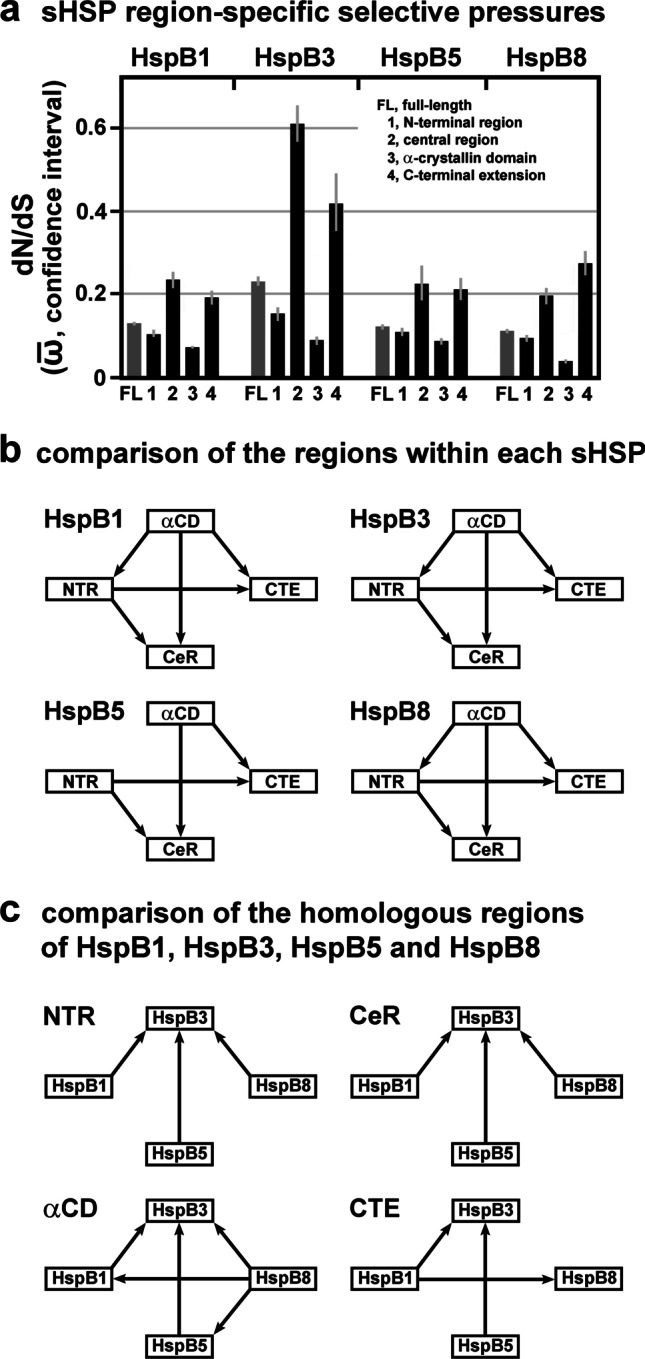
Small heat shock proteins (sHSPs) emerged early in evolution and occur in all domains of life and nearly in all species, including humans. Mutations in four sHSPs (HspB1, HspB3, HspB5, HspB8) are associated with neuromuscular disorders. The aim of this study is to investigate the evolutionary forces shaping these sHSPs during vertebrate evolution. We performed comparative evolutionary analyses on a set of orthologous sHSP sequences, based on the ratio of non-synonymous: synonymous substitution rates for each codon. We found that these sHSPs had been historically exposed to different degrees of purifying selection, decreasing in this order: HspB8 > HspB1, HspB5 > HspB3. Within each sHSP, regions with different degrees of purifying selection can be discerned, resulting in characteristic selective pressure profiles. The conserved α-crystallin domains were exposed to the most stringent purifying selection compared to the flanking regions, supporting a 'dimorphic pattern' of evolution. Thus, during vertebrate evolution the different sequence partitions were exposed to different and measurable degrees of selective pressures. Among the disease-associated mutations, most are missense mutations primarily in HspB1 and to a lesser extent in the other sHSPs. Our data provide an explanation for this disparate incidence. Contrary to the expectation, most missense mutations cause dominant disease phenotypes. Theoretical considerations support a connection between the historic exposure of these sHSP genes to a high degree of purifying selection and the unusual prevalence of genetic dominance of the associated disease phenotypes. Our study puts the genetics of inheritable sHSP-borne diseases into the context of vertebrate evolution.
小分子热休克蛋白(sHSPs)在进化早期出现,存在于所有生命领域和几乎所有物种中,包括人类。四种 sHSP(HspB1、HspB3、HspB5、HspB8)的突变与神经肌肉疾病有关。本研究旨在探讨在脊椎动物进化过程中塑造这些 sHSP 的进化力量。我们基于每个密码子的非同义:同义替换率,对一组同源 sHSP 序列进行了比较进化分析。我们发现,这些 sHSP 历史上受到不同程度的纯化选择,按照以下顺序减少:HspB8>HspB1、HspB5>HspB3。在每个 sHSP 中,可以辨别出具有不同程度纯化选择的区域,导致特征性的选择压力分布。与侧翼区域相比,保守的α-晶状体蛋白结构域受到最严格的纯化选择,支持“二态模式”的进化。因此,在脊椎动物进化过程中,不同的序列分区受到不同的、可测量的选择压力。在与疾病相关的突变中,大多数是错义突变,主要发生在 HspB1 中,在其他 sHSP 中则较少。我们的数据为这种不同的发生率提供了解释。与预期相反,大多数错义突变导致显性疾病表型。理论考虑支持这些 sHSP 基因历史上受到高度纯化选择与相关疾病表型遗传显性的异常普遍性之间的联系。我们的研究将遗传性 sHSP 相关疾病的遗传学置于脊椎动物进化的背景下。