Department of Obstetrics and Gynecology, Massachusetts General Hospital, Harvard Medical School, Boston.
Center for Quantitative Health and Department of Psychiatry, Massachusetts General Hospital, Harvard Medical School, Boston.
JAMA Netw Open. 2022 Jun 1;5(6):e2215787. doi: 10.1001/jamanetworkopen.2022.15787.
Epidemiologic studies suggest maternal immune activation during pregnancy may be associated with neurodevelopmental effects in offspring.
To evaluate whether in utero exposure to SARS-CoV-2 is associated with risk for neurodevelopmental disorders in the first 12 months after birth.
DESIGN, SETTING, AND PARTICIPANTS: This retrospective cohort study examined live offspring of all mothers who delivered between March and September 2020 at any of 6 Massachusetts hospitals across 2 health systems. Statistical analysis was performed from October to December 2021.
Maternal SARS-CoV-2 infection confirmed by a polymerase chain reaction test during pregnancy.
Neurodevelopmental disorders determined from International Statistical Classification of Diseases and Related Health Problems, Tenth Revision (ICD-10) diagnostic codes over the first 12 months of life; sociodemographic and clinical features of mothers and offspring; all drawn from the electronic health record.
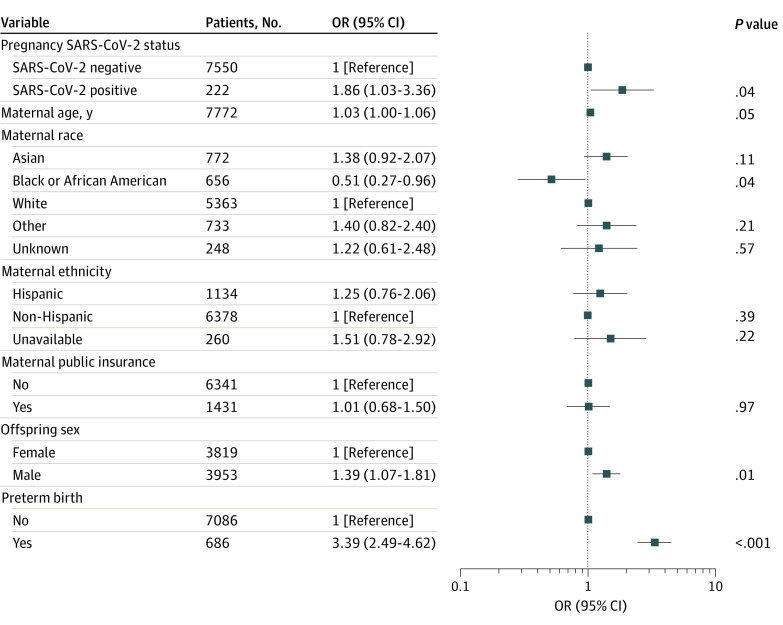
The cohort included 7772 live births (7466 pregnancies, 96% singleton, 222 births to SARS-CoV-2 positive mothers), with mean (SD) maternal age of 32.9 (5.0) years; offspring were 9.9% Asian (772), 8.4% Black (656), and 69.0% White (5363); 15.1% (1134) were of Hispanic ethnicity. Preterm delivery was more likely among exposed mothers: 14.4% (32) vs 8.7% (654) (P = .003). Maternal SARS-CoV-2 positivity during pregnancy was associated with greater rate of neurodevelopmental diagnoses in unadjusted models (odds ratio [OR], 2.17 [95% CI, 1.24-3.79]; P = .006) as well as those adjusted for race, ethnicity, insurance status, offspring sex, maternal age, and preterm status (adjusted OR, 1.86 [95% CI, 1.03-3.36]; P = .04). Third-trimester infection was associated with effects of larger magnitude (adjusted OR, 2.34 [95% CI, 1.23-4.44]; P = .01).
This cohort study of SARS-CoV-2 exposure in utero found preliminary evidence that maternal SARS-CoV-2 may be associated with neurodevelopmental sequelae in some offspring. Prospective studies with longer follow-up duration will be required to exclude confounding and confirm these associations.
流行病学研究表明,妊娠期间母体免疫激活可能与后代的神经发育效应有关。
评估宫内暴露于 SARS-CoV-2 是否与出生后 12 个月内神经发育障碍的风险相关。
设计、地点和参与者: 这项回顾性队列研究检查了在 2020 年 3 月至 9 月期间在马萨诸塞州 2 个卫生系统的 6 家医院分娩的所有母亲的活产儿。统计分析于 2021 年 10 月至 12 月进行。
妊娠期间通过聚合酶链反应试验确认的 SARS-CoV-2 感染。
在生命的头 12 个月内通过国际疾病分类第十版(ICD-10)诊断代码确定的神经发育障碍;来自电子健康记录的母亲和后代的社会人口统计学和临床特征。
队列纳入了 7772 例活产儿(7466 例妊娠,96%为单胎,222 例为 SARS-CoV-2 阳性母亲所生),母亲平均(SD)年龄为 32.9(5.0)岁;新生儿中,亚洲裔占 9.9%(772 例),非裔占 8.4%(656 例),白人占 69.0%(5363 例);15.1%(1134 例)为西班牙裔。暴露组母亲的早产率更高:14.4%(32 例) vs 8.7%(654 例)(P = .003)。未调整模型中,妊娠期间母亲 SARS-CoV-2 阳性与神经发育诊断率升高相关(优势比[OR],2.17 [95%置信区间,1.24-3.79];P = .006),以及调整了种族、民族、保险状况、后代性别、母亲年龄和早产状况后的模型中(调整后的 OR,1.86 [95%置信区间,1.03-3.36];P = .04)。第三孕期感染与更大的影响相关(调整后的 OR,2.34 [95%置信区间,1.23-4.44];P = .01)。
这项对宫内 SARS-CoV-2 暴露的队列研究初步发现,母体 SARS-CoV-2 可能与一些后代的神经发育后遗症有关。需要进行具有更长随访时间的前瞻性研究以排除混杂因素并确认这些关联。