Chemistry Department, University of Rome "La Sapienza", 00185 Rome, Italy.
Department of Chemical, Pharmaceutical and Agricultural Sciences, University of Ferrara, 44121 Ferrara, Italy.
Molecules. 2022 Jun 3;27(11):3604. doi: 10.3390/molecules27113604.
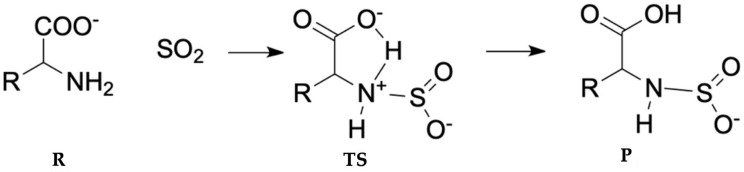
We report a series of calculations to elucidate one possible mechanism of SO chemisorption in amino acid-based ionic liquids. Such systems have been successfully exploited as CO absorbents and, since SO is also a by-product of fossil fuels' combustion, their ability in capturing SO has been assessed by recent experiments. This work is exclusively focused on evaluating the efficiency of the chemical trapping of SO by analyzing its reaction with the amino group of the amino acid. We have found that, overall, SO is less reactive than CO, and that the specific amino acid side chain (either acid or basic) does not play a relevant role. We noticed that bimolecular absorption processes are quite unlikely to take place, a notable difference with CO. The barriers along the reaction paths are found to be non-negligible, around 7-11 kcal/mol, and the thermodynamic of the reaction appears, from our models, unfavorable.
我们报告了一系列计算,以阐明氨基酸基离子液体中 SO 化学吸附的一种可能机制。这些系统已成功地用作 CO 吸收剂,并且由于 SO 也是化石燃料燃烧的副产品,因此最近的实验评估了它们捕获 SO 的能力。这项工作专门用于通过分析其与氨基酸的氨基的反应来评估 SO 化学捕获的效率。我们发现,总的来说,SO 的反应性比 CO 差,并且特定的氨基酸侧链(酸性或碱性)没有起到相关作用。我们注意到,双分子吸收过程不太可能发生,这与 CO 有明显的区别。反应路径上的势垒被发现不可忽略,约为 7-11 kcal/mol,并且根据我们的模型,反应的热力学似乎不利。