Department of Information Engineering and Mathematics, University of Siena, 53100 Siena, Italy.
Department of Information Engineering, University of Padova, 35131 Padova, Italy.
Sensors (Basel). 2022 May 26;22(11):4046. doi: 10.3390/s22114046.
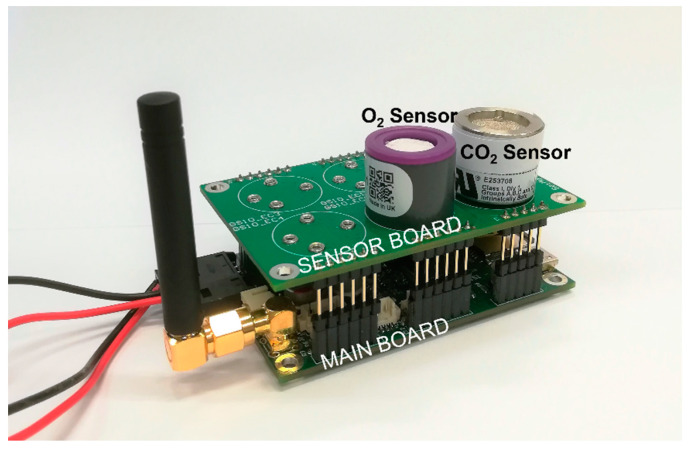
This paper aims at demonstrating the energy self-sufficiency of a LoRaWAN-based sensor node for monitoring environmental parameters exploiting energy harvesting directly coming from the artificial light used in indoor horticulture. A portable polycrystalline silicon module is used to charge a Li-Po battery, employed as the power reserve of a wireless sensor node able to accurately monitor, with a 1-h period, both the physical quantities most relevant for the application, i.e., humidity, temperature and pressure, and the chemical quantities, i.e., O and CO concentrations. To this aim, the node also hosts a power-hungry NDIR sensor. Two programmable light sources were used to emulate the actual lighting conditions of greenhouses, and to prove the effectiveness of the designed autonomous system: a LED-based custom designed solar simulator and a commercial LED light especially thought for plant cultivation purposes in greenhouses. Different lighting conditions used in indoor horticulture to enhance different plant growth phases, obtained as combinations of blue, red, far-red and white spectra, were tested by field tests of the sensor node. The energy self-sufficiency of the system was demonstrated by monitoring the charging/discharging trend of the Li-Po battery. Best results are obtained when white artificial light is mixed with the far-red component, closest to the polycrystalline silicon spectral response peak.
本文旨在展示一种基于 LoRaWAN 的传感器节点的能量自给能力,该节点利用来自室内园艺人工照明的能量采集来监测环境参数。使用便携式多晶硅模块为 Li-Po 电池充电,Li-Po 电池用作无线传感器节点的备用电源,该节点能够精确地监测与应用相关的物理量(即湿度、温度和压力)以及化学量(即 O 和 CO 浓度),监测周期为 1 小时。为了实现这一目标,节点还配备了一个耗电的 NDIR 传感器。使用两个可编程光源来模拟温室的实际照明条件,并证明所设计的自主系统的有效性:一个基于 LED 的定制太阳能模拟器和一个专为温室植物种植目的而设计的商业 LED 灯。通过传感器节点的现场测试,测试了室内园艺中用于增强不同植物生长阶段的不同照明条件,这些条件是通过组合蓝、红、远红和白光谱获得的。通过监测 Li-Po 电池的充电/放电趋势,证明了系统的能量自给能力。当白色人造光与远红成分混合时,最接近多晶硅光谱响应峰值,可获得最佳结果。