• 文献检索
  • 文档翻译
  • 深度研究
  • 学术资讯
  • Suppr Zotero 插件Zotero 插件
  • 邀请有礼
  • 套餐&价格
  • 历史记录
应用&插件
Suppr Zotero 插件Zotero 插件浏览器插件Mac 客户端Windows 客户端微信小程序
定价
高级版会员购买积分包购买API积分包
服务
文献检索文档翻译深度研究API 文档MCP 服务
关于我们
关于 Suppr公司介绍联系我们用户协议隐私条款
关注我们

Suppr 超能文献

核心技术专利:CN118964589B侵权必究
粤ICP备2023148730 号-1Suppr @ 2026

文献检索

告别复杂PubMed语法,用中文像聊天一样搜索,搜遍4000万医学文献。AI智能推荐,让科研检索更轻松。

立即免费搜索

文件翻译

保留排版,准确专业,支持PDF/Word/PPT等文件格式,支持 12+语言互译。

免费翻译文档

深度研究

AI帮你快速写综述,25分钟生成高质量综述,智能提取关键信息,辅助科研写作。

立即免费体验

建立加速度计切点以分类脑卒中后患者的行走速度。

Establishing Accelerometer Cut-Points to Classify Walking Speed in People Post Stroke.

机构信息

Division of Physiotherapy, Department of Neurobiology, Care Sciences and Society, Karolinska Institutet, 141 83 Stockholm, Sweden.

Women's Health and Allied Health Professionals Theme, Medical Unit Occupational Therapy and Physiotherapy, Karolinska University Hospital, 171 64 Stockholm, Sweden.

出版信息

Sensors (Basel). 2022 May 27;22(11):4080. doi: 10.3390/s22114080.

DOI:10.3390/s22114080
PMID:35684697
原文链接:https://pmc.ncbi.nlm.nih.gov/articles/PMC9185353/
Abstract

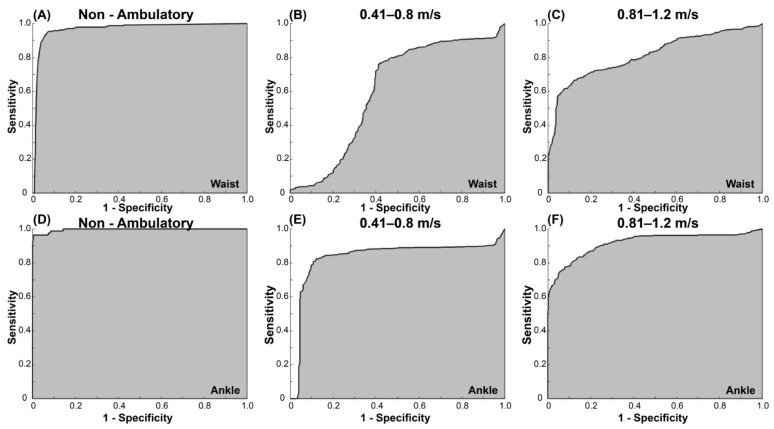
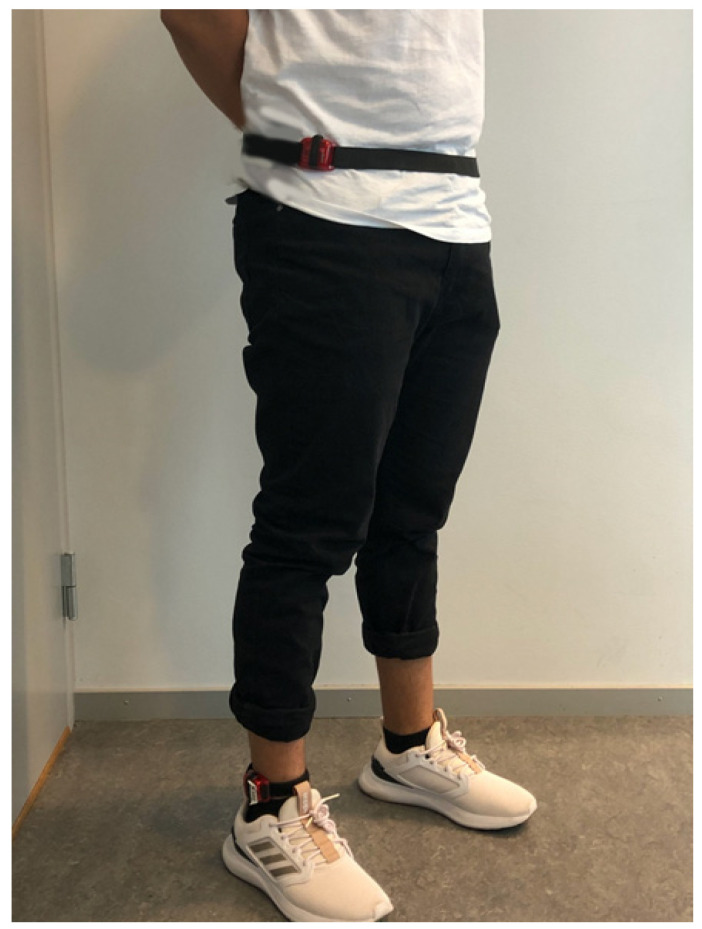
While accelerometers could be used to monitor important domains of walking in daily living (e.g., walking speed), the interpretation of accelerometer data often relies on validation studies performed with healthy participants. The aim of this study was to develop cut-points for waist- and ankle-worn accelerometers to differentiate non-ambulation from walking and different walking speeds in people post stroke. Forty-two post-stroke persons wore waist and ankle accelerometers (ActiGraph GT3x+, AG) while performing three non-ambulation activities (i.e., sitting, setting the table and washing dishes) and while walking in self-selected and brisk speeds. Receiver operating characteristic (ROC) curve analysis was used to define AG cut-points for non-ambulation and different walking speeds (0.41−0.8 m/s, 0.81−1.2 m/s and >1.2 m/s) by considering sensor placement, axis, filter setting and epoch length. Optimal data input and sensor placements for measuring walking were a vector magnitude at 15 s epochs for waist- and ankle-worn AG accelerometers, respectively. Across all speed categories, cut-point classification accuracy was good-to-excellent for the ankle-worn AG accelerometer and fair-to-excellent for the waist-worn AG accelerometer, except for between 0.81 and 1.2 m/s. These cut-points can be used for investigating the link between walking and health outcomes in people post stroke.

摘要

虽然加速度计可用于监测日常生活中行走的重要领域(例如,行走速度),但加速度计数据的解释通常依赖于在健康参与者中进行的验证研究。本研究的目的是为佩戴在腰部和脚踝上的加速度计制定区分非步行和中风后患者不同步行速度的切点。42 名中风后患者佩戴腰部和脚踝加速度计(ActiGraph GT3x+,AG),同时进行三种非步行活动(即坐着、摆放餐桌和洗碗)以及以自我选择和轻快的速度行走。使用接收器操作特性(ROC)曲线分析,通过考虑传感器位置、轴、滤波器设置和时间长度,为非步行和不同步行速度(0.41-0.8 m/s、0.81-1.2 m/s 和>1.2 m/s)定义 AG 切点。测量行走的最佳数据输入和传感器位置分别为腰部和脚踝佩戴的 AG 加速度计的 15 秒时间间隔的向量幅度。在所有速度类别中,脚踝佩戴的 AG 加速度计的切点分类准确性为良好到优秀,腰部佩戴的 AG 加速度计的切点分类准确性为一般到优秀,除了在 0.81-1.2 m/s 之间。这些切点可用于研究中风后患者行走与健康结果之间的联系。
https://cdn.ncbi.nlm.nih.gov/pmc/blobs/a413/9185353/44cc8de35178/sensors-22-04080-g002.jpg
https://cdn.ncbi.nlm.nih.gov/pmc/blobs/a413/9185353/3c33de7caa68/sensors-22-04080-g001.jpg
https://cdn.ncbi.nlm.nih.gov/pmc/blobs/a413/9185353/44cc8de35178/sensors-22-04080-g002.jpg
https://cdn.ncbi.nlm.nih.gov/pmc/blobs/a413/9185353/3c33de7caa68/sensors-22-04080-g001.jpg
https://cdn.ncbi.nlm.nih.gov/pmc/blobs/a413/9185353/44cc8de35178/sensors-22-04080-g002.jpg

相似文献

1
Establishing Accelerometer Cut-Points to Classify Walking Speed in People Post Stroke.建立加速度计切点以分类脑卒中后患者的行走速度。
Sensors (Basel). 2022 May 27;22(11):4080. doi: 10.3390/s22114080.
2
Validity of Hip and Ankle Worn Actigraph Accelerometers for Measuring Steps as a Function of Gait Speed during Steady State Walking and Continuous Turning.髋关节和踝关节佩戴计步器测量步速的有效性,以稳态行走和连续转弯过程中的步态速度为函数。
Sensors (Basel). 2021 May 1;21(9):3154. doi: 10.3390/s21093154.
3
Assessment of gait kinetics in post-menopausal women using tri-axial ankle accelerometers during barefoot walking.使用三轴踝关节加速度计评估绝经后女性在赤脚行走时的步态动力学。
Gait Posture. 2019 Mar;69:85-90. doi: 10.1016/j.gaitpost.2019.01.021. Epub 2019 Jan 15.
4
Validity of the ActiGraph activity monitor for individuals who walk slowly post-stroke.适用于中风后行走缓慢个体的ActiGraph活动监测器的有效性。
Top Stroke Rehabil. 2018 May;25(4):295-304. doi: 10.1080/10749357.2018.1446487. Epub 2018 Mar 20.
5
Generation and validation of ActiGraph GT3X+ accelerometer cut-points for assessing physical activity intensity in older adults. The OUTDOOR ACTIVE validation study.生成和验证 ActiGraph GT3X+ 加速度计切点以评估老年人的身体活动强度。户外主动验证研究。
PLoS One. 2021 Jun 3;16(6):e0252615. doi: 10.1371/journal.pone.0252615. eCollection 2021.
6
"Stepping Up" Activity Poststroke: Ankle-Positioned Accelerometer Can Accurately Record Steps During Slow Walking.中风后“增强活动”:脚踝处的加速度计能够准确记录慢走时的步数。
Phys Ther. 2016 Mar;96(3):355-60. doi: 10.2522/ptj.20140611. Epub 2015 Aug 6.
7
Reliable recognition of lying, sitting, and standing with a hip-worn accelerometer.使用佩戴在髋部的加速度计可靠地识别躺、坐和站。
Scand J Med Sci Sports. 2018 Mar;28(3):1092-1102. doi: 10.1111/sms.13017. Epub 2017 Dec 13.
8
Does a waist-worn accelerometer capture intra- and inter-person variation in walking behavior among persons with multiple sclerosis?佩戴在腰部的加速度计能否捕捉到多发性硬化症患者行走行为的个体内和个体间变化?
Med Eng Phys. 2010 Dec;32(10):1224-8. doi: 10.1016/j.medengphy.2010.08.015. Epub 2010 Sep 26.
9
Gait regularity assessed by wearable sensors: Comparison between accelerometer and gyroscope data for different sensor locations and walking speeds in healthy subjects.可穿戴传感器评估的步态规律性:健康受试者不同传感器位置和步行速度下加速度计与陀螺仪数据的比较
J Biomech. 2020 Dec 2;113:110115. doi: 10.1016/j.jbiomech.2020.110115. Epub 2020 Nov 9.
10
A catalog of validity indices for step counting wearable technologies during treadmill walking: the CADENCE-Kids study.计步可穿戴技术在跑步机行走时的有效性指标目录:CADENCE-Kids 研究。
Int J Behav Nutr Phys Act. 2021 Jul 16;18(1):97. doi: 10.1186/s12966-021-01167-y.

引用本文的文献

1
Comparability of Daily-Life Walking Speed Measured by Smartphone GPS and Ankle-Band Accelerometer: Cross-Sectional Study.智能手机GPS与脚踝佩戴式加速度计测量的日常生活步行速度的可比性:横断面研究。
JMIR Form Res. 2025 Aug 18;9:e73722. doi: 10.2196/73722.
2
Characterizing physical activity bouts in people with stroke with different ambulation statuses.对不同步行状态的中风患者的身体活动发作进行特征描述。
PLoS One. 2025 May 14;20(5):e0307625. doi: 10.1371/journal.pone.0307625. eCollection 2025.
3
How should we measure physical activity after stroke? An international consensus.

本文引用的文献

1
Evaluation of Wrist Accelerometer Cut-Points for Classifying Physical Activity Intensity in Youth.评估用于青少年身体活动强度分类的手腕加速度计切点
Front Digit Health. 2022 May 2;4:884307. doi: 10.3389/fdgth.2022.884307. eCollection 2022.
2
Accelerometer assessed upper limb activity in people with stroke: a validation study considering ambulatory and non-ambulatory activities.加速度计评估脑卒中患者上肢活动:考虑非卧床和卧床活动的验证研究。
Disabil Rehabil. 2022 Dec;44(26):8463-8470. doi: 10.1080/09638288.2021.2012838. Epub 2021 Dec 14.
3
Validity of Hip and Ankle Worn Actigraph Accelerometers for Measuring Steps as a Function of Gait Speed during Steady State Walking and Continuous Turning.
如何衡量卒中后的体力活动?国际共识。
Int J Stroke. 2023 Oct;18(9):1132-1142. doi: 10.1177/17474930231184108. Epub 2023 Jun 24.
髋关节和踝关节佩戴计步器测量步速的有效性,以稳态行走和连续转弯过程中的步态速度为函数。
Sensors (Basel). 2021 May 1;21(9):3154. doi: 10.3390/s21093154.
4
World Health Organization 2020 guidelines on physical activity and sedentary behaviour.世界卫生组织 2020 年关于身体活动和 sedentary behaviour 的指南。
Br J Sports Med. 2020 Dec;54(24):1451-1462. doi: 10.1136/bjsports-2020-102955.
5
Levels and patterns of physical activity in stroke survivors with different ambulation status living in low-income areas of Cape Town, South Africa.南非开普敦低收入地区不同步行状态的脑卒中幸存者的身体活动水平和模式。
Top Stroke Rehabil. 2020 Oct;27(7):494-502. doi: 10.1080/10749357.2020.1741242. Epub 2020 Mar 18.
6
Gait asymmetry pattern following stroke determines acute response to locomotor task.中风后步态不对称模式决定了对运动任务的急性反应。
Gait Posture. 2020 Mar;77:300-307. doi: 10.1016/j.gaitpost.2020.02.016. Epub 2020 Feb 26.
7
Stepping After Stroke: Walking Characteristics in People With Chronic Stroke Differ on the Basis of Walking Speed, Walking Endurance, and Daily Steps.中风后行走:慢性中风患者的行走特征因行走速度、行走耐力和日常步数的不同而有所不同。
Phys Ther. 2020 May 18;100(5):807-817. doi: 10.1093/ptj/pzaa020.
8
Calibration and validation of accelerometry to measure physical activity in adult clinical groups: A systematic review.校准与验证加速度计在成年临床群体中测量身体活动的应用:一项系统综述
Prev Med Rep. 2019 Nov 6;16:101001. doi: 10.1016/j.pmedr.2019.101001. eCollection 2019 Dec.
9
Google fit smartphone application or Gt3X Actigraph: Which is better for detecting the stepping activity of individuals with stroke? A validity study.谷歌健康智能手机应用程序还是Gt3X活动记录仪:哪一种更适合检测中风患者的步行活动?一项效度研究。
J Bodyw Mov Ther. 2019 Jul;23(3):461-465. doi: 10.1016/j.jbmt.2019.01.011. Epub 2019 Feb 2.
10
Defining accelerometer cut-points for different intensity levels in motor-complete spinal cord injury.定义运动完全性脊髓损伤不同强度水平的加速度计切点。
Spinal Cord. 2020 Jan;58(1):116-124. doi: 10.1038/s41393-019-0308-y. Epub 2019 Jun 26.