Lentine Krista L, Fleetwood Vidya A, Caliskan Yasar, Randall Henry, Wellen Jason R, Lichtenberger Melissa, Dedert Craig, Rothweiler Richard, Marklin Gary, Brockmeier Diane, Schnitzler Mark A, Husain Syed A, Mohan Sumit, Kasiske Bertram L, Cooper Matthew, Mannon Roslyn B, Axelrod David A
Saint Louis University Center for Abdominal Transplantation, St. Louis, Missouri, USA.
Washington University, St. Louis, Missouri, USA.
Kidney Int Rep. 2022 Mar 28;7(6):1268-1277. doi: 10.1016/j.ekir.2022.03.021. eCollection 2022 Jun.
The utility of kidney procurement biopsies is controversial. Understanding the current landscape of how clinicians obtain and use biopsies in organ evaluation may help inform consensus-building efforts.
An electronic survey was distributed to clinicians at US kidney transplant programs (April 22, 2021-June 30, 2021) to evaluate donor biopsy indications, frequency, processing and interpretation, and impact of findings on practices.
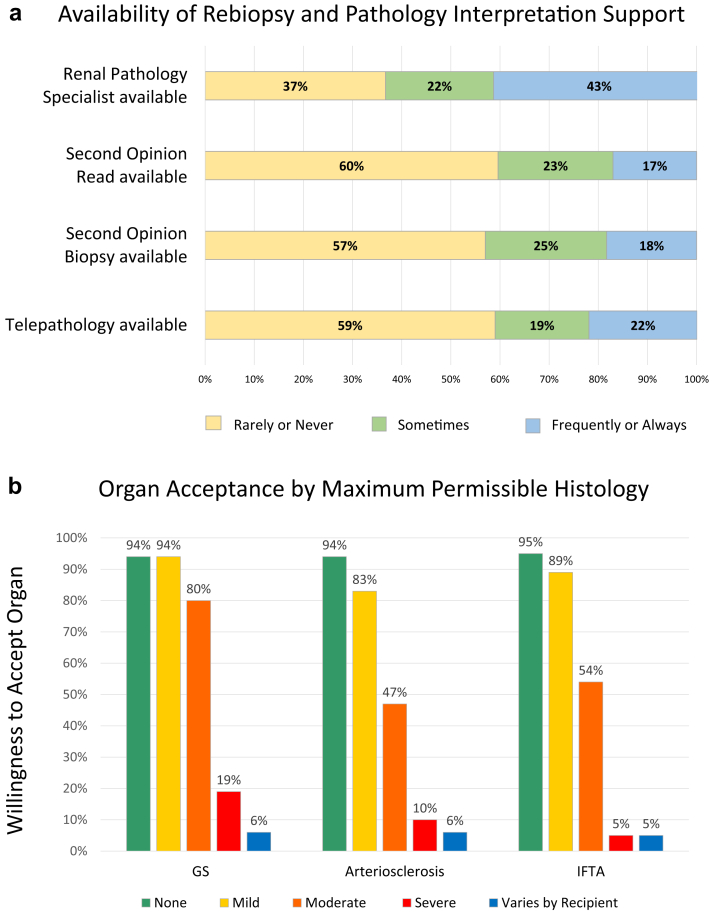
Responses from staff involved in organ acceptance (73% surgeons, 20% nephrologists, 6% coordinators) at 95 transplant centers were analyzed, representing 40% of US transplant centers and 50% of recent deceased donor kidney transplant volume. More than a third of centers (35%) reported obtaining procurement biopsies on most-to-all kidneys. Most clinicians decided when to biopsy jointly with the Organ Procurement Organization (OPO) (82%) based on formal criteria for the decision (72%), although 41% reported having requested a biopsy outside of the criteria. Most respondents used a semiquantitative scoring system for interpretation (57%). Many respondents reported rarely or never having access to renal specialty pathologists (37%) or to telepathology (59%). Most respondents reported that a favorable biopsy result would encourage them to accept a "marginal" donor kidney (72%); nearly half (46%) indicated that an unfavorable biopsy result would lead to decline of a standard criteria kidney.
Procurement biopsies are commonly used in organ acceptance decisions despite inconsistent access to experienced renal pathologists and heterogeneous approaches to criteria, scoring, and interpretation. Ongoing study and consensus building are needed to direct procurement biopsy practice toward increasing organ utilization and reducing allocation inefficiency.
肾脏获取活检的效用存在争议。了解临床医生在器官评估中获取和使用活检的当前情况,可能有助于为达成共识的努力提供信息。
于2021年4月22日至2021年6月30日向美国肾脏移植项目的临床医生进行电子调查,以评估供体活检的指征、频率、处理与解读,以及检查结果对实践的影响。
分析了95个移植中心参与器官接受工作的人员(73%为外科医生,20%为肾病学家,6%为协调员)的回复,这些中心占美国移植中心的40%,以及近期 deceased 供体肾脏移植量的50%。超过三分之一的中心(35%)报告称对大多数至所有肾脏都进行了获取活检。大多数临床医生根据正式的决策标准(72%)与器官获取组织(OPO)共同决定何时进行活检(82%),尽管41%的人报告曾在标准之外要求进行活检。大多数受访者使用半定量评分系统进行解读(57%)。许多受访者报告很少或从未有机会接触肾脏专科病理学家(37%)或远程病理学(59%)。大多数受访者报告称,活检结果良好会促使他们接受“边缘”供体肾脏(72%);近一半(46%)表示活检结果不佳会导致拒绝标准标准肾脏。
尽管获取经验丰富的肾脏病理学家的机会不一致,且在标准、评分和解读方法上存在差异,但获取活检在器官接受决策中仍被普遍使用。需要持续的研究和达成共识,以指导获取活检实践,提高器官利用率并减少分配效率低下的情况。