Verdickt Sébastien, Van Nes Falco, Moyson Carolien, Maes Toon, Van Crombrugge Paul, Van den Bruel Annick, Decallonne Brigitte
Department of Endocrinology, University Hospitals of Leuven, Leuven, Belgium.
Department of Endocrinology, Imeldaziekenhuis Bonheiden, Bonheiden, Belgium.
Eur Thyroid J. 2022 Jun 29;11(4). doi: 10.1530/ETJ-22-0047. Print 2022 Aug 1.
We investigated whether a positive thyroid peroxidase antibody (TPO Ab) status before radioactive iodine (RAI) therapy in patients with Graves' hyperthyroidism is a predictive factor for developing hypothyroidism post RAI.
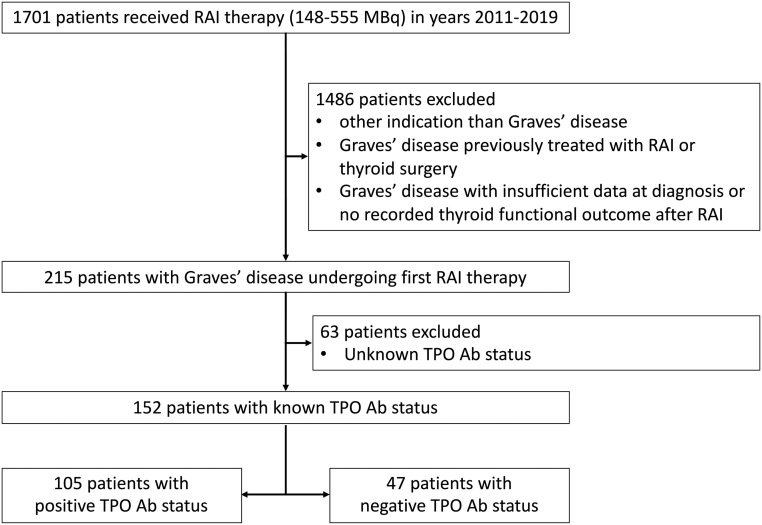
We performed a retrospective study of patients with Graves' hyperthyroidism with known TPO Ab status, receiving the first administration of RAI. Patients from four thyroid outpatient centres in Belgium receiving their first RAI therapy between the years 2011 and 2019 were studied. Clinical, laboratory, imaging, and treatment data were recorded from medical charts. Hypothyroidism and cure (defined as combined hypo- and euthyroidism) were evaluated in period 1 (≥2 and ≤9 months, closest to 6 months post RAI) and period 2 (>9 months and ≤24 months post RAI, closest to 12 months post RAI).
A total of 152 patients were included of which 105 (69%) were TPO Ab-positive. Compared to TPO Ab-negative patients, TPO Ab-positive patients were younger, had a larger thyroid gland, and had more previous episodes of hyperthyroidism. In period 1, 89% of the TPO Ab-positive group developed hypothyroidism and 72% in the TPO Ab-negative group (P = 0.007). In period 2, the observation was similar: 88% vs 72% (P = 0.019). In the multivariate logistic regression analysis, a positive TPO Ab status was associated with hypothyroidism in period 2 (adjusted OR: 4.78; 95% CI: 1.27-20.18; P = 0.024). In period 1, the aOR was 4.16 (95% CI: 1.0-18.83; P = 0.052).
A positive TPO Ab status in patients with Graves' hyperthyroidism receiving the first administration of RAI is associated with a higher risk of early hypothyroidism.
我们调查了格雷夫斯甲亢患者在放射性碘(RAI)治疗前甲状腺过氧化物酶抗体(TPO Ab)呈阳性是否是RAI治疗后发生甲状腺功能减退的预测因素。
我们对已知TPO Ab状态且首次接受RAI治疗的格雷夫斯甲亢患者进行了一项回顾性研究。研究对象为2011年至2019年间在比利时四个甲状腺门诊中心接受首次RAI治疗的患者。从病历中记录临床、实验室、影像学和治疗数据。在第1阶段(RAI治疗后≥2个月且≤9个月,最接近6个月)和第2阶段(RAI治疗后>9个月且≤24个月,最接近12个月)评估甲状腺功能减退和治愈情况(定义为甲状腺功能减退和甲状腺功能正常的综合情况)。
共纳入152例患者,其中105例(69%)TPO Ab呈阳性。与TPO Ab阴性患者相比,TPO Ab阳性患者更年轻,甲状腺更大,且既往甲亢发作次数更多。在第1阶段,TPO Ab阳性组89%发生甲状腺功能减退,TPO Ab阴性组为72%(P = 0.007)。在第2阶段,观察结果相似:分别为88%和72%(P = 0.019)。在多因素逻辑回归分析中,TPO Ab阳性状态与第2阶段的甲状腺功能减退相关(调整后的比值比:4.78;95%置信区间:1.27 - 20.18;P = 0.024)。在第1阶段,调整后的比值比为4.16(95%置信区间:1.0 - 18.83;P = 0.052)。
首次接受RAI治疗的格雷夫斯甲亢患者TPO Ab呈阳性与早期甲状腺功能减退的较高风险相关。