Faculty of Medicine and Health Technology, Tampere University, Tampere, Finland.
Department of Surgery, Central Finland Hospital Nova, Hoitajantie 3, Jyväskylä, Finland.
Medicine (Baltimore). 2022 Jun 10;101(23):e29496. doi: 10.1097/MD.0000000000029496.
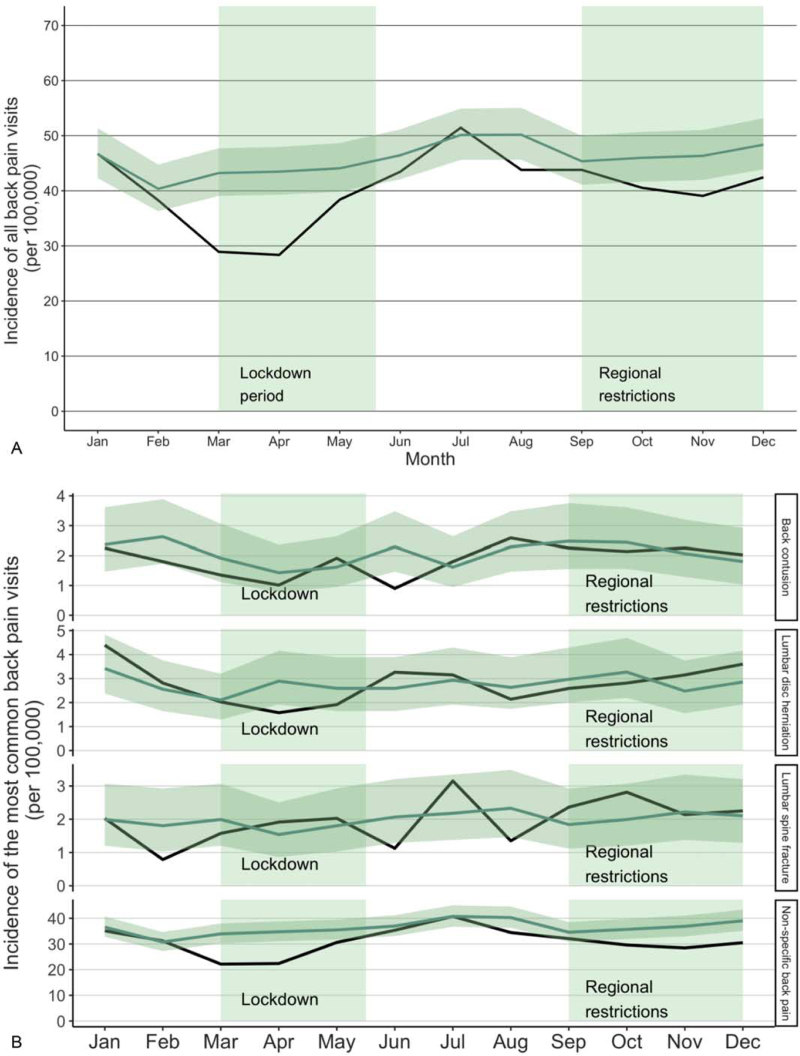
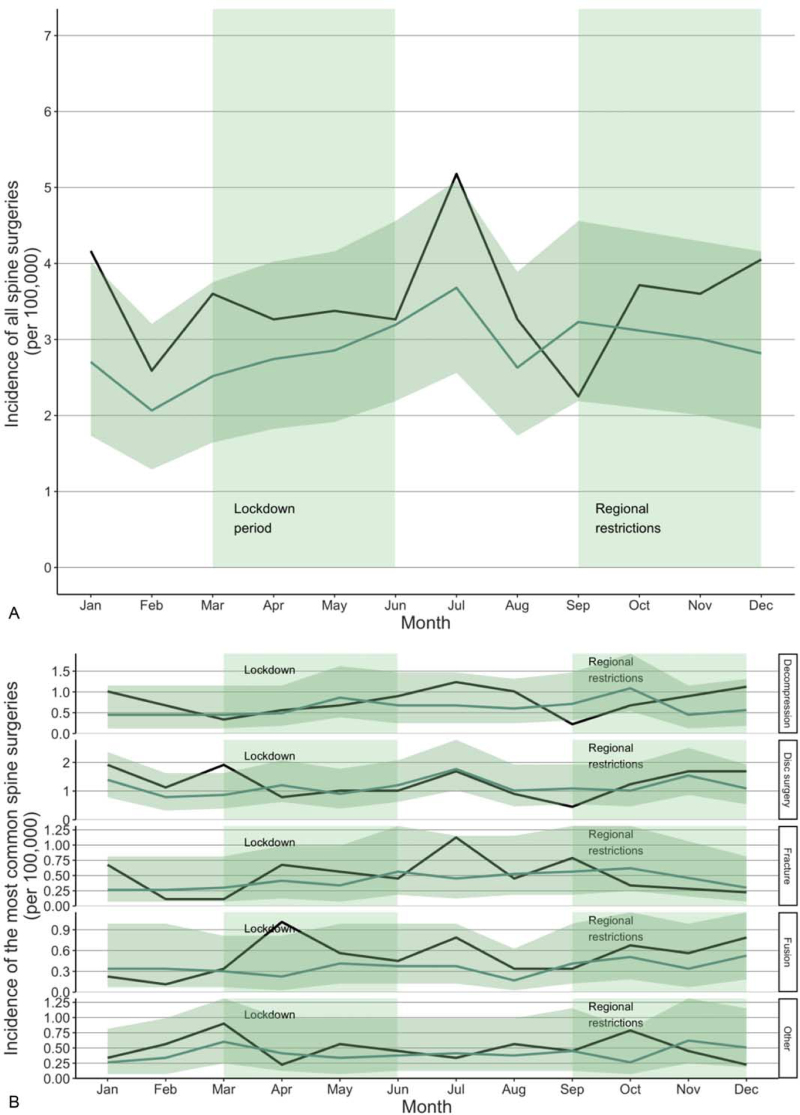
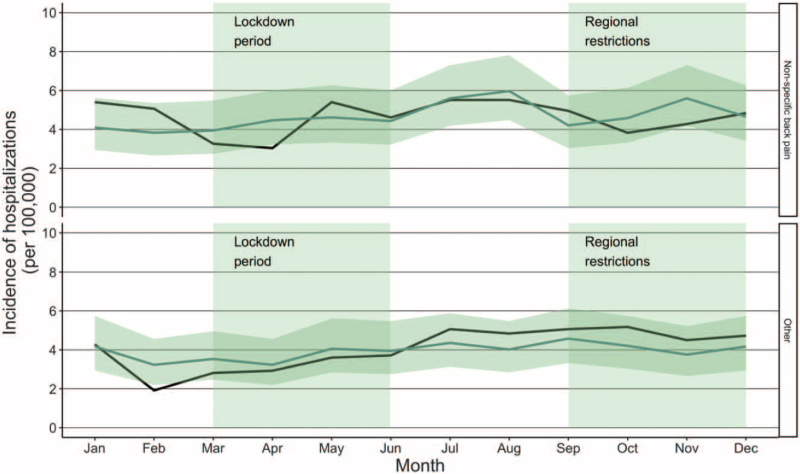
We aim to report the incidences of ED visits due to back pain, hospitalizations, and urgent spine surgeries during the first and second waves of COVID-19 in Finland. The number of emergency department visits and hospitalizations due to back pain as well as urgent spine surgeries in the adult population was collected from hospital discharge registers for the years 2017 through 2019 (reference years) and 2020.This study was conducted at three large Finnish hospitals. The monthly incidence with 95% confidence intervals (CI) of emergency department visits and hospitalizations due to back pain and spine surgeries in the three participating hospitals were calculated and compared by incidence rate ratios (IRR).Visits to ED due to back pain decreased during the pandemic. The incidence of ED visits due to back pain was similar in February (IRR 0.95, CI: 0.82-1.10), but a decrease was seen after lockdown began (March IRR 0.67, CI: 0.57-0.78; April IRR 0.65, CI: 0.56-0.76) compared to the reference years. A second decrease in visits was seen after regional restrictions were implemented in October (IRR 0.88, CI: 0.76-1.02). The most common diagnoses were non-specific back pain, lumbar disk herniation, and back contusion. Incidence of non-specific back pain decreased during the lockdown (March IRR 0.65, CI: 0.55-0.78) and regional restrictions (October IRR 0.83, CI: 0.70-0.98), whereas the rates of other diagnoses remained unchanged, and incidences of hospitalizations and urgent spine surgeries remained stable.A clear decrease in ED visits due to back pain was seen during the first and second waves of the pandemic. This decrease was mainly the result of patients with non-specific back pain avoiding visits to the ED. The incidence of specific back pain, hospitalizations, and urgent spine surgeries remained unchanged during the pandemic.
我们旨在报告芬兰 COVID-19 第一波和第二波期间因背痛就诊、住院和紧急脊柱手术的发生率。2017 年至 2019 年(参考年)和 2020 年,从医院出院登记处收集了因背痛而到急诊科就诊和住院以及紧急脊柱手术的人数。本研究在芬兰的三家大医院进行。计算了参与医院每月因背痛就诊和住院以及脊柱手术的发生率(95%置信区间[CI]),并通过发病率比(IRR)进行比较。大流行期间,因背痛到急诊科就诊的人数有所减少。2 月因背痛到急诊科就诊的发生率相似(IRR 0.95,CI:0.82-1.10),但自封锁开始后(3 月 IRR 0.67,CI:0.57-0.78;4 月 IRR 0.65,CI:0.56-0.76),与参考年相比,就诊人数有所下降。10 月实施区域限制后,就诊人数再次下降(IRR 0.88,CI:0.76-1.02)。最常见的诊断是非特异性背痛、腰椎间盘突出症和背部挫伤。封锁期间(3 月 IRR 0.65,CI:0.55-0.78)和区域限制期间(10 月 IRR 0.83,CI:0.70-0.98),非特异性背痛的发生率下降,而其他诊断的比率保持不变,住院和紧急脊柱手术的发生率保持稳定。大流行期间,因背痛就诊的急诊科就诊人数明显减少。这种减少主要是由于非特异性背痛患者避免了到急诊科就诊。大流行期间,特定背痛、住院和紧急脊柱手术的发生率保持不变。