Department of Structural Cell Biology, Max Planck Institute of Biochemistry, Am Klopferspitz 18, Martinsried, Munich, Germany.
Department of Molecular Biology and Genetics, Aarhus University, Aarhus, Denmark.
Mol Cell. 2022 Jul 7;82(13):2505-2518.e7. doi: 10.1016/j.molcel.2022.04.011. Epub 2022 Jun 9.
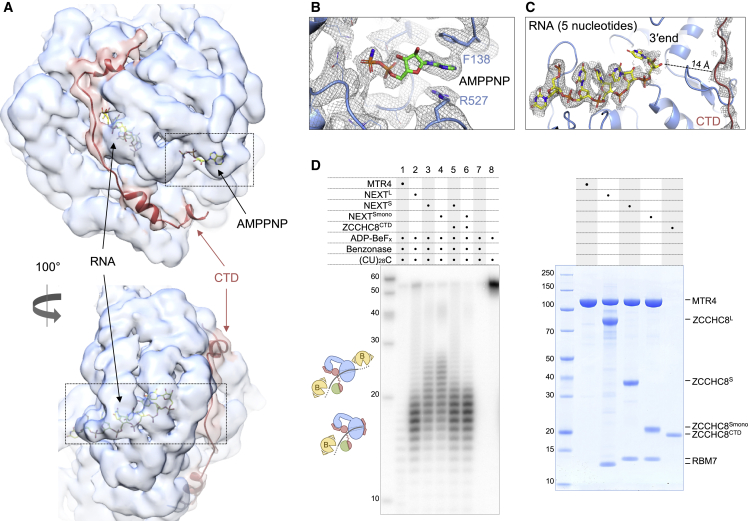
In mammalian cells, spurious transcription results in a vast repertoire of unproductive non-coding RNAs, whose deleterious accumulation is prevented by rapid decay. The nuclear exosome targeting (NEXT) complex plays a central role in directing non-functional transcripts to exosome-mediated degradation, but the structural and molecular mechanisms remain enigmatic. Here, we elucidated the architecture of the human NEXT complex, showing that it exists as a dimer of MTR4-ZCCHC8-RBM7 heterotrimers. Dimerization preconfigures the major MTR4-binding region of ZCCHC8 and arranges the two MTR4 helicases opposite to each other, with each protomer able to function on many types of RNAs. In the inactive state of the complex, the 3' end of an RNA substrate is enclosed in the MTR4 helicase channel by a ZCCHC8 C-terminal gatekeeping domain. The architecture of a NEXT-exosome assembly points to the molecular and regulatory mechanisms with which the NEXT complex guides RNA substrates to the exosome.
在哺乳动物细胞中,错误转录导致大量无功能的非编码 RNA 的产生,这些 RNA 的有害积累被快速降解所阻止。核体 exosome 靶向(NEXT)复合物在指导无功能转录本进行 exosome 介导的降解方面发挥着核心作用,但结构和分子机制仍然是个谜。在这里,我们阐明了人源 NEXT 复合物的结构,表明它作为 MTR4-ZCCHC8-RBM7 异三聚体的二聚体存在。二聚化预先配置了 ZCCHC8 的主要 MTR4 结合区域,并将两个 MTR4 解旋酶彼此相对排列,每个单体都能够作用于多种类型的 RNA。在复合物的非活性状态下,RNA 底物的 3' 端被 ZCCHC8 C 末端的门控结构域封闭在 MTR4 解旋酶通道内。NEXT-exosome 组装的结构为 NEXT 复合物将 RNA 底物引导至 exosome 的分子和调节机制提供了线索。