Kaye Sharlene, Lewandowski Amy, Dunne Mitchell, Bowman Julia, Archer Vicki
Research Unit, Justice Health and Forensic Mental Health Network, Long Bay Complex, Roundhouse, 1300 Anzac Parade, Malabar, NSW, 2036, Australia.
National Drug and Alcohol Research Centre, UNSW Sydney, Sydney, Australia.
Pilot Feasibility Stud. 2022 Jun 11;8(1):122. doi: 10.1186/s40814-022-01068-2.
Despite elevated risk of cardiometabolic disease among those with serious mental illness, and widespread recognition that physical activity interventions are required, there are multiple barriers to implementing typically recommended physical activity programmes in secure inpatient settings. Due to low mood, negative symptoms and poor socio-occupational functioning, psychiatric inpatients often lack motivation to engage in physical activity programmes. Moreover, regular access to outdoor spaces and exercise equipment is limited. As such, there is a need for novel physical activity interventions that are suitable for secure settings. This study aims to investigate the feasibility, acceptability and potential effectiveness of an intervention (exergaming) to promote physical activity among patients in a secure mental health setting.
This non-randomised, two-arm pilot study will employ a pre-test/post-test parallel group design, comparing the exergaming intervention with a "routine treatment" control. Two high-secure, sub-acute wards in the Long Bay Hospital Mental Health Unit will be non-randomly allocated to either the exergaming intervention or the "routine treatment" control group. The intervention group will receive a 12-week programme comprising three 30-min exergaming sessions per week using various Xbox Kinect activity-based games designed to simulate moderate intensity exercise. The "routine treatment" group will continue to receive the standard model of care delivered by the Justice Health and Forensic Mental Health Network. Accelerometers will be distributed to all participants to collect daily energy expenditure, number of steps taken, intensity of physical activity and heart rate data throughout the study. The primary outcomes are (1) intervention feasibility and acceptability, and (2) baseline to post-intervention changes in physical health outcomes (levels of physical activity; cardiovascular fitness; clinical measures of cardiometabolic risk). Secondary outcomes are baseline to post-intervention changes in mental health outcomes (depression, anxiety, stress, positive psychiatric symptoms). Outcomes will be assessed at baseline, mid-intervention, and post-intervention.
This research will contribute to evidence-based practice in the care of patients with serious mental illness: a vulnerable population with complex physical and mental health needs and a markedly elevated risk of cardiovascular disease. The findings will inform cardiovascular health promotion strategies and the implementation of physical activity interventions in secure inpatient settings.
ANZCTR, ACTRN12619000202167. Registered on 12 February 2019, https://www.anzctr.org.au . ANZCTR mandatory data items comply with the minimum dataset requirements of the World Health Organisation (WHO). The ANZCTR contributes trial registration data to the WHO International Clinical Trials Registry Platform (WHO ICTRP).
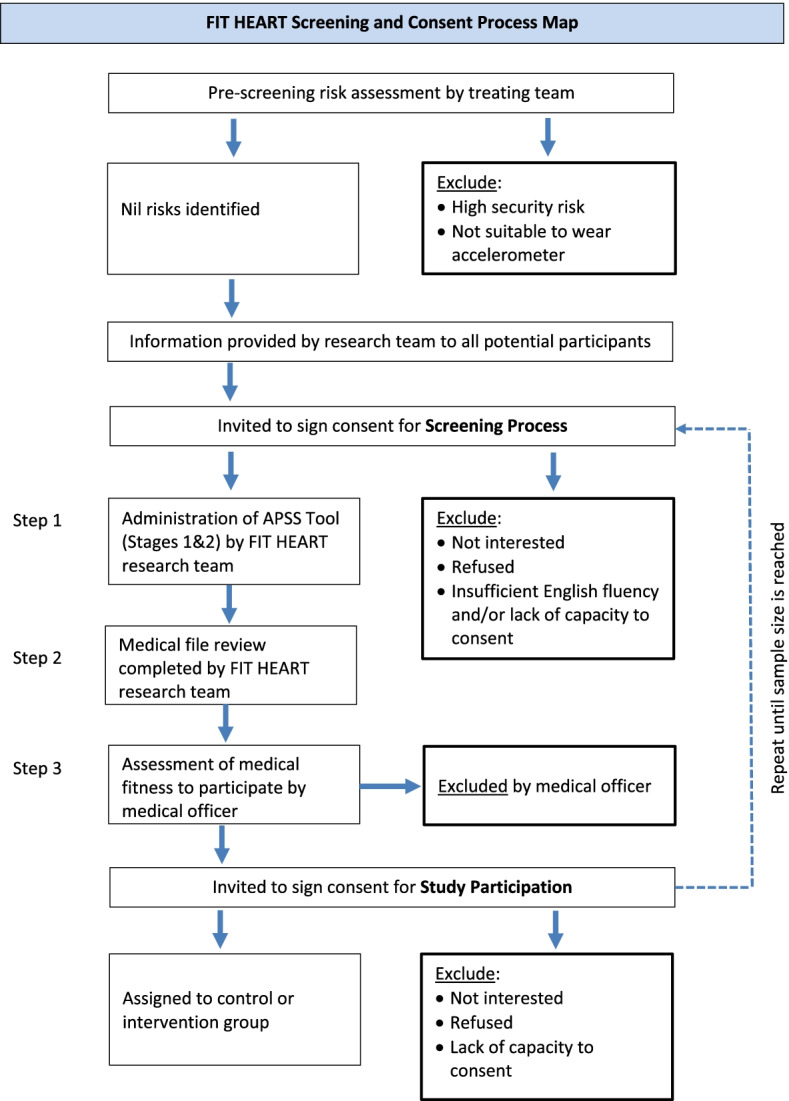
尽管患有严重精神疾病的人群患心脏代谢疾病的风险较高,且人们普遍认识到需要进行体育活动干预,但在安全的住院环境中实施通常推荐的体育活动计划存在多重障碍。由于情绪低落、阴性症状以及社会职业功能不佳,精神科住院患者往往缺乏参与体育活动计划的动力。此外,定期使用户外空间和运动器材的机会有限。因此,需要适合安全环境的新型体育活动干预措施。本研究旨在调查一种干预措施(电子游戏运动)在安全的心理健康环境中促进患者体育活动的可行性、可接受性和潜在效果。
这项非随机、双臂试点研究将采用预测试/后测试平行组设计,将电子游戏运动干预与“常规治疗”对照进行比较。朗湾医院心理健康科的两个高度安全的亚急性病房将被非随机分配到电子游戏运动干预组或“常规治疗”对照组。干预组将接受为期12周的计划,每周包括三次30分钟的电子游戏运动课程,使用各种基于Xbox Kinect活动的游戏,旨在模拟中等强度运动。“常规治疗”组将继续接受司法健康和法医心理健康网络提供的标准护理模式。在整个研究过程中,将向所有参与者发放加速度计,以收集每日能量消耗、步数、体育活动强度和心率数据。主要结果是:(1)干预的可行性和可接受性;(2)干预后身体健康结果(体育活动水平、心血管健康、心脏代谢风险的临床指标)相对于基线的变化。次要结果是干预后心理健康结果(抑郁、焦虑、压力、阳性精神症状)相对于基线的变化。结果将在基线、干预中期和干预后进行评估。
这项研究将为严重精神疾病患者的循证护理做出贡献:这是一个身体和心理健康需求复杂且心血管疾病风险显著升高的弱势群体。研究结果将为心血管健康促进策略以及在安全住院环境中实施体育活动干预提供信息。
澳大利亚和新西兰临床试验注册中心,ACTRN1261900020
