Exeter Knee Reconstruction Unit, RD+E Hospital, Exeter, UK.
Signidat, Roderwolde, The Netherlands.
Arch Orthop Trauma Surg. 2023 Apr;143(4):2141-2151. doi: 10.1007/s00402-022-04487-1. Epub 2022 Jun 12.
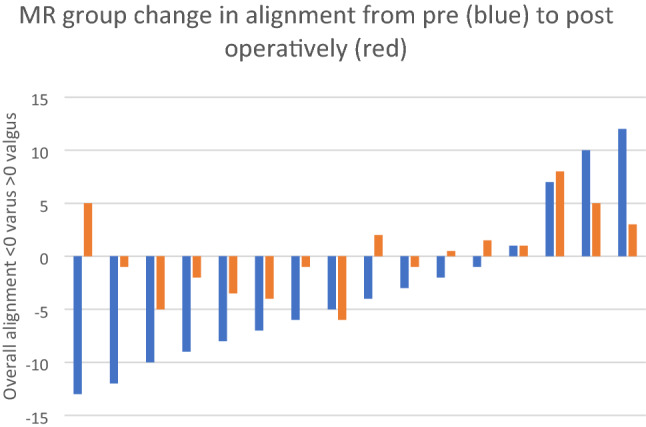
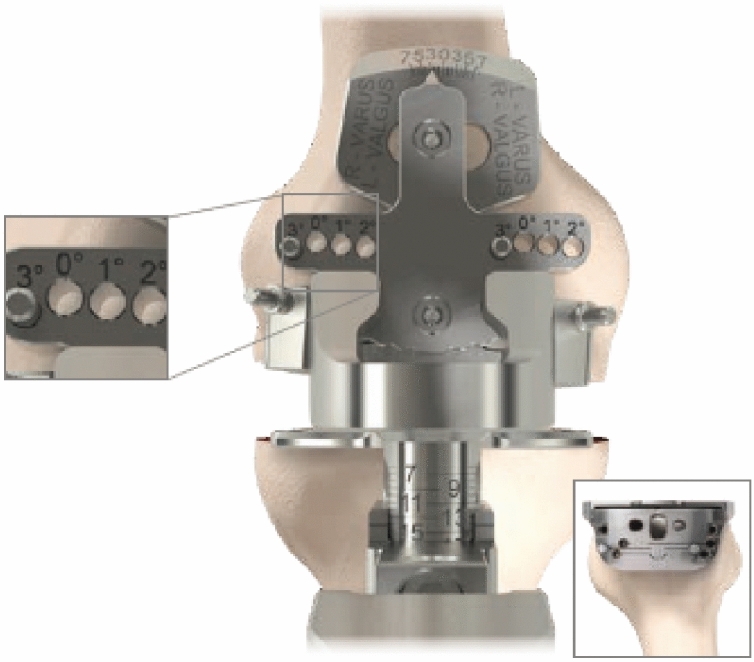
Alignment goals in total knee replacement (TKR) is a topical subject. This study compares the short-term functional outcomes and patient reported outcome measures (PROMs) of two philosophies for knee arthroplasty alignment: measured resection (MR) and an individualised alignment philosophy, with the tibia mechanically aligned and an instrumented gap balancer (GB) to align the femur in both flexion and extension.
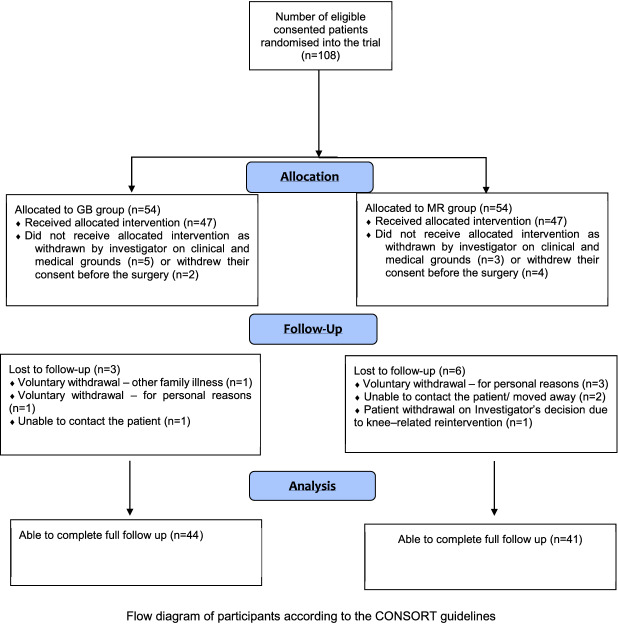
94 knees were enrolled in this randomised controlled trial. The surgical protocol used a MR technique for mechanical alignment or a GB technique for individualised alignment. Primary outcome was quadriceps strength. Secondary outcomes included validated functional tests and PROMs as well as patient satisfaction. Outcomes were assessed pre-operatively, at 6 weeks, 3, 6 and 12 months post-operatively.
At 12-month follow-up, there was no significant difference in the change from baseline mean quadriceps peak torque between the two groups (p = 0.988). Significant improvement in the change in range of motion (ROM) in the GB group compared to the MR group at 3 months (13° vs 6° p = 0.028) but this improvement was not significant at 1 year (20° vs 17° p = 0.21). The functional test of balance showed statistically significant improvement at 6 weeks (p = 0.03) in the GB group but this difference was not maintained. PROMs favoured the GB group, with the KOOS pain scoring statistically better (p ≤ 0.05) at 6 weeks, 3, 6 and 12 months.
Individualised alignment philosophy utilising a GB technique did not demonstrate an improvement in the primary outcome measure quadriceps peak torque. Improvement was seen in the GB group in PROM pain scores that was significant, both statistically and clinically, out to at least 1 year. Gains that were seen in functional assessment with GB, although significant at some time points, were no longer significant at 1 year and no difference was seen in quads strength. Compared to a MR technique, the individualised GB technique appears to confer some improvement in pain, ROM and some functional tests following TKR in the short-term.
全膝关节置换术(TKR)的对线目标是一个热门话题。本研究比较了两种膝关节置换对线理念的短期功能结果和患者报告的结果测量(PROM):测量切除(MR)和个体化对线理念,胫骨采用机械对线,仪器间隙平衡器(GB)在膝关节屈伸时对线股骨。
本随机对照试验纳入 94 例膝关节。手术方案采用 MR 技术进行机械对线或 GB 技术进行个体化对线。主要结果是股四头肌力量。次要结果包括经过验证的功能测试和 PROM 以及患者满意度。在术前、术后 6 周、3 个月、6 个月和 12 个月进行评估。
在 12 个月的随访中,两组之间从基线平均股四头肌峰值扭矩的变化没有显著差异(p=0.988)。在 3 个月时,GB 组与 MR 组相比,ROM 的变化有显著改善(13°比 6°,p=0.028),但在 1 年时差异无统计学意义(20°比 17°,p=0.21)。平衡功能测试显示,在 6 周时,GB 组有统计学意义的改善(p=0.03),但这种差异没有持续。PROM 结果有利于 GB 组,KOOS 疼痛评分在 6 周、3 个月、6 个月和 12 个月时均具有统计学意义(p≤0.05)。
采用 GB 技术的个体化对线理念并未显示出主要结果测量股四头肌峰值扭矩的改善。在 GB 组中,PROM 疼痛评分有所改善,在统计学和临床上均至少持续 1 年。在 GB 组中,功能评估中出现的改善虽然在某些时间点有统计学意义,但在 1 年后不再有统计学意义,且在股四头肌力量方面没有差异。与 MR 技术相比,个体化的 GB 技术在 TKR 后短期内似乎在疼痛、ROM 和一些功能测试方面有一定的改善。