Department of Gastroenterology, Kanazawa University Graduate School of Medicine, Kanazawa, Japan.
Department of Clinical Laboratory Medicine, Kanazawa University Graduate School of Medicine, Kanazawa, Japan.
Hepatol Commun. 2022 Sep;6(9):2441-2454. doi: 10.1002/hep4.2018. Epub 2022 Jun 12.
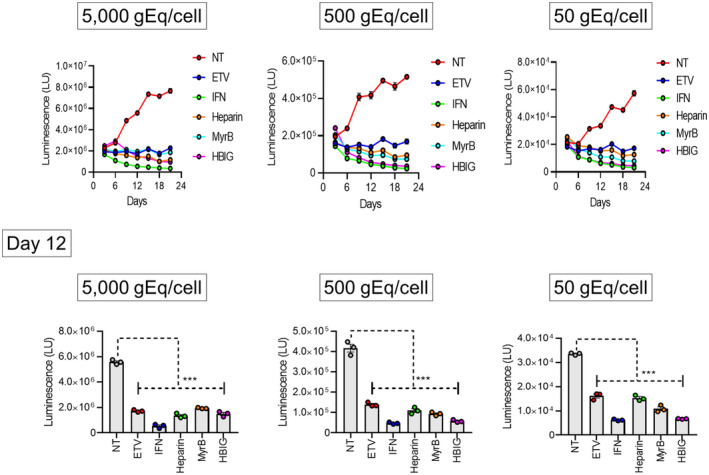
For the development of antiviral agents to eliminate hepatitis B virus (HBV), it is essential to establish an HBV cell culture system that can easily monitor HBV infection. Here, we created a novel HBV infection monitoring system using a luminescent 11-amino acid reporter, the high-affinity subunit of nano-luciferase binary technology (HiBiT). The HiBiT-coding sequence was inserted at the N-terminus of preS1 in a 1.2-fold plasmid encoding a genotype C HBV genome. After transfection of HepG2 cells with this HiBiT-containing plasmid, the supernatant was used to prepare a recombinant cell culture-derived virus (HiBiT-HBVcc). Primary human hepatocytes (PXB) were inoculated with HiBiT-HBVcc. Following inoculation, intracellular and extracellular HiBiT activity and the levels of various HBV markers were determined. Reinfection of naive PXB cells with HiBiT-HBVcc prepared from HiBiT-HBVcc-infected PXB cells was analyzed. When PXB cells were infected with HiBiT-HBVcc at several titers, extracellular HiBiT activity was detected in a viral titer-dependent manner and was correlated with intracellular HiBiT activity. Inhibitors of HBV entry or replication suppressed extracellular HiBiT activity. Viral DNA, RNA, and proteins were detectable, including covalently closed circular DNA, by Southern blot analysis. The synthesis of relaxed-circular DNA from single-stranded DNA in HiBiT-HBV decreased to one third of that of wild-type HBV, and the infectivity of HiBiT-HBVcc decreased to one tenth of that of wild-type HBVcc. HiBiT-HBVcc prepared from PXB cells harboring HiBiT-HBV was able to infect naive PXB cells. Conclusions: Recombinant HiBiT-HBV can undergo the entire viral life cycle, thus facilitating high-throughput screening for HBV infection in vitro using supernatants. This system will be a powerful tool for developing antiviral agents.
为了开发消除乙型肝炎病毒 (HBV) 的抗病毒药物,建立一种能够轻松监测 HBV 感染的 HBV 细胞培养系统至关重要。在这里,我们使用发光 11 个氨基酸报告物高亲和力亚基纳米荧光素酶二元技术 (HiBiT) 创建了一种新型 HBV 感染监测系统。将 HiBiT 编码序列插入编码基因型 C HBV 基因组的 1.2 倍质粒的 preS1 的 N 末端。用此包含 HiBiT 的质粒转染 HepG2 细胞后,用上清液制备重组细胞培养衍生的病毒 (HiBiT-HBVcc)。用 HiBiT-HBVcc 接种原代人肝细胞 (PXB)。接种后,测定细胞内和细胞外 HiBiT 活性以及各种 HBV 标志物的水平。用从 HiBiT-HBVcc 感染的 PXB 细胞制备的 HiBiT-HBVcc 再次感染幼稚的 PXB 细胞。当 PXB 细胞以几个滴度感染 HiBiT-HBVcc 时,以病毒滴度依赖的方式检测到细胞外 HiBiT 活性,并且与细胞内 HiBiT 活性相关。HBV 进入或复制抑制剂抑制细胞外 HiBiT 活性。通过 Southern blot 分析可检测到病毒 DNA、RNA 和蛋白质,包括共价闭合环状 DNA。HiBiT-HBV 中从单链 DNA 合成松弛环状 DNA 减少到野生型 HBV 的三分之一,并且 HiBiT-HBVcc 的感染性减少到野生型 HBVcc 的十分之一。来自携带 HiBiT-HBV 的 PXB 细胞的 HiBiT-HBVcc 能够感染幼稚的 PXB 细胞。结论:重组 HiBiT-HBV 可以经历整个病毒生命周期,因此便于使用上清液进行体外 HBV 感染的高通量筛选。该系统将成为开发抗病毒药物的有力工具。