The Ei Zune, Lin Ne Naing, Chan Ching Jocelyn, Loon Jason Cher Wei, Tan Benjamin Yong-Qiang, Seet Chee Seong Raymond, Teoh Hock Luen, Vijayan Joy, Yeo Leong Litt Leonard
Division of Neurology, Department of Medicine, National University Hospital, Singapore, Singapore.
University Hospitals of Leicester NHS Trust, Leicester, UK.
Neurol Res Pract. 2022 Jun 13;4(1):23. doi: 10.1186/s42466-022-00188-7.
Extracranial artery dissection involving either internal carotid artery or vertebral artery is a major cause of stroke in adults under 50 years of age. There is no conclusive evidence whether antiplatelets or anticoagulants are better suited in the treatment of extracranial artery dissection.
To determine whether antiplatelets or anticoagulants have advantage over the other in the treatment of extracranial artery dissection for secondary prevention of recurrent ischemic events or death.
Present meta-analysis followed Preferred Reporting Items for Systematic reviews and Meta-Analyses (PRISMA) 2020 statement. Database search was done in Medline, Cochrane Central Register of Controlled Trials (CENTRAL) and ClinicalTrials.gov from inception to May 2021 using pre-defined search strategy. Additional studies were identified from reference lists from included studies, reviews and previous meta-analyses. Outcome measures were ischaemic stroke, ischaemic stroke or transient ischaemic attack (TIA), and death.
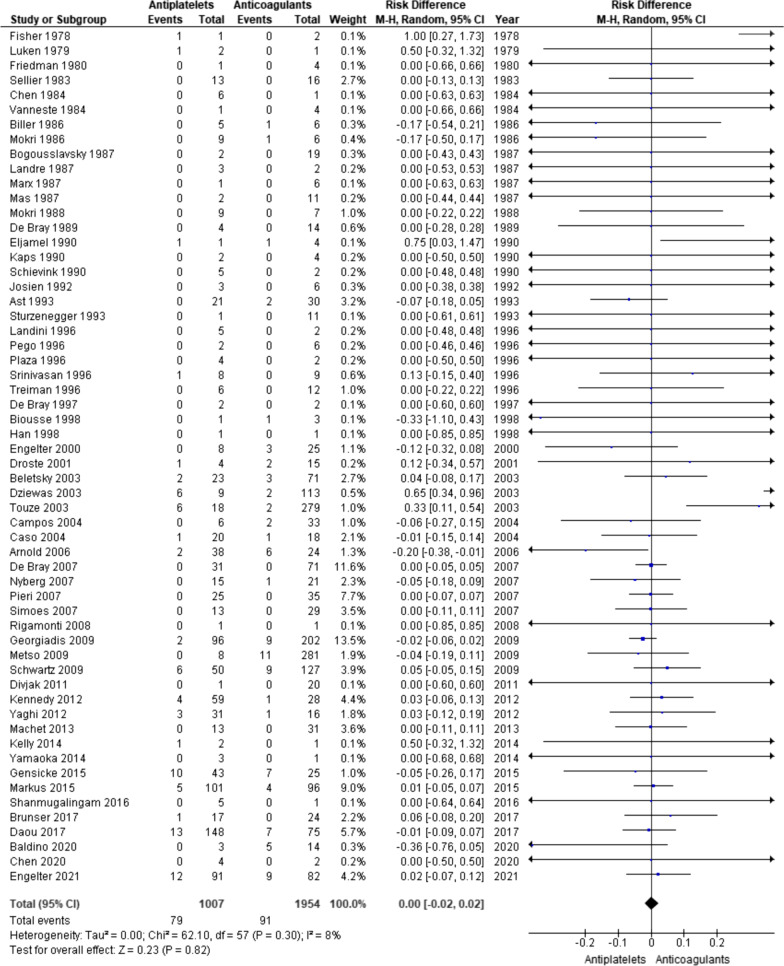
Two RCTs and 64 observational studies were included in the meta-analysis. While the outcome measures of stroke, stroke or TIA and death were numerically higher with antiplatelet use, there were no statistically significant differences between antiplatelets and anticoagulants.
We found no significant difference between antiplatelet and anticoagulation treatment after extracranial artery dissection. The choice of treatment should be tailored to individual cases.
累及颈内动脉或椎动脉的颅外动脉夹层是50岁以下成年人中风的主要原因。对于颅外动脉夹层的治疗,抗血小板药物或抗凝药物哪种更合适,尚无确凿证据。
确定在颅外动脉夹层治疗中,抗血小板药物或抗凝药物在预防复发性缺血事件或死亡的二级预防方面是否优于对方。
本荟萃分析遵循系统评价和荟萃分析的首选报告项目(PRISMA)2020声明。使用预定义的检索策略,从创刊至2021年5月在Medline、Cochrane对照试验中央注册库(CENTRAL)和ClinicalTrials.gov中进行数据库检索。从纳入研究、综述和先前荟萃分析的参考文献列表中识别其他研究。结局指标为缺血性中风、缺血性中风或短暂性脑缺血发作(TIA)以及死亡。
两项随机对照试验和64项观察性研究纳入了荟萃分析。虽然使用抗血小板药物时,中风、中风或TIA以及死亡的结局指标在数值上更高,但抗血小板药物和抗凝药物之间没有统计学上的显著差异。
我们发现颅外动脉夹层后抗血小板治疗和抗凝治疗之间没有显著差异。治疗选择应根据个体情况量身定制。