Pinckaers Hans, van Ipenburg Jolique, Melamed Jonathan, De Marzo Angelo, Platz Elizabeth A, van Ginneken Bram, van der Laak Jeroen, Litjens Geert
Department of Pathology, Radboud Institute for Health Sciences, Radboud University Medical Center, Nijmegen, The Netherlands.
Department of Pathology, New York University Langone Medical Center, New York, NY USA.
Commun Med (Lond). 2022 Jun 8;2:64. doi: 10.1038/s43856-022-00126-3. eCollection 2022.
The first sign of metastatic prostate cancer after radical prostatectomy is rising PSA levels in the blood, termed biochemical recurrence. The prediction of recurrence relies mainly on the morphological assessment of prostate cancer using the Gleason grading system. However, in this system, within-grade morphological patterns and subtle histopathological features are currently omitted, leaving a significant amount of prognostic potential unexplored.
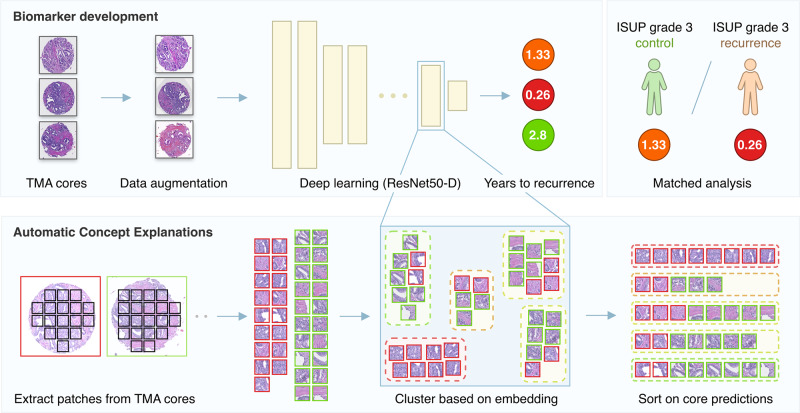
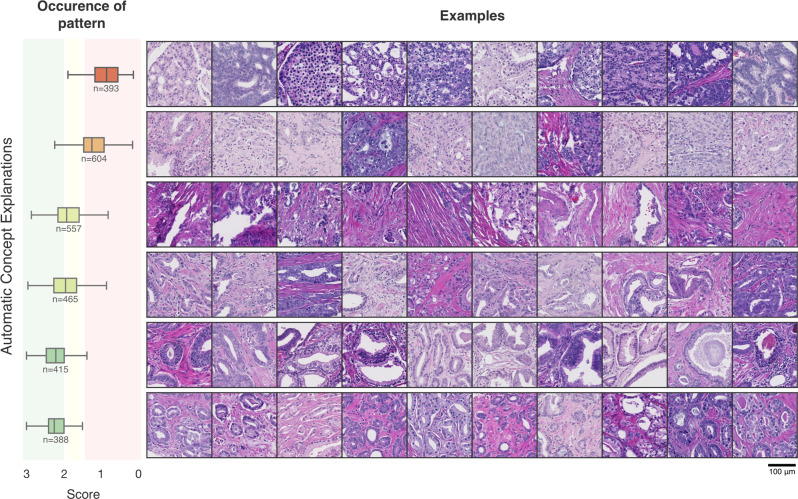
To discover additional prognostic information using artificial intelligence, we trained a deep learning system to predict biochemical recurrence from tissue in H&E-stained microarray cores directly. We developed a morphological biomarker using convolutional neural networks leveraging a nested case-control study of 685 patients and validated on an independent cohort of 204 patients. We use concept-based explainability methods to interpret the learned tissue patterns.
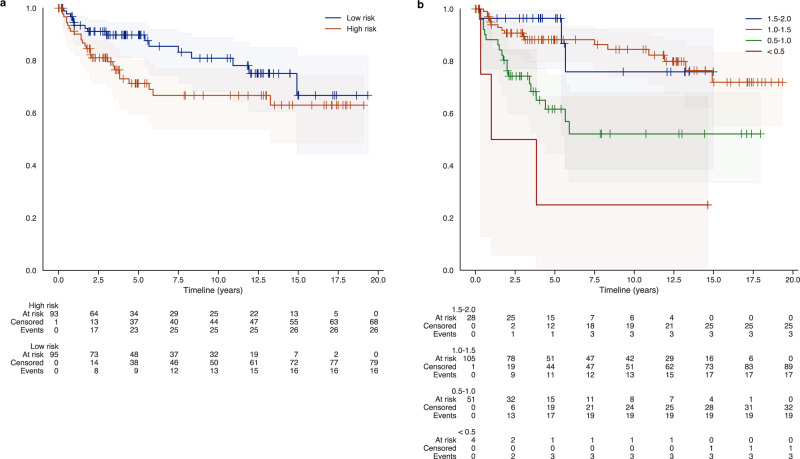
The biomarker provides a strong correlation with biochemical recurrence in two sets ( = 182 and = 204) from separate institutions. Concept-based explanations provided tissue patterns interpretable by pathologists.
These results show that the model finds predictive power in the tissue beyond the morphological ISUP grading.
根治性前列腺切除术后转移性前列腺癌的首个迹象是血液中前列腺特异性抗原(PSA)水平升高,即生化复发。复发的预测主要依赖于使用 Gleason 分级系统对前列腺癌进行形态学评估。然而,在该系统中,目前忽略了分级内的形态学模式和细微的组织病理学特征,大量的预后潜力尚未得到探索。
为了利用人工智能发现更多的预后信息,我们训练了一个深度学习系统,直接从苏木精和伊红(H&E)染色的微阵列芯片组织中预测生化复发。我们利用对685例患者的巢式病例对照研究,通过卷积神经网络开发了一种形态学生物标志物,并在204例患者的独立队列中进行了验证。我们使用基于概念的可解释性方法来解释所学习到的组织模式。
该生物标志物与来自不同机构的两组(n = 182和n = 204)生化复发具有强相关性。基于概念的解释提供了病理学家可解释的组织模式。
这些结果表明,该模型在组织中发现了超出形态学国际泌尿病理学会(ISUP)分级的预测能力。