Baker Heart and Diabetes Institute, Melbourne, Victoria, Australia.
School of Public Health and Preventive Medicine, Monash University, Melbourne, Victoria, Australia.
Diabet Med. 2022 Sep;39(9):e14898. doi: 10.1111/dme.14898. Epub 2022 Jun 20.
It is unknown how use of newer glucose-lowering drugs (GLDs) has changed in Australia following the publication of clinical trials demonstrating definitive clinical advantages for glucagon-like peptide-1 receptor agonists (GLP-1 RAs) and sodium-glucose co-transporter 2 inhibitors (SGLT2is), and whether this varies by socio-economic disadvantage.
We included 1,064,645 people with type 2 diabetes registered on the National Diabetes Services Scheme. This cohort was linked to the Pharmaceutical Benefits Scheme database to evaluate trends in diabetes medication receipt and variation by socio-economic disadvantage between 2013 and 2019.
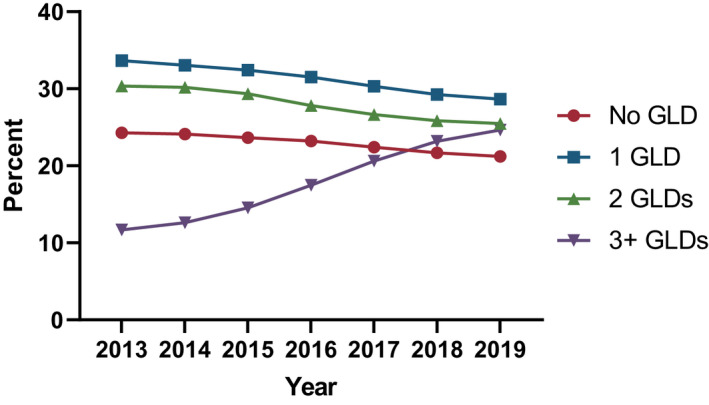
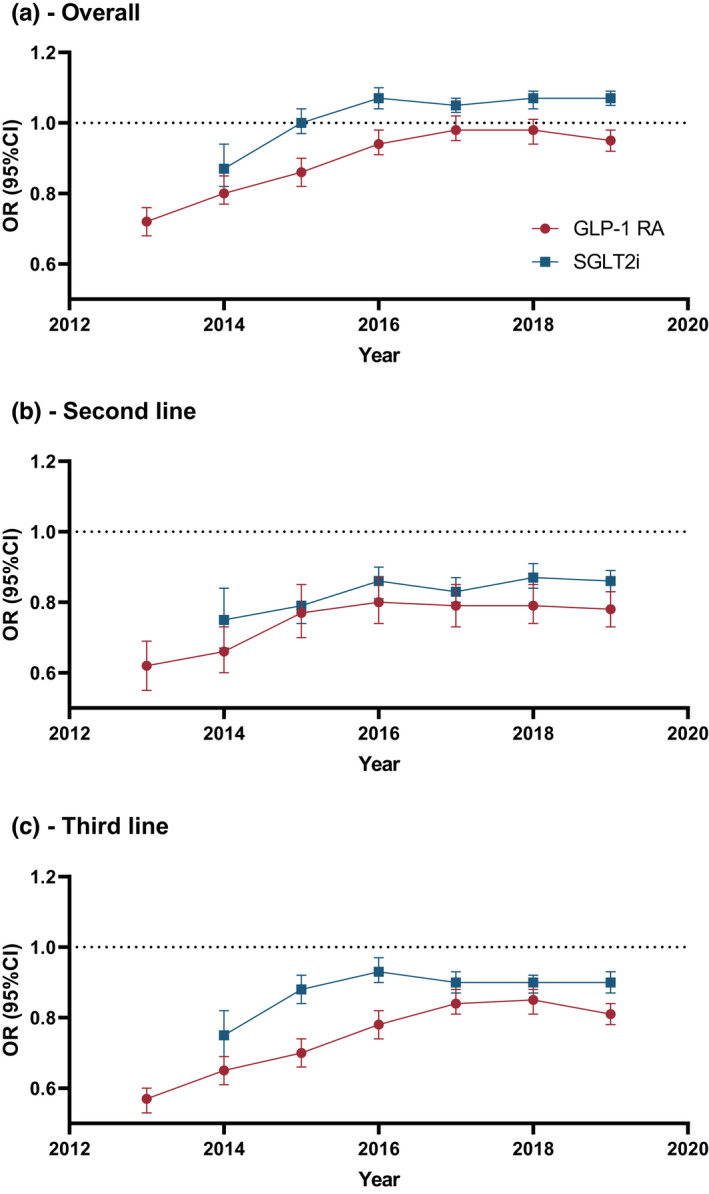
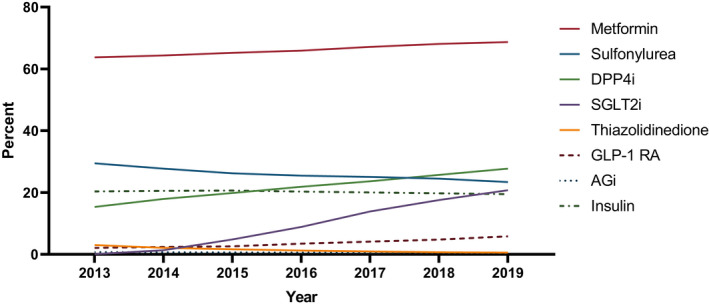
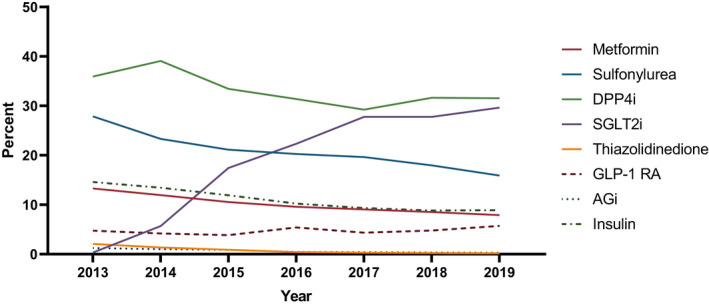
The proportion of people with type 2 diabetes receiving ≥3 GLDs concurrently increased from 12% in 2013 to 25% in 2019. By 2019, 6% of people with diabetes were receiving a GLP-1 RA and 21% an SGLT2i. Disparities in receipt of GLP-1 RAs and SGLT2is by socio-economic disadvantage decreased over time (ORs for most vs. least disadvantaged quintile were 0.80 [0.77-0.85] and 0.87 [0.82-0.94] in 2014 and 0.95 [0.92-0.98] and 1.07 [1.05-1.09] in 2019 for GLP-1 RAs and SGLT2is, respectively). However, people in more disadvantaged areas were more likely to receive multiple GLDs. After stratifying by number of concurrent GLDs received, people in more disadvantaged areas were less likely to receive GLP-1 RAs and SGLT2is in 2019 (ORs for most vs. least disadvantaged: 0.81 [0.78-0.84] and 0.90 [0.87-0.93] for people receiving ≥3 GLDs, respectively).
After controlling for intensity of glucose-lowering therapy, people in more disadvantaged areas were less likely to receive cardioprotective GLDs, although disparities decreased over time.
在临床试验证明胰高血糖素样肽-1 受体激动剂(GLP-1 RAs)和钠-葡萄糖共转运蛋白 2 抑制剂(SGLT2is)具有明确的临床优势后,澳大利亚新型降糖药物(GLDs)的使用情况发生了怎样的变化尚不清楚,且这种变化是否因社会经济劣势而有所不同。
我们纳入了 1064645 名在国家糖尿病服务计划注册的 2 型糖尿病患者。该队列与药品福利计划数据库相关联,以评估 2013 年至 2019 年期间糖尿病药物接受情况的趋势以及社会经济劣势的变化。
同时接受≥3 种 GLDs 治疗的 2 型糖尿病患者比例从 2013 年的 12%增加到 2019 年的 25%。到 2019 年,6%的糖尿病患者接受 GLP-1 RA 治疗,21%的患者接受 SGLT2i 治疗。随着时间的推移,GLP-1 RA 和 SGLT2is 治疗的社会经济劣势接受率差异逐渐缩小(2014 年,与最不具优势的五分位数相比,最具优势五分位数的比值分别为 0.80 [0.77-0.85]和 0.87 [0.82-0.94],2019 年为 0.95 [0.92-0.98]和 1.07 [1.05-1.09])。然而,处于更不利地区的人更有可能同时接受多种 GLDs 治疗。按同时接受 GLDs 的数量分层后,2019 年处于更不利地区的人更不可能接受 GLP-1 RA 和 SGLT2is 治疗(最具优势五分位数与最不具优势五分位数的比值:同时接受≥3 种 GLDs 的患者分别为 0.81 [0.78-0.84]和 0.90 [0.87-0.93])。
在控制了降糖治疗强度后,处于更不利地区的人更不可能接受心脏保护型 GLD 治疗,尽管这种差异随着时间的推移而缩小。