School of Life Sciences, Ulsan National Institute of Science and Technology (UNIST), Ulsan, South Korea.
Microbiol Spectr. 2022 Jun 29;10(3):e0082522. doi: 10.1128/spectrum.00825-22. Epub 2022 Jun 13.
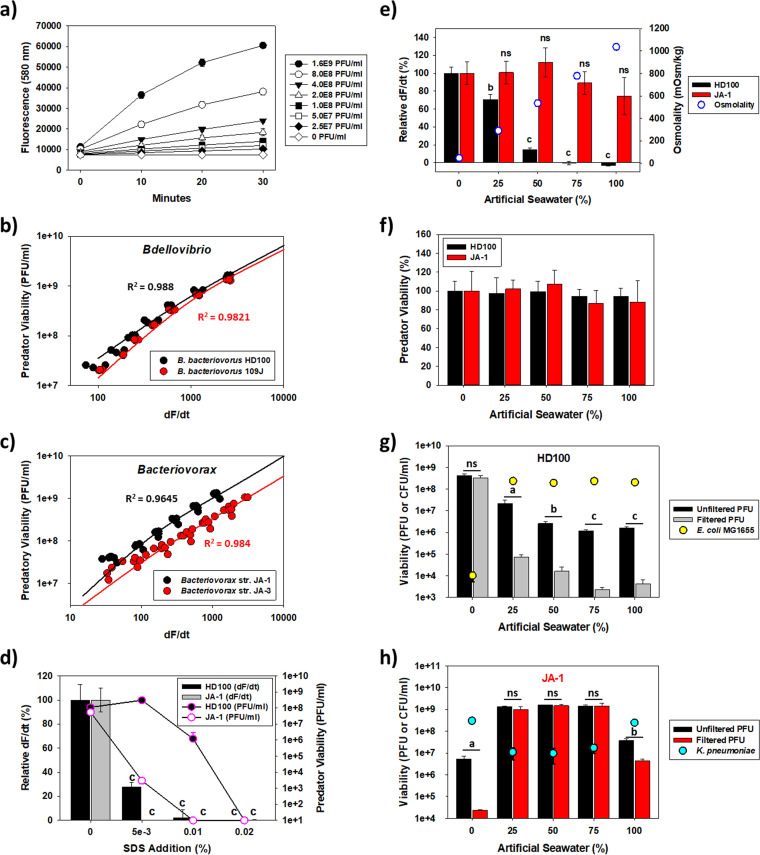
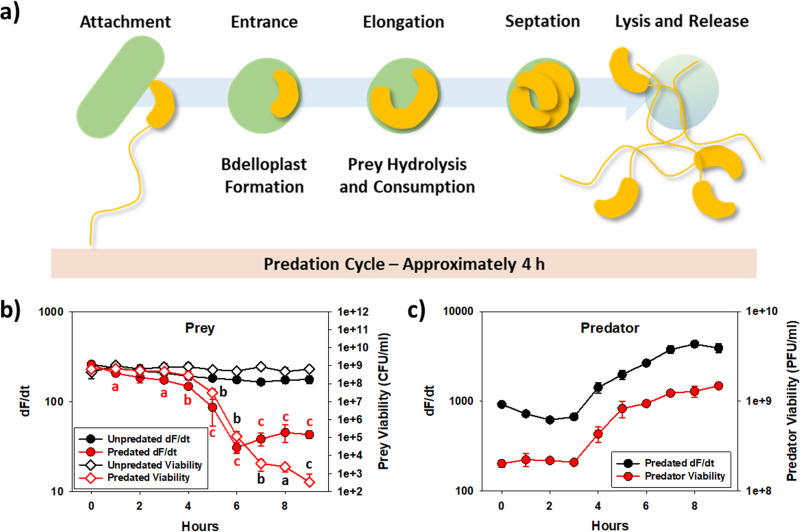
A method to rapidly quantify predatory bacterial cell populations using resazurin reduction to resorufin and its resulting fluorescence kinetics (dF/dt) are described. The reliability of this method to measure the predatory populations was demonstrated with the type strain, Bdellovibrio bacteriovorus HD100, as well as B. bacteriovorus 109J and two natural isolates, strains JA-1 and JA-3, with clear correlation when densities were between 10 and 10 PFU/ml. Resazurin was also used to evaluate how B. bacteriovorus HD100 and strain JA-1 respond to harmful conditions, i.e., exposure to sodium dodecyl sulfate (SDS), with both the dF/dt and PFU/ml indicating strain JA-1 is more sensitive to this surfactant. Tests were also performed using media of different osmolalities, with the dF/dt values matching the 24-h predatory activities reasonably well. Finally, this method was successfully applied in near real-time analyses of predator-prey dynamics and, when coupled with SDS, was capable of differentiating between the predatory and prey populations. All of these tests serve to prove this method is (i) very rapid, needing only 15 min from start to finish; (ii) very reliable with different predatory bacterial species; and (iii) very versatile as it can be easily adapted to measure predatory numbers and activities in a range of experiments. and like organisms are predatory bacteria that are capable of attacking, killing, and consuming many bacterial pathogens, including multidrug-resistant strains. These qualities have led to them being labeled as "living antibiotics." Research work with these remarkable strains, however, has been hampered by long growth times needed to quantify the predatory populations through plaque assays, which typically take 4 days to develop. Here, we describe a fluorescence-based method using the conversion of resazurin (low fluorescence) to resorufin (high fluorescence) after it is reduced by the predators' NADH. Not only do we show that the fluorescence correlates strongly with the predatory concentration and that we can use it to evaluate if the predators are viable, but the entire procedure from start to finish takes only 15 min, drastically reducing the time researchers need to quantify the predatory numbers. Employing this technique will greatly advance research related to predatory bacteria and their potential applications.
本文描述了一种使用 Resazurin 还原为 Resorufin 及其荧光动力学(dF/dt)快速定量捕食性细菌细胞群体的方法。通过使用模式菌株 Bdellovibrio bacteriovorus HD100 以及 B. bacteriovorus 109J 和两个天然分离株,菌株 JA-1 和 JA-3,证明了该方法测量捕食种群的可靠性,当密度在 10 到 10 PFU/ml 之间时,相关性非常明显。Resazurin 还用于评估 B. bacteriovorus HD100 和菌株 JA-1 如何应对有害条件,例如暴露于十二烷基硫酸钠(SDS),dF/dt 和 PFU/ml 都表明菌株 JA-1 对这种表面活性剂更敏感。还使用不同渗透压的培养基进行了测试,dF/dt 值与 24 小时捕食活性相当吻合。最后,该方法成功应用于捕食者-猎物动力学的实时分析,并且与 SDS 结合使用时,能够区分捕食者和猎物群体。所有这些测试都证明该方法(i)非常快速,从开始到结束只需要 15 分钟;(ii)非常可靠,适用于不同的捕食性细菌物种;(iii)非常通用,因为它可以很容易地适应测量一系列实验中的捕食者数量和活动。与 like 生物体一样,它们是能够攻击、杀死和消耗许多细菌病原体的捕食性细菌,包括多药耐药株。这些特性使它们被标记为“活体抗生素”。然而,由于通过菌斑测定法量化捕食种群所需的生长时间较长,这些卓越菌株的研究工作受到了阻碍,通常需要 4 天才能发展。在这里,我们描述了一种基于荧光的方法,该方法使用 Resazurin(低荧光)在被捕食者的 NADH 还原后转化为 Resorufin(高荧光)。我们不仅表明荧光与捕食浓度密切相关,并且可以使用它来评估捕食者是否具有活力,而且从开始到结束的整个过程仅需 15 分钟,大大减少了研究人员量化捕食者数量所需的时间。采用这项技术将极大地推动与捕食性细菌及其潜在应用相关的研究。