Center for Sickle Cell Disease, University of Tennessee Health Scienter Center, Memphis, TN.
Department of Mathematics and Statistics, University of North Carolina at Charlotte, Charlotte, NC.
Blood Adv. 2022 Aug 9;6(15):4461-4470. doi: 10.1182/bloodadvances.2022007693.
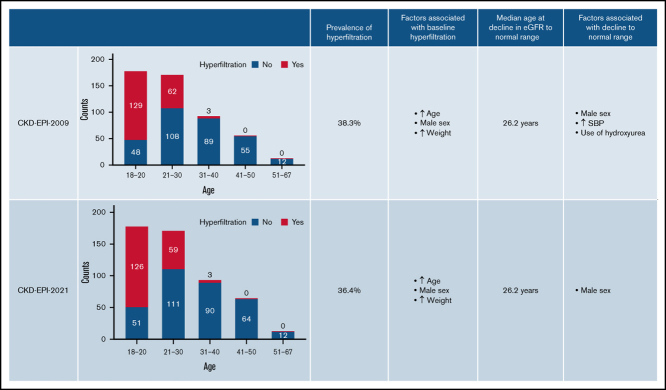
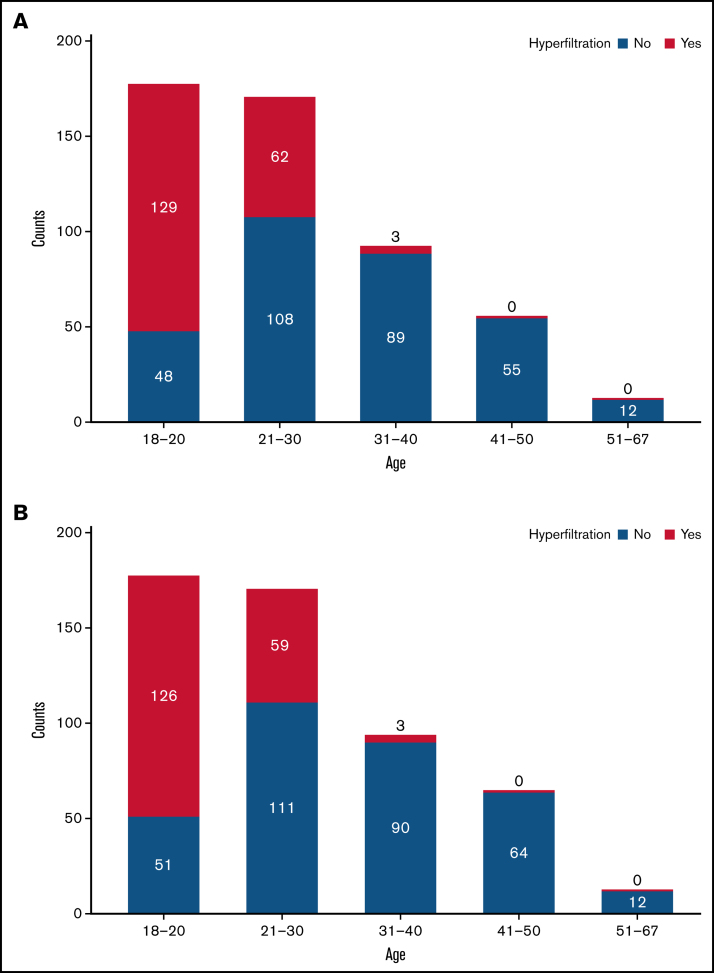
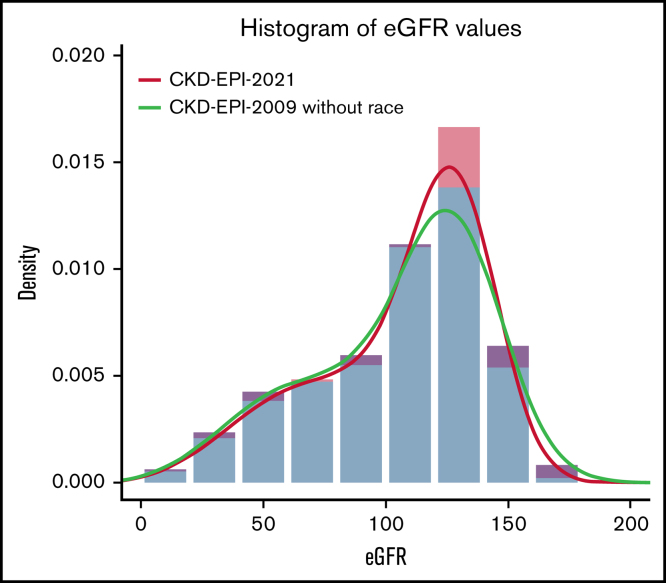
Glomerular hyperfiltration is common in young sickle cell anemia patients and precedes development of overt kidney disease. In this multicenter pooled cohort, we characterized hyperfiltration and its decline to normal range in adult patients. Glomerular filtration rate (GFR) was estimated using the creatinine-based 2009 CKD-EPI (Chronic Kidney Disease Epidemiology Collaboration) equation omitting race adjustment and the 2021 CKD-EPI equation. Using CKD-EPI-2009, 506 patients had baseline estimated GFR (eGFR) ≥90 mL/min per 1.73 m2, median age of 24 (interquartile range [IQR], 19-34) years and 5.17 years of follow-up. The prevalence of hyperfiltration (eGFR ≥140 and ≥130 mL/min per 1.73 m2 for men and women, respectively) was 38.3%. Using CKD-EPI-2009, baseline hyperfiltration was less likely with older age (odds ratio [OR], 0.78; 95% confidence interval [CI], 0.73-0.83; P < .0001), male sex (OR, 0.32; 95% CI, 0.18-0.58; P = .0002), and higher weight (OR, 0.96; 95% CI, 0.94-0.99; P = .001). Using CKD-EPI-2021, hyperfiltration was similarly less likely with older age (OR, 0.75; 95% CI, 0.70-0.81; P < .0001), male sex (OR, 0.24; 95% CI, 0.13-0.44; P < .0001), and higher weight (OR, 0.97; 95% CI, 0.95-0.99; P = .004). In patients with baseline hyperfiltration, eGFR declined to normal values at a median age of 26.2 years. Using CKD-EPI-2009, this decline was associated with male sex (HR, 2.20; 95% CI, 1.26-3.87; P = .006), systolic blood pressure (hazard ratio [HR], 1.02; 95% CI, 1.01-1.04; P = .01), and hydroxyurea use (HR, 1.74; 95% CI, 1.002-3.03; P = .05). Using CKD-EPI-2021, decline of eGFR to normal was only associated with male sex (HR, 3.39; 95% CI, 2.01-5.69; P < .0001). Decline to normal eGFR range from hyperfiltration occurs earlier in males, those on hydroxyurea, and with higher systolic blood pressure.
肾小球高滤过在年轻的镰状细胞贫血患者中很常见,并且先于明显的肾脏疾病发生。在这项多中心队列研究中,我们描述了成年患者的高滤过及其向正常范围的下降。使用基于肌酐的 2009 年 CKD-EPI(慢性肾脏病流行病学合作)方程(不包括种族调整)和 2021 年 CKD-EPI 方程估计肾小球滤过率(GFR)。使用 CKD-EPI-2009,506 名患者基线估计肾小球滤过率(eGFR)≥90 mL/min/1.73 m2,中位年龄为 24 岁(四分位距 [IQR],19-34),随访时间为 5.17 年。高滤过(eGFR≥140 和≥130 mL/min/1.73 m2 分别为男性和女性)的患病率为 38.3%。使用 CKD-EPI-2009,年龄较大(比值比 [OR],0.78;95%置信区间 [CI],0.73-0.83;P<0.0001)、男性(OR,0.32;95%CI,0.18-0.58;P=0.0002)和体重较高(OR,0.96;95%CI,0.94-0.99;P=0.001)的患者更不可能出现基线高滤过。使用 CKD-EPI-2021,年龄较大(OR,0.75;95%CI,0.70-0.81;P<0.0001)、男性(OR,0.24;95%CI,0.13-0.44;P<0.0001)和体重较高(OR,0.97;95%CI,0.95-0.99;P=0.004)的患者也更不可能出现高滤过。在基线高滤过的患者中,eGFR 在中位年龄为 26.2 岁时降至正常值。使用 CKD-EPI-2009,这种下降与男性(HR,2.20;95%CI,1.26-3.87;P=0.006)、收缩压(HR,1.02;95%CI,1.01-1.04;P=0.01)和使用羟基脲(HR,1.74;95%CI,1.002-3.03;P=0.05)相关。使用 CKD-EPI-2021,eGFR 降至正常值仅与男性相关(HR,3.39;95%CI,2.01-5.69;P<0.0001)。高滤过向正常 eGFR 范围的下降在男性、使用羟基脲和收缩压较高的患者中更早发生。