Cardiovascular Research Institute Maastricht, Department of Biochemistry, Maastricht University, Maastricht, The Netherlands.
Synapse Research Institute, Maastricht, The Netherlands.
BMC Cancer. 2022 Jun 13;22(1):653. doi: 10.1186/s12885-022-09676-0.
Tyrosine kinase inhibitors (TKIs), such as sunitinib, are used for cancer treatment, but may also affect platelet count and function with possible hemostatic consequences. Here, we investigated whether patient treatment with the TKI sunitinib affected quantitative and qualitative platelet traits as a function of the sunitinib level and the occurrence of bleeding.
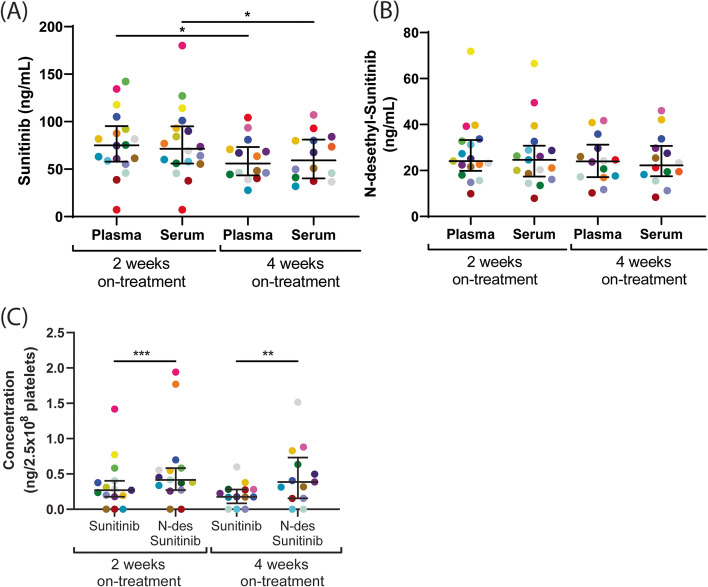
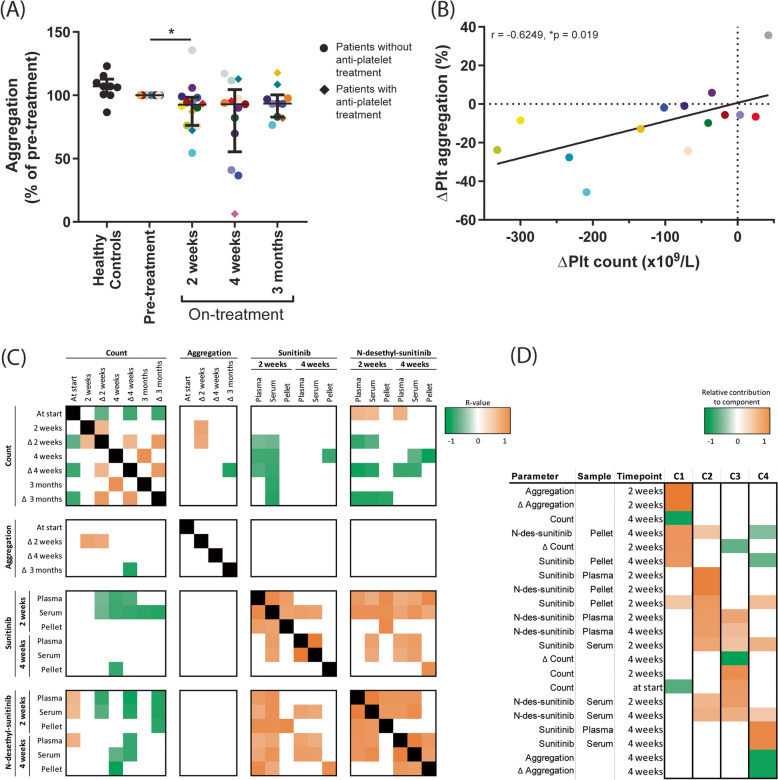
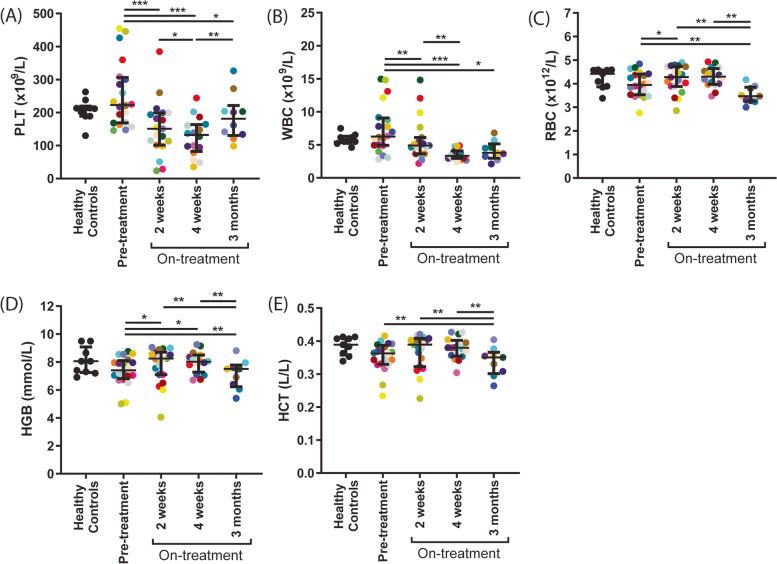
Blood was collected from 20 metastatic renal cell carcinoma (mRCC) patients before treatment, and at 2 weeks, 4 weeks and 3 months after sunitinib administration. We measured blood cell counts, platelet aggregation, and concentrations of sunitinib as well as its N-desethyl metabolite in plasma, serum and isolated platelets. Progression of disease (PD) and bleeding were monitored after 3 months.
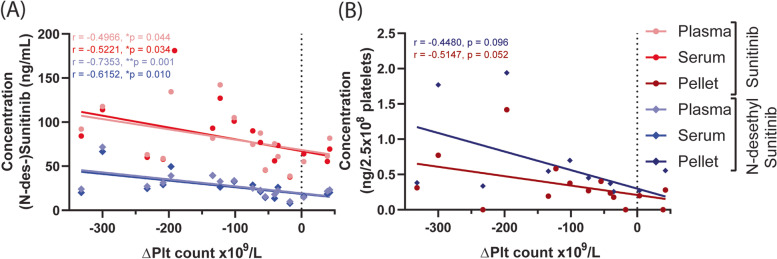
In sunitinib-treated mRCC patients, concentrations of (N-desethyl-)sunitinib in plasma and serum were highly correlated. In the patients' platelets the active metabolite levels were relatively increased as compared to sunitinib. On average, a sustained reduction in platelet count was observed on-treatment, which was significantly related to the inhibitor levels in plasma/serum. Principal component and correlational analysis showed that the (N-desethyl-)sunitinib levels in plasma/serum were linked to a reduction in both platelet count and collagen-induced platelet aggregation. The reduced aggregation associated in part with reported bleeding, but did not correlate to PD.
The sunitinib-induced reduction in quantitative and qualitative platelet traits may reflect the effective sunitinib levels in the patient. These novel results may serve as a proof-of-principle for other TKI-related drugs, where both platelet count and functions are affected, which could be used for therapeutic drug monitoring.
酪氨酸激酶抑制剂(TKIs),如舒尼替尼,被用于癌症治疗,但也可能影响血小板计数和功能,从而产生止血后果。在这里,我们研究了 TKI 舒尼替尼治疗患者是否会影响血小板的数量和质量特征,这些特征与舒尼替尼水平和出血的发生有关。
采集 20 例转移性肾细胞癌(mRCC)患者治疗前、舒尼替尼给药后 2 周、4 周和 3 个月的血液。我们测量了血细胞计数、血小板聚集以及血浆、血清和分离血小板中舒尼替尼及其 N-去乙基代谢物的浓度。在 3 个月后监测疾病进展(PD)和出血情况。
在舒尼替尼治疗的 mRCC 患者中,(N-去乙基)舒尼替尼在血浆和血清中的浓度高度相关。在患者的血小板中,活性代谢物的水平相对增加。治疗期间平均观察到血小板计数持续减少,这与抑制剂在血浆/血清中的水平显著相关。主成分和相关分析表明,血浆/血清中的(N-去乙基)舒尼替尼水平与血小板计数和胶原诱导的血小板聚集减少有关。这种减少的聚集部分与报道的出血有关,但与 PD 无关。
舒尼替尼引起的血小板数量和质量特征的减少可能反映了患者中有效舒尼替尼的水平。这些新的结果可能为其他受 TKI 影响的药物提供原理证明,这些药物会影响血小板计数和功能,可用于治疗药物监测。