School of Psychological Sciences, Tel-Aviv University, Tel-Aviv, Israel.
Sagol Brain Institute, Tel-Aviv Sourasky Medical Center, Tel-Aviv, Israel.
Psychol Med. 2023 Jul;53(10):4569-4579. doi: 10.1017/S0033291722001453. Epub 2022 Jun 14.
Negative self-views, especially in the domain of power (i.e. social-rank), characterize social anxiety (SA). Neuroimaging studies on self-evaluations in SA have mainly focused on subcortical threat processing systems. Yet, self-evaluation may concurrently invoke diverse affective processing, as motivational systems related to desired self-views may also be activated. To investigate the conflictual nature that may accompany self-evaluation of certain social domains in SA, we examined brain activity related to both threat and reward processing.
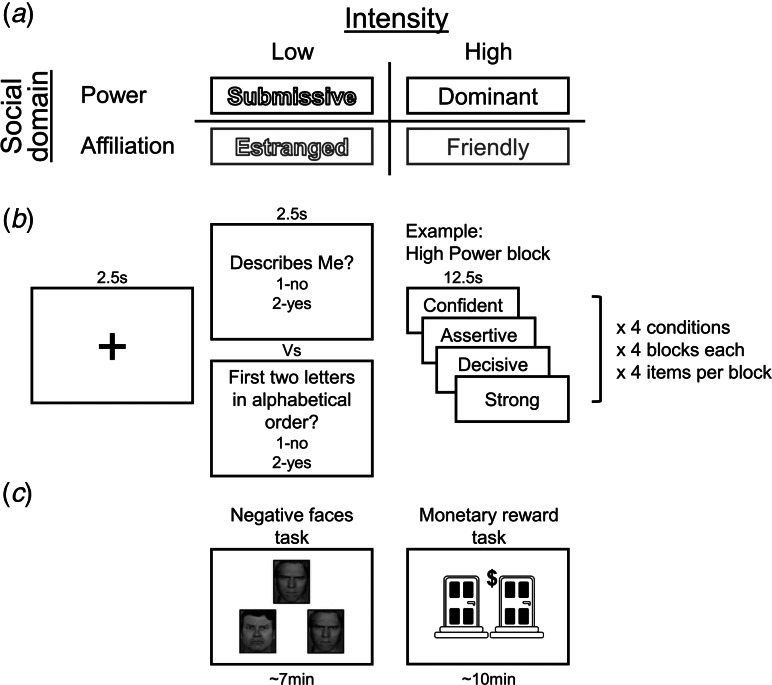
Participants ( = 74) differing in self-reported SA-severity underwent fMRI while completing a self-evaluation task, wherein they judged the self-descriptiveness of high- low-intensity traits in the domains of power and affiliation (i.e. social connectedness). Participants also completed two auxiliary fMRI tasks designated to evoke reward- and threat-related activations in the ventral striatum (VS) and amygdala, respectively. We hypothesized that self-evaluations in SA, particularly in the domain of power, involve aberrant brain activity related to both threat and reward processing.
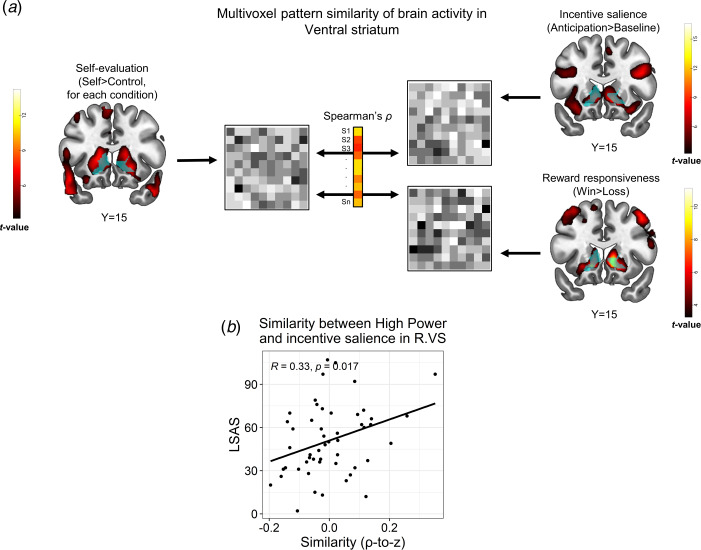
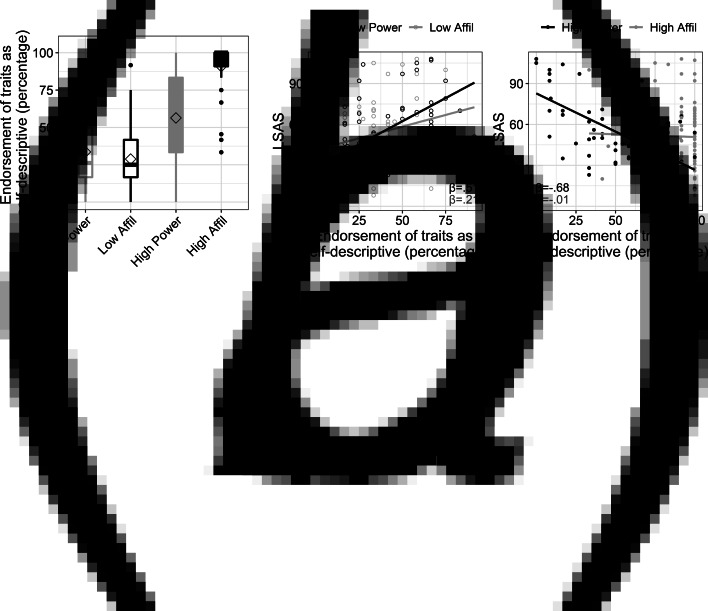
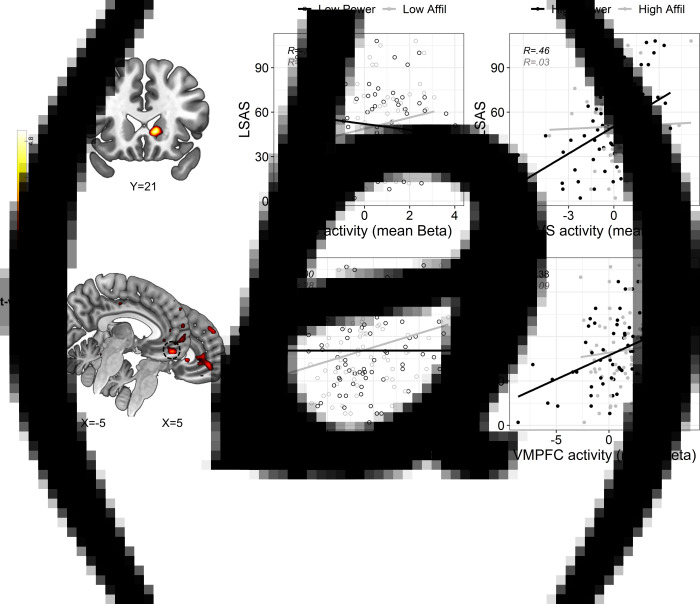
SA-severity was more negatively associated with power than with affiliation self-evaluations. During self-evaluative judgment of high-power (e.g. dominant), SA-severity associated with increased activity in the VS and ventromedial prefrontal cortex. Moreover, SA-severity correlated with higher similarity between brain activity patterns activated by high-power traits and patterns activated by incentive salience (i.e. reward anticipation) in the VS during the reward task.
Our findings indicate that self-evaluation of high-power in SA involves excessive striatal reward-related activation, and pinpoint the downregulation of VS-VMPFC activity within such self-evaluative context as a potential neural outcome for therapeutic interventions.
消极的自我评价,尤其是在权力领域(即社会等级),是社交焦虑(SA)的特征。SA 中自我评估的神经影像学研究主要集中在下丘脑的威胁处理系统上。然而,自我评估可能同时引发多种情感处理,因为与理想自我形象相关的动机系统也可能被激活。为了研究 SA 中某些社会领域自我评估可能伴随的冲突性质,我们研究了与威胁和奖励处理相关的大脑活动。
参与者(n = 74)根据自我报告的 SA 严重程度不同,在完成自我评估任务时接受 fMRI 检查,在该任务中,他们判断高、低强度特质在权力和亲和领域(即社会联系)中的自我描述性。参与者还完成了两个辅助 fMRI 任务,分别旨在诱发腹侧纹状体(VS)和杏仁核的奖励和威胁相关激活。我们假设,SA 中的自我评估,特别是在权力领域,涉及与威胁和奖励处理相关的异常大脑活动。
SA 严重程度与权力自我评估的相关性比亲和自我评估更负相关。在高权力(例如支配性)特质的自我评估判断中,SA 严重程度与 VS 和腹内侧前额叶皮质的活动增加相关。此外,SA 严重程度与 VS 中高权力特质激活的大脑活动模式与激励显著性(即奖励预期)激活的大脑活动模式之间的相似性增加相关。
我们的研究结果表明,SA 中高权力的自我评估涉及过度的纹状体奖励相关激活,并指出在这种自我评估背景下,VS-VMPFC 活动的下调可能是治疗干预的潜在神经结果。