Albana Rifki, Prasetia Renaldi, Primadhi Andri, Rahim Agus Hadian, Ismiarto Yoyos Dias, Rasyid Hermawan Nagar
Department of Orthopaedics-Traumatology, Faculty of Medicine, Universitas Padjadjaran, Hasan Sadikin General Hospital, 40161 Bandung, Indonesia.
SICOT J. 2022;8:25. doi: 10.1051/sicotj/2022026. Epub 2022 Jun 14.
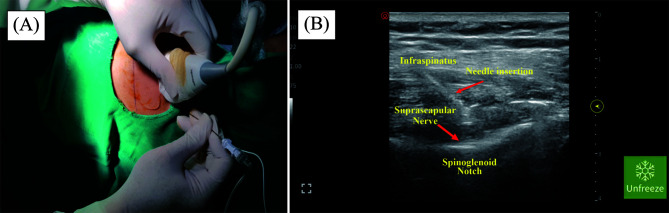
Frozen shoulder is a debilitating problem that requires comprehensive diagnosis and management. Patients usually recover, but the possibility of not reobtaining a full range of motion exists. Thus, early shoulder exercises are necessary to achieve their full range of motion. This study aims to understand the effects of suprascapular nerve block (SSNB) augmentation at the spinoglenoid notch in hydrodilatation to treat frozen shoulder to facilitate early shoulder exercises.
The current study retrospectively observed 31 patients, including 40-60-year-old patients diagnosed and treated with primary frozen shoulder. The participants were divided into groups A (hydrodilatation) and B (hydrodilatation and the augmentation of an SSNB). Shoulder function and pain scores were assessed before, during, and after the intervention (at months 1 and 6).
The result of this study shows that suprascapular nerve block plays a role in decreasing pain in intraintervention (0.69 vs. 5.73; p < 0.05), month 1 of follow-up (3.44 vs. 6.40; p < 0.05), but not significant on month 6 of group A and B after intervention (5.88 vs. 7.20; p > 0.05). Better delta functional scores were noted in the therapy group during month 1 of the follow-up (delta American shoulder and elbow surgeons [ASES]: 19.29 vs. 34.40, p < 0.05; delta disabilities of the arm, shoulder, and hand [DASH]: 17.88 vs. 38.15, p < 0.05). The difference in functional score on month 6 between both groups was not significantly different (delta ASES: 31.97 vs. 30.31, p > 0.05; delta DASH: 36.63 vs. 38.92, p > 0.05).
One rationale for using an SSNB augmentation at spinoglenoid notch in hydrodilatation for treating frozen shoulder was to obtain pain relief immediately to facilitate early manual exercise. SSNB has positive effects on short-term evaluation of shoulder pain and function after glenohumeral hydrodilatation, but not in the long term.
肩周炎是一个使人衰弱的问题,需要全面的诊断和管理。患者通常会康复,但仍存在无法恢复全范围活动的可能性。因此,早期进行肩部锻炼对于实现全范围活动是必要的。本研究旨在了解在关节腔扩张术的同时于肩胛下切迹处进行肩胛上神经阻滞(SSNB)强化治疗肩周炎的效果,以促进早期肩部锻炼。
本研究回顾性观察了31例患者,包括年龄在40至60岁之间、被诊断并接受原发性肩周炎治疗的患者。参与者被分为A组(关节腔扩张术)和B组(关节腔扩张术加SSNB强化)。在干预前、干预期间和干预后(第1个月和第6个月)评估肩部功能和疼痛评分。
本研究结果表明,肩胛上神经阻滞在干预期间(0.69对5.73;p<0.05)、随访第1个月(3.44对6.40;p<0.05)可起到减轻疼痛的作用,但在干预后第6个月,A组和B组之间差异不显著(5.88对7.20;p>0.05)。在随访第1个月时,治疗组的功能评分变化更好(美国肩肘外科医师学会[ASES]评分变化:19.29对34.40,p<0.05;手臂、肩部和手部功能障碍[DASH]评分变化:17.88对38.15,p<0.05)。两组在第6个月时的功能评分差异无统计学意义(ASES评分变化:31.97对30.31,p>0.05;DASH评分变化:36.63对38.92,p>0.05)。
在关节腔扩张术的同时于肩胛下切迹处进行SSNB强化治疗肩周炎的一个基本原理是立即缓解疼痛,以促进早期手法锻炼。SSNB对肩关节腔扩张术后肩部疼痛和功能的短期评估有积极作用,但对长期评估无作用。