Department of Clinical Laboratory, The First Affiliated Hospital of Wenzhou Medical Universitygrid.268099.c; Key Laboratory of Clinical Laboratory Diagnosis and Translational Research of Zhejiang Province, Wenzhou, Zhejiang Province, China.
Department of Medical Lab Science, School of Laboratory Medicine and Life Science, Wenzhou Medical Universitygrid.268099.c, Wenzhou, Zhejiang Province, China.
Microbiol Spectr. 2022 Aug 31;10(4):e0018422. doi: 10.1128/spectrum.00184-22. Epub 2022 Jun 14.
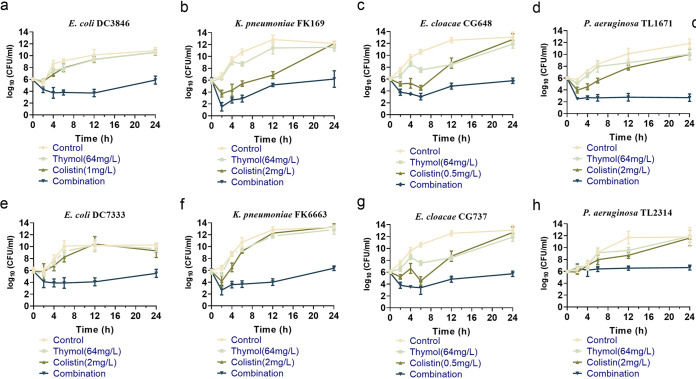
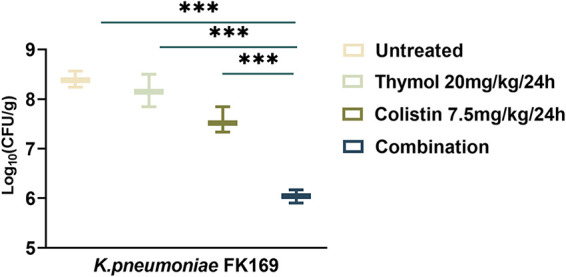
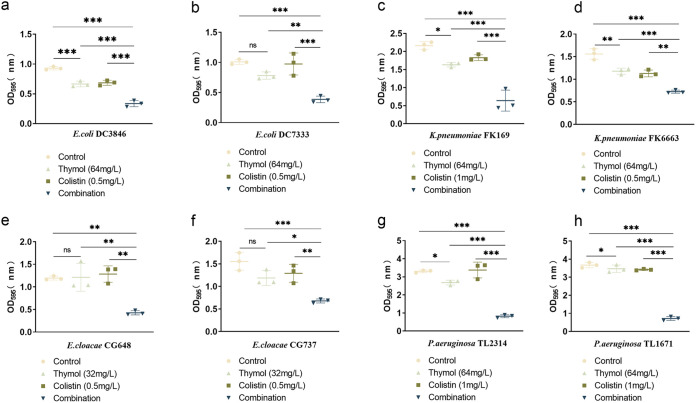
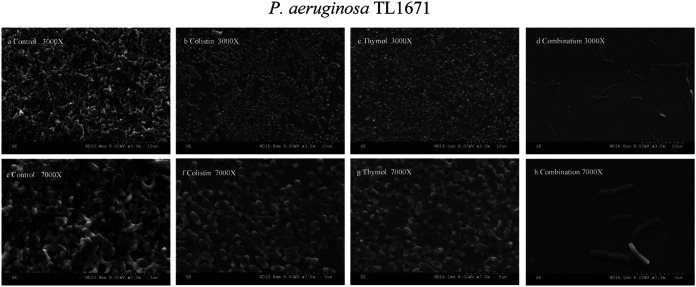
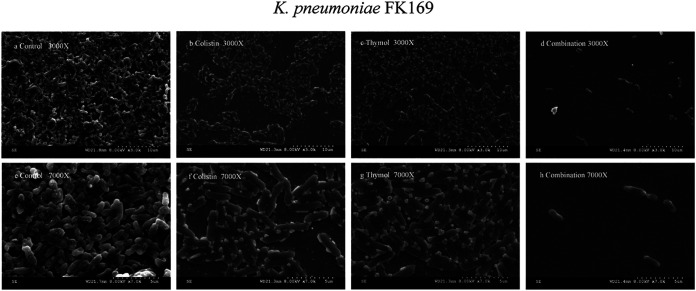
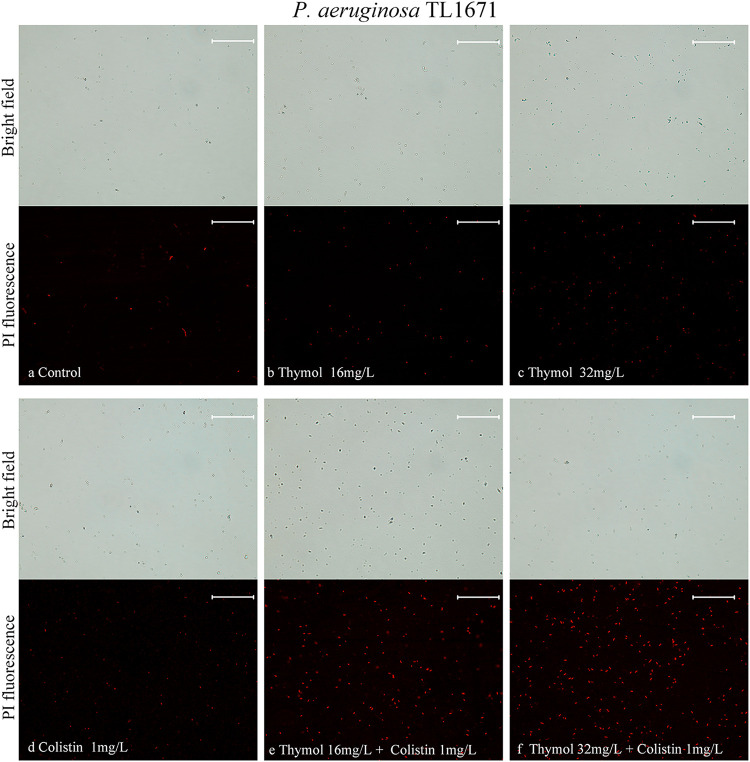
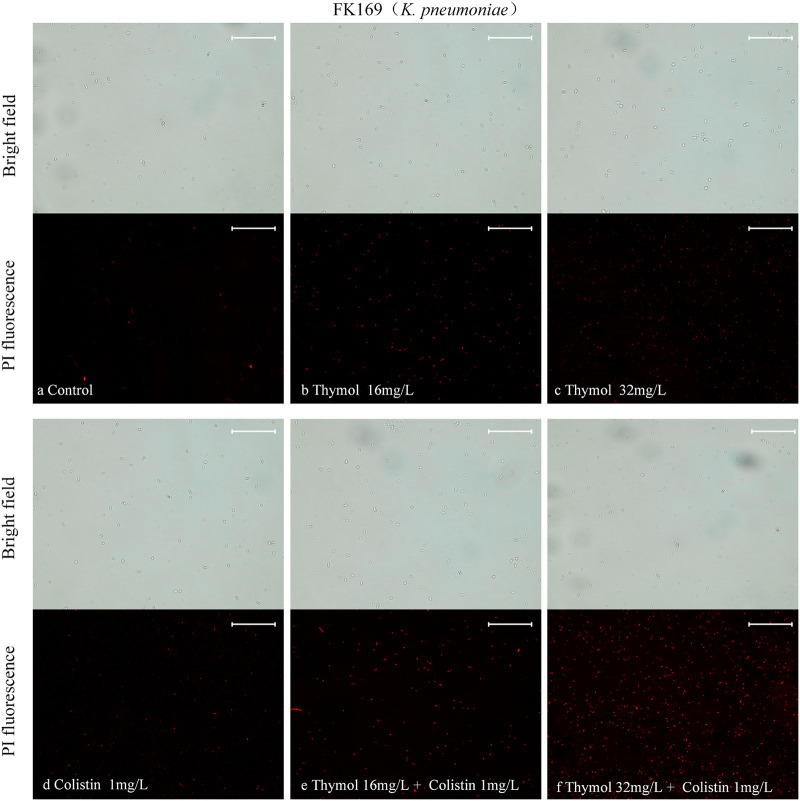
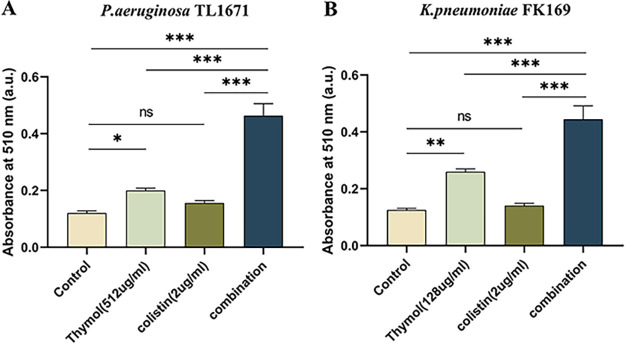
Colistin-resistant (Col-R) bacteria are increasing sharply, which poses a serious threat to public health. Thymol is a phenolic compound used for its wide-spectrum antimicrobial activity, while the combination of nontraditional drugs to restore colistin activity is an attractive strategy to treat infections caused by these pathogens. This study showed that thymol could play a synergistic role with colistin against Gram-negative bacteria (GNB), including nonfermenting bacteria and Enterobacteriaceae. According to antimicrobial resistance profiles, most of the colistin-resistant strains we collected showed multidrug-resistant (MDR) phenotypes. The checkerboard method and time-kill curve confirmed the synergistic effect of thymol combined with colistin against Col-R GNB. The synergistic antibiofilm activity of thymol combined with colistin was assessed via crystal violet staining and scanning electron microscopy (SEM) assays. Results showed that compared with a single drug, the combination partially destroyed bacterial cells and inhibit the formation of bacterial biofilms. Mechanismly, the thymol/colistin combination synergistically potentiated the antibacterial activity by accelerating the damage and permeability of the bacterial outer membrane. Preliminary data indicated that the thymol/colistin combination could decrease the number of bacteria ≥2 log CFU/mL after 24 h of therapy in a mouse thigh infection model. Our results fully prove that thymol and colistin combination possesses a promising treatment option against colistin-resistant GNB infections. Colistin is being considered "the last ditch" treatment in many infections caused by multidrug-resistant GNB clinical isolates, but colistin-resistant (Col-R) strains with different drug resistance mechanisms have appeared worldwide. Hence, it is of great significance to rejuvenate sensitization of clinical Col-R Gram-negative bacteria to colistin. In this study, the thymol/colistin combination showed notable antibacterial activity and . These findings suggest that the thymol/colistin combination may have promise as a treatment approach for treating the infections caused by Col-R pathogens.
耐粘菌素(Col-R)细菌正在急剧增加,这对公众健康构成了严重威胁。百里香酚是一种酚类化合物,因其广谱抗菌活性而被广泛使用,而将非传统药物联合使用以恢复粘菌素活性是治疗这些病原体引起的感染的一种有吸引力的策略。本研究表明,百里香酚可以与粘菌素协同作用,对革兰氏阴性菌(GNB),包括非发酵菌和肠杆菌科发挥作用。根据抗菌药物耐药性谱,我们收集的大多数耐粘菌素菌株均表现出多重耐药(MDR)表型。棋盘法和时间杀伤曲线证实了百里香酚与粘菌素联合使用对 Col-R GNB 的协同作用。通过结晶紫染色和扫描电子显微镜(SEM)实验评估了百里香酚与粘菌素联合使用的协同抗生物膜活性。结果表明,与单一药物相比,联合用药部分破坏了细菌细胞并抑制了细菌生物膜的形成。机制上,百里香酚/粘菌素联合用药通过加速细菌外膜的损伤和通透性来协同增强抗菌活性。初步数据表明,在小鼠大腿感染模型中,联合用药 24 小时后,细菌数量减少了≥2 log CFU/mL。我们的研究结果充分证明,百里香酚和粘菌素联合用药是治疗耐粘菌素革兰氏阴性菌感染的一种有前途的治疗选择。粘菌素在许多由多药耐药革兰氏阴性菌临床分离株引起的感染中被认为是“最后的治疗手段”,但具有不同耐药机制的耐粘菌素(Col-R)菌株已在全球范围内出现。因此,重新激活临床 Col-R 革兰氏阴性菌对粘菌素的敏感性具有重要意义。在这项研究中,百里香酚/粘菌素联合用药表现出显著的抗菌活性。这些发现表明,百里香酚/粘菌素联合用药可能是治疗 Col-R 病原体引起的感染的一种有前途的治疗方法。