Faculty of Biology, University of Duisburg-Essen, Aquatic Ecology, Universitätsstraße 5, Essen, Germany.
Centre for Water and Environmental Research, University Duisburg-Essen, Universitätsstraße 5, Essen, Germany.
PLoS One. 2022 Jun 14;17(6):e0269744. doi: 10.1371/journal.pone.0269744. eCollection 2022.
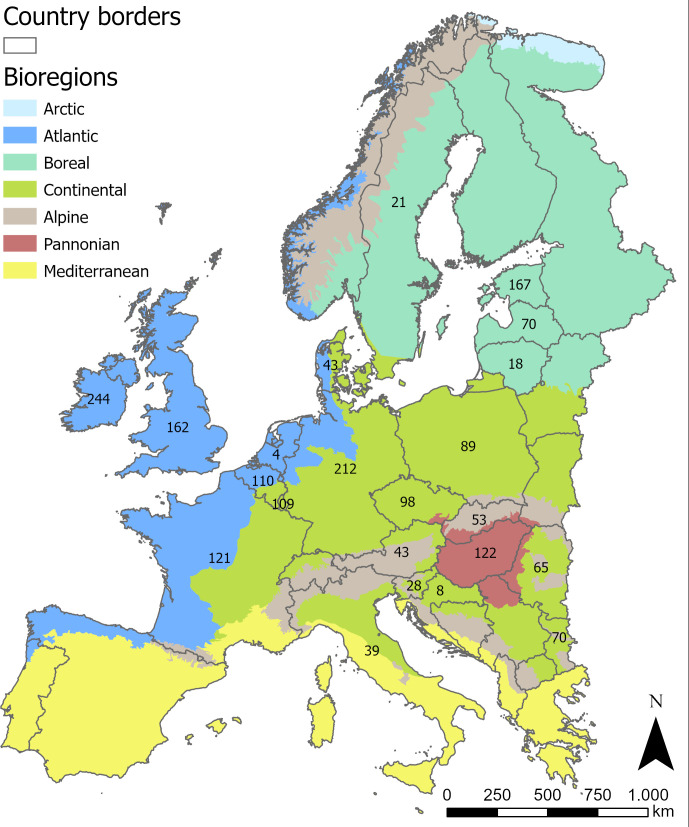
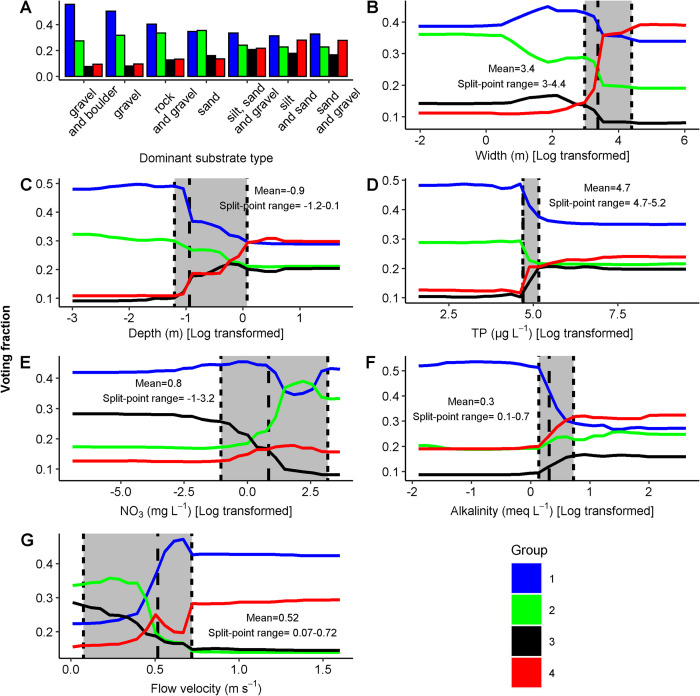
Riverine macrophytes form distinct species groups. Their occurrence is determined by environmental gradients, e.g. in terms of physico-chemistry and hydromorphology. However, the ranges of environmental variables discriminating between species groups ("discriminatory ranges") have rarely been quantified and mainly been based on expert judgement, thus limiting options for predicting and assessing ecosystem characteristics. We used a pan-European dataset of riverine macrophyte surveys obtained from 22 countries including data on total phosphorus, nitrate, alkalinity, flow velocity, depth, width and substrate type. Four macrophyte species groups were identified by cluster analysis based on species' co-occurrences. These comprised Group 1) mosses, such as Amblystegium fluviatile and Fontinalis antipyretica, Group 2) shorter and pioneer species such as Callitriche spp., Group 3) emergent and floating species such as Sagittaria sagittifolia and Lemna spp., and Group 4) eutraphent species such as Myriophyllum spicatum and Stuckenia pectinata. With Random Forest models, the ranges of environmental variables discriminating between these groups were estimated as follows: 100-150 μg L-1 total phosphorus, 0.5-20 mg L-1 nitrate, 1-2 meq L-1 alkalinity, 0.05-0.70 m s-1 flow velocity, 0.3-1.0 m depth and 20-80 m width. Mosses were strongly related to coarse substrate, while vascular plants were related to finer sediment. The four macrophyte groups and the discriminatory ranges of environmental variables fit well with those described in literature, but have now for the first time been quantitatively approximated with a large dataset, suggesting generalizable patterns applicable at regional and local scales.
河流型大型水生植物形成了不同的物种群。它们的出现是由环境梯度决定的,例如理化性质和水力学形态。然而,区分物种群的环境变量范围(“判别范围”)很少被量化,并且主要基于专家判断,从而限制了预测和评估生态系统特征的选择。我们使用了一项来自 22 个国家的河流大型水生植物调查的泛欧数据集,其中包括总磷、硝酸盐、碱度、流速、水深、宽度和基质类型的数据。基于物种共存情况,通过聚类分析确定了四个大型水生植物物种群,分别是:1)莫斯,如 Amblystegium fluviatile 和 Fontinalis antipyretica;2)较短和先锋物种,如 Callitriche spp.;3)挺水和浮叶物种,如 Sagittaria sagittifolia 和 Lemna spp.;4)富营养物种,如 Myriophyllum spicatum 和 Stuckenia pectinata。使用随机森林模型,估计了这些组之间区分的环境变量范围如下:总磷 100-150 μg L-1、硝酸盐 0.5-20 mg L-1、碱度 1-2 meq L-1、流速 0.05-0.70 m s-1、水深 0.3-1.0 m 和宽度 20-80 m。莫斯与粗基质密切相关,而维管束植物与较细的沉积物有关。四个大型水生植物群和环境变量的判别范围与文献中描述的非常吻合,但现在首次使用大数据集进行了定量逼近,表明适用于区域和局部尺度的可推广模式。