CHU Nantes, CNRS, Inserm, l'institut du thorax, Nantes Université, Nantes, France.
CHU Nantes, Inserm CIC 1413, Pôle Hospitalo-Universitaire 11 : Santé Publique, Clinique des données, Nantes, France.
Diabetologia. 2022 Sep;65(9):1436-1449. doi: 10.1007/s00125-022-05734-1. Epub 2022 Jun 15.
AIMS/HYPOTHESIS: Diabetes has been recognised as a pejorative prognostic factor in coronavirus disease 2019 (COVID-19). Since diabetes is typically a disease of advanced age, it remains unclear whether diabetes remains a COVID-19 risk factor beyond advanced age and associated comorbidities. We designed a cohort study that considered age and comorbidities to address this question.
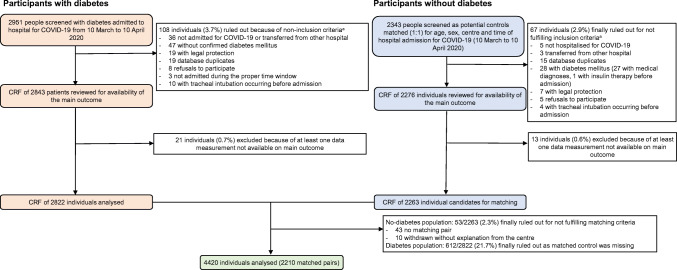
The Coronavirus SARS-CoV-2 and Diabetes Outcomes (CORONADO) initiative is a French, multicentric, cohort study of individuals with (exposed) and without diabetes (non-exposed) admitted to hospital with COVID-19, with a 1:1 matching on sex, age (±5 years), centre and admission date (10 March 2020 to 10 April 2020). Comorbidity burden was assessed by calculating the updated Charlson comorbidity index (uCCi). A predefined composite primary endpoint combining death and/or invasive mechanical ventilation (IMV), as well as these two components separately, was assessed within 7 and 28 days following hospital admission. We performed multivariable analyses to compare clinical outcomes between patients with and without diabetes.
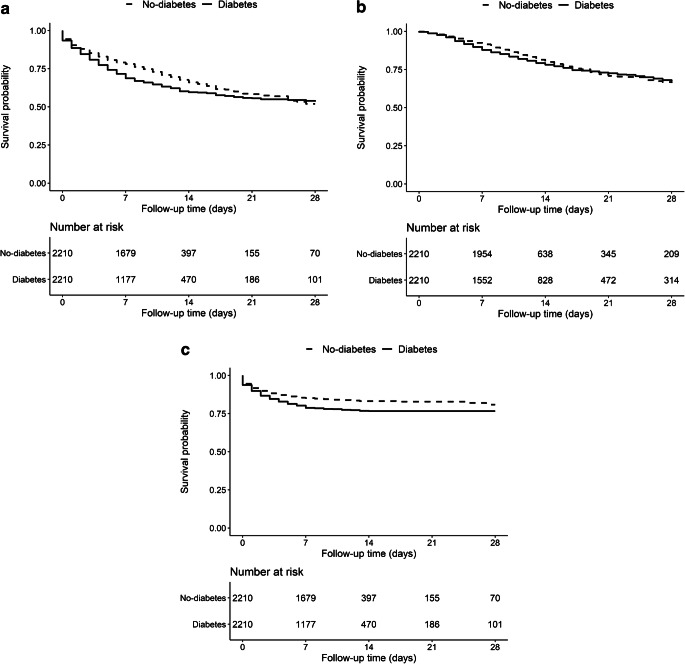
A total of 2210 pairs of participants (diabetes/no-diabetes) were matched on age (mean±SD 69.4±13.2/69.5±13.2 years) and sex (36.3% women). The uCCi was higher in individuals with diabetes. In unadjusted analysis, the primary composite endpoint occurred more frequently in the diabetes group by day 7 (29.0% vs 21.6% in the no-diabetes group; HR 1.43 [95% CI 1.19, 1.72], p<0.001). After multiple adjustments for age, BMI, uCCi, clinical (time between onset of COVID-19 symptoms and dyspnoea) and biological variables (eGFR, aspartate aminotransferase, white cell count, platelet count, C-reactive protein) on admission to hospital, diabetes remained associated with a higher risk of primary composite endpoint within 7 days (adjusted HR 1.42 [95% CI 1.17, 1.72], p<0.001) and 28 days (adjusted HR 1.30 [95% CI 1.09, 1.55], p=0.003), compared with individuals without diabetes. Using the same adjustment model, diabetes was associated with the risk of IMV, but not with risk of death, within 28 days of admission to hospital.
CONCLUSIONS/INTERPRETATION: Our results demonstrate that diabetes status was associated with a deleterious COVID-19 prognosis irrespective of age and comorbidity status.
ClinicalTrials.gov NCT04324736.
目的/假设:糖尿病已被认为是 2019 年冠状病毒病(COVID-19)的一个不利预后因素。由于糖尿病通常是一种老年病,因此尚不清楚糖尿病是否仍然是 COVID-19 的危险因素,超出了老年和相关合并症的范围。我们设计了一项队列研究,考虑了年龄和合并症,以解决这个问题。
冠状病毒 SARS-CoV-2 和糖尿病结局(CORONADO)倡议是一项法国多中心队列研究,研究对象为患有(暴露)和不患有糖尿病(未暴露)的 COVID-19 住院患者,按性别、年龄(±5 岁)、中心和入院日期(2020 年 3 月 10 日至 2020 年 4 月 10 日)进行 1:1 匹配。通过计算更新的 Charlson 合并症指数(uCCi)评估合并症负担。在住院后 7 天和 28 天内,评估了包括死亡和/或有创机械通气(IMV)在内的预先设定的复合主要终点,以及这两个组成部分。我们进行了多变量分析,以比较糖尿病患者和非糖尿病患者的临床结局。
共有 2210 对年龄(均数±标准差 69.4±13.2/69.5±13.2 岁)和性别(36.3%女性)匹配的参与者。糖尿病患者的 uCCi 更高。在未调整分析中,第 7 天糖尿病组的主要复合终点更常见(糖尿病组为 29.0%,非糖尿病组为 21.6%;HR 1.43 [95%CI 1.19, 1.72],p<0.001)。在调整年龄、BMI、uCCi、临床(COVID-19 症状出现和呼吸困难之间的时间)和生物学变量(入院时 eGFR、天冬氨酸氨基转移酶、白细胞计数、血小板计数、C 反应蛋白)后,糖尿病仍然与 7 天内(调整后的 HR 1.42 [95%CI 1.17, 1.72],p<0.001)和 28 天内(调整后的 HR 1.30 [95%CI 1.09, 1.55],p=0.003)的主要复合终点风险增加相关,与无糖尿病的患者相比。使用相同的调整模型,糖尿病与住院 28 天内的 IMV 风险相关,但与死亡风险无关。
结论/解释:我们的结果表明,糖尿病状态与 COVID-19 的不良预后相关,无论年龄和合并症状况如何。
ClinicalTrials.gov NCT04324736。