Pharmacology Unit, Department of Medical and Surgical Sciences, Alma Mater Studiorum-University of Bologna, Bologna 40138, Italy.
Medical Oncology Unit, IRCCS Azienda Ospedaliero-Universitaria di Bologna, Bologna 40138, Italy.
J Clin Endocrinol Metab. 2022 Jul 14;107(8):e3107-e3114. doi: 10.1210/clinem/dgac359.
Adrenal insufficiency (AI) is a life-threatening condition complicating heterogeneous disorders across various disciplines, with challenging diagnosis and a notable drug-induced component.
This work aimed to describe the spectrum of drug-induced AI through adverse drug event reports received by the US Food and Drug Administration (FDA).
A retrospective disproportionality analysis reporting trends of drug-induced AI was conducted on the FDA Adverse Event Reporting System (FAERS) (> 15 000 000 reports since 2004). AE reports were extracted from FAERS over the past 2 decades. Interventions included cases containing any of the preferred terms in the Medical Dictionary for Regulatory Activities describing AI, and signals of disproportionate reporting for drugs recorded in 10 or more cases as primary suspect.
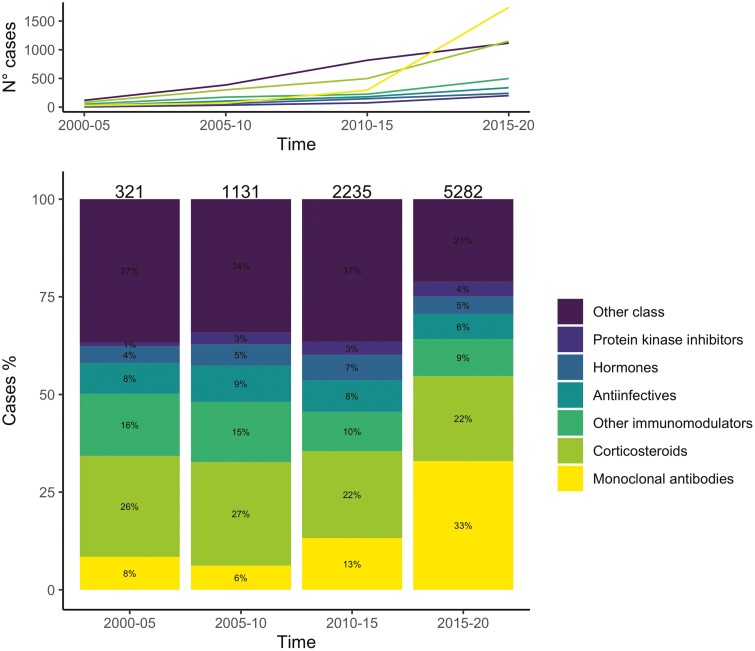
We identified 8496 cases of AI: 97.5% serious, 41.1% requiring hospitalization. AI showed an exponential increase throughout the years, with 5282 (62.2%) cases in 2015 to 2020. We identified 56 compounds associated with substantial disproportionality: glucocorticoids (N = 1971), monoclonal antibodies (N = 1644, of which N = 1330 were associated with immune checkpoint inhibitors-ICIs), hormone therapy (N = 291), anti-infectives (N = 252), drugs for hypercortisolism or adrenocortical cancer diagnosis/treatment (N = 169), and protein kinase inhibitors (N = 138). Cases of AI by glucocorticoids were stable in each 5-year period (22%-27%), whereas those by monoclonal antibodies, largely ICIs, peaked from 13% in 2010 to 2015 to 33% in 2015 to 2020.
We provide a comprehensive insight into the evolution of drug-induced AI, highlighting the heterogeneous spectrum of culprit drug classes and the emerging increased reporting of ICIs. We claim for the urgent identification of predictive factors for drug-induced AI, and the establishment of screening and educational protocols for patients and caregivers.
肾上腺功能不全(AI)是一种危及生命的病症,涉及多个学科的多种异质疾病,其诊断具有挑战性,且明显与药物相关。
本研究旨在通过美国食品和药物管理局(FDA)收到的药物不良事件报告,描述药物引起的 AI 谱。
我们对 FDA 不良事件报告系统(FAERS)(自 2004 年以来超过 1500 万份报告)进行了药物引起 AI 的回顾性比例失调分析。FAERS 中提取 AE 报告超过过去 20 年。干预措施包括包含任何描述 AI 的监管活动医学词典首选术语的病例,以及在 10 个或更多病例中记录的作为主要嫌疑药物的药物的不成比例报告信号。
我们确定了 8496 例 AI 病例:97.5%为严重病例,41.1%需要住院治疗。AI 呈指数增长,2015 年至 2020 年有 5282 例(62.2%)。我们确定了 56 种与大量不成比例相关的化合物:糖皮质激素(N=1971)、单克隆抗体(N=1644,其中 N=1330 与免疫检查点抑制剂-ICI 相关)、激素治疗(N=291)、抗感染药物(N=252)、用于高皮质醇症或肾上腺皮质癌诊断/治疗的药物(N=169)和蛋白激酶抑制剂(N=138)。糖皮质激素引起的 AI 病例在每个 5 年期间保持稳定(22%-27%),而单克隆抗体(主要是 ICI)引起的 AI 病例则从 2010 年至 2015 年的 13%上升到 2015 年至 2020 年的 33%。
我们全面深入地了解了药物引起的 AI 的演变,突出了罪魁祸首药物类别的异质谱以及 ICI 报告的增加。我们呼吁迫切确定药物引起的 AI 的预测因素,并为患者和护理人员建立筛选和教育方案。