Science and Technology Innovation Center, Guangzhou University of Chinese Medicine, Guangzhou, PR China.
Pi-Wei Institute, Guangzhou University of Chinese Medicine, Guangzhou, PR China.
PLoS One. 2022 Jun 15;17(6):e0269621. doi: 10.1371/journal.pone.0269621. eCollection 2022.
Malnutrition, defined according to Nutritional risk screening (NRS 2002), is commonly observed in patients of Myasthenia gravis (MG), a neuromuscular disorder manifested by varied degrees of skeletal muscle weakness. Because biochemical composition of saliva changes in correspondence to alterations in nutritional status, we tested our hypothesis that a certain saliva component(s) might serve as a biomarker(s) for nutrition status of MG, particularly for those MG patients with high risk of malnutrition.
60 MG patients and 60 subjects belonging to the healthy control group (HCG) were enrolled in this case-control study. The salivary α-amylase (sAA) activity, salivary flow rate (SFR), pH, total protein density (TPD), and the concentrations of chloride and calcium ions in MG group with or without malnutrition were measured before and after citric acid stimulation. Thereafter, the relationship between sAA activity and BMI was determined in MG and HCG.
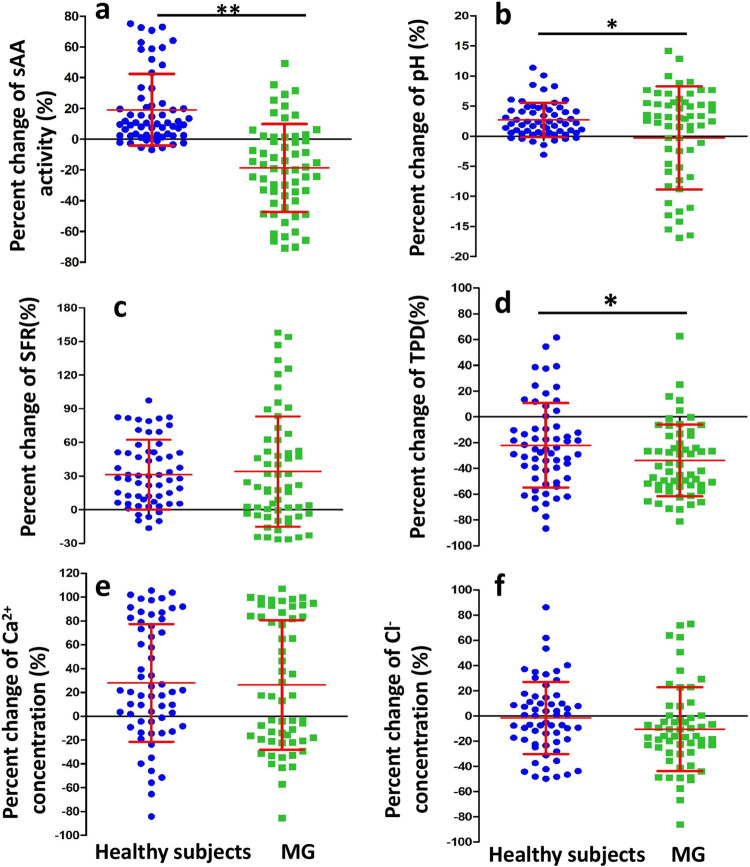
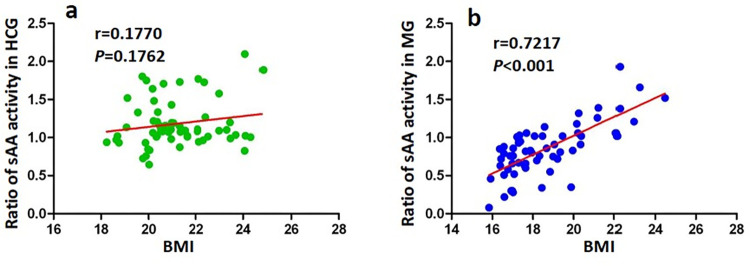
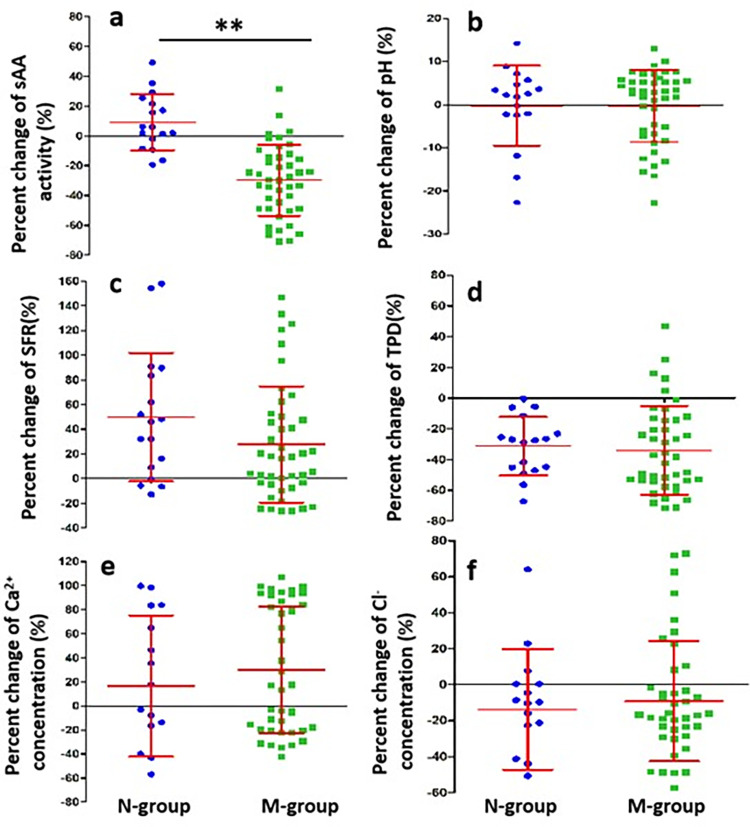
Compared with HCG, more patients with malnutrition, increased TPD and chloride and calcium concentrations but decreased pH value and SFR both before and after acid stimulation, as well as reduced sAA activity, pH and TPD responses to acid stimulation. MG with malnutrition showed decreased sAA activity and TPD responding to acid stimulation compared with those without malnutrition. Compared with normal BMI, sAA activity response to acid stimulation was reduced in low BMI. There was a significant strong positive correlation between the ratio of sAA activity and BMI in MG.
Salivary biochemical characteristics are abnormally altered in MG with malnutrition. Altered sAA activity responding to acid stimulation was associated with malnutrition.
Decreased sAA activity responding to acid stimulation can reflect malnutrition state and may be one potential screening marker for MG patients with high risk of malnutrition.
根据营养风险筛查(NRS 2002)定义,营养不良在重症肌无力(MG)患者中很常见,MG 是一种神经肌肉疾病,表现为不同程度的骨骼肌无力。由于唾液的生化成分会随着营养状况的变化而改变,因此我们假设某种唾液成分可能作为 MG 营养状况的生物标志物,特别是对于那些有营养不良高风险的 MG 患者。
本病例对照研究纳入了 60 名 MG 患者和 60 名健康对照组(HCG)受试者。测量了 MG 患者和 HCG 中有无营养不良的患者的唾液α-淀粉酶(sAA)活性、唾液流量率(SFR)、pH 值、总蛋白密度(TPD)以及氯离子和钙离子浓度,然后在柠檬酸刺激前后进行测量。之后,在 MG 和 HCG 中确定了 sAA 活性与 BMI 之间的关系。
与 HCG 相比,更多营养不良的患者具有更高的 TPD 和氯离子及钙离子浓度,但 pH 值和 SFR 在酸刺激前后均降低,以及 sAA 活性、pH 值和 TPD 对酸刺激的反应降低。MG 中伴有营养不良的患者与不伴营养不良的患者相比,sAA 活性和 TPD 对酸刺激的反应均降低。与正常 BMI 相比,低 BMI 患者的 sAA 活性对酸刺激的反应降低。MG 中 sAA 活性与 BMI 的比值呈显著正相关。
营养不良的 MG 患者唾液生化特征异常改变。sAA 活性对酸刺激的反应改变与营养不良有关。
sAA 活性对酸刺激的反应降低可以反映营养不良状态,可能是 MG 患者中具有营养不良高风险的潜在筛查标志物。