Department of Nuclear Medicine, Aalborg University Hospital, Aalborg, Denmark
Department of Nuclear Medicine, Aalborg University Hospital, Aalborg, Denmark.
BMJ Open. 2022 Jun 15;12(6):e058898. doi: 10.1136/bmjopen-2021-058898.
To determine whether preoperative staging of high-risk prostate cancer with F-sodium-fluoride (F-NaF) positron emission tomography (PET) reduces the risk of skeletal metastases.
Nationwide, population-based cohort study using real-world data.
The study used national health registries, including all sites in Denmark from 2011 to 2018.
Newly diagnosed high-risk prostate cancer patients who underwent radical prostatectomy from 2011 to 2018. Patients were stratified into two groups according to the preoperative imaging modality of either F-NaF PET or bone scintigraphy.
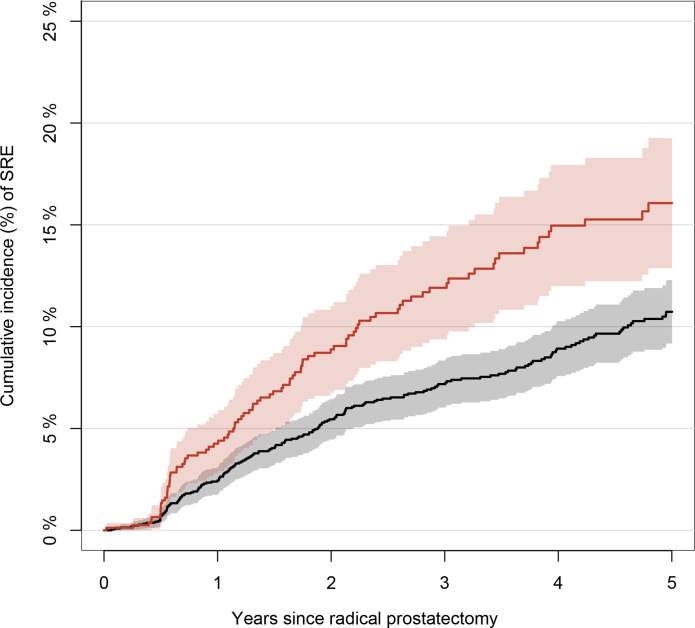
The risk of skeletal-related events (SREs) as a proxy for skeletal metastases following radical prostatectomy. The secondary endpoint was overall survival.
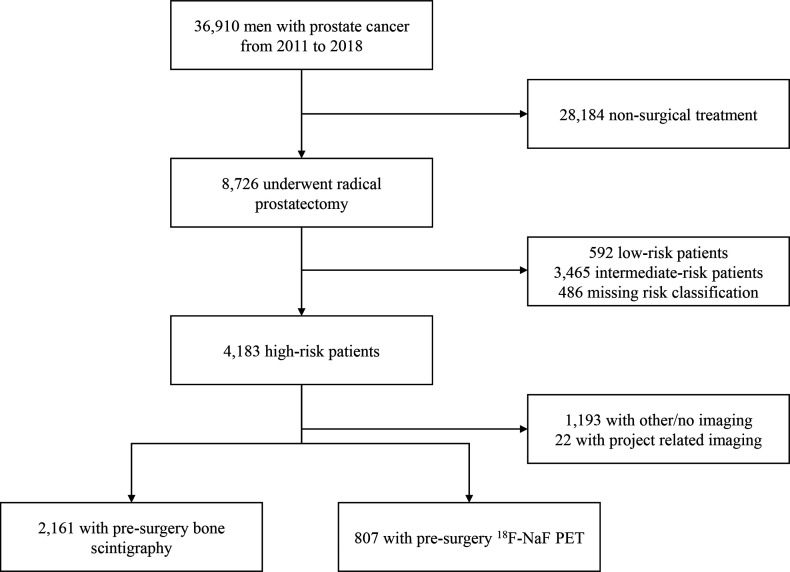
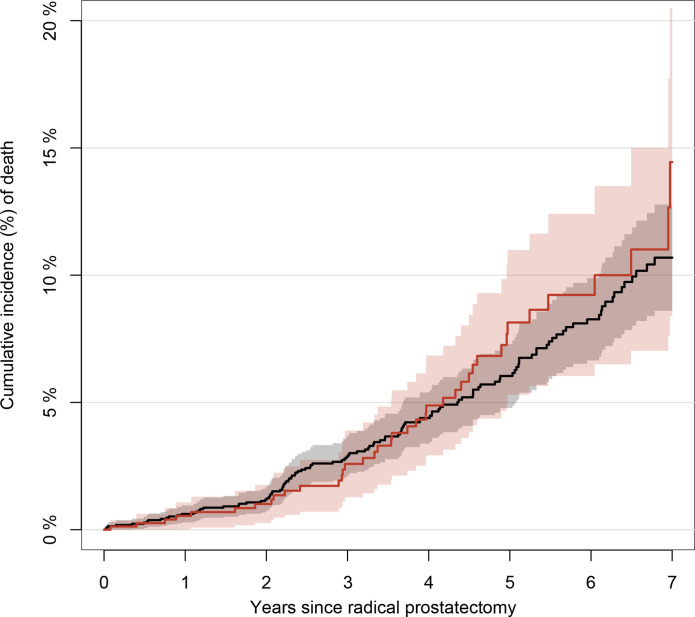
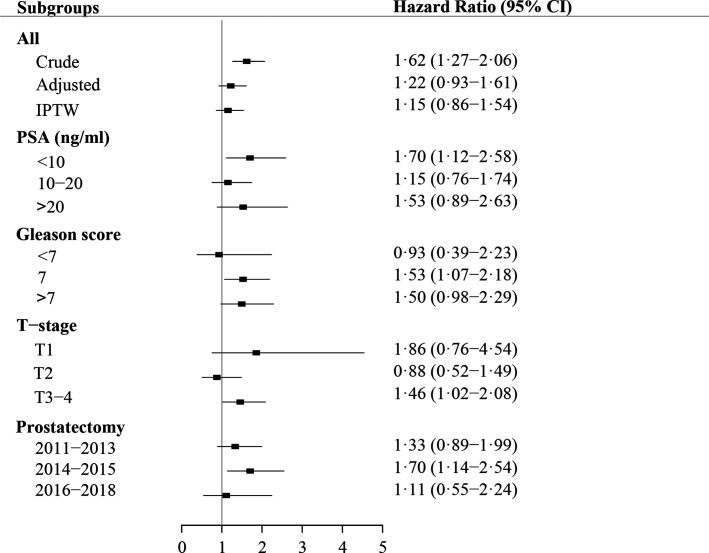
Between 1 January 2011 and 31 December 2018, 4183 high-risk patients underwent radical prostatectomy. Of these patients, 807 (19.3%) underwent F-NaF PET and 2161 (51.7%) underwent bone scintigraphy. The remaining 30% were examined by a different imaging method or did not undergo imaging. Using the inverse probability of treatment weighting to control potential confounding, the HR of experiencing an SRE for patients in the F-NaF PET group versus the bone scintigraphy group was 1.15 (95% CI 0.86 to 1.54). The 3-year survival rates were 97.4% (95% CI 96.1 to 98.7) and 97.1% (95% CI 96.4 to 97.9) for patients receiving F-NaF PET and bone scintigraphy, respectively.
Patients with high-risk prostate cancer undergoing preoperative staging with F-NaF PET did not display a lower risk of developing SREs after prostatectomy compared with patients undergoing bone scintigraphy. The survival rates were similar between the two groups.
确定氟-钠-氟(F-NaF)正电子发射断层扫描(PET)术前对高危前列腺癌进行分期是否降低了骨转移的风险。
利用真实世界数据进行全国范围内的基于人群的队列研究。
该研究使用了国家健康登记处,包括丹麦所有地区 2011 年至 2018 年的数据。
2011 年至 2018 年期间接受根治性前列腺切除术的新诊断为高危前列腺癌患者。根据 F-NaF PET 或骨闪烁扫描的术前影像学方式,将患者分为两组。
作为根治性前列腺切除术后骨相关事件(SRE)的替代指标,骨转移的风险。次要终点是总生存率。
2011 年 1 月 1 日至 2018 年 12 月 31 日,共有 4183 名高危患者接受了根治性前列腺切除术。其中,807 名(19.3%)患者接受了 F-NaF PET 检查,2161 名(51.7%)患者接受了骨闪烁扫描。其余 30%的患者接受了其他影像学检查或未接受影像学检查。通过逆概率治疗加权法控制潜在的混杂因素,F-NaF PET 组和骨闪烁扫描组患者发生 SRE 的 HR 为 1.15(95%CI 0.86 至 1.54)。接受 F-NaF PET 和骨闪烁扫描的患者 3 年生存率分别为 97.4%(95%CI 96.1%至 98.7%)和 97.1%(95%CI 96.4%至 97.9%)。
与接受骨闪烁扫描的患者相比,接受 F-NaF PET 术前分期的高危前列腺癌患者在前列腺切除术后发生 SRE 的风险并未降低。两组患者的生存率相似。