Molecular Virology and Gene Therapy, KU Leuven, Leuven, Belgium.
Department of Chemistry, Indian Institute of Technology, Kanpur, India.
mBio. 2022 Aug 30;13(4):e0000722. doi: 10.1128/mbio.00007-22. Epub 2022 Jun 16.
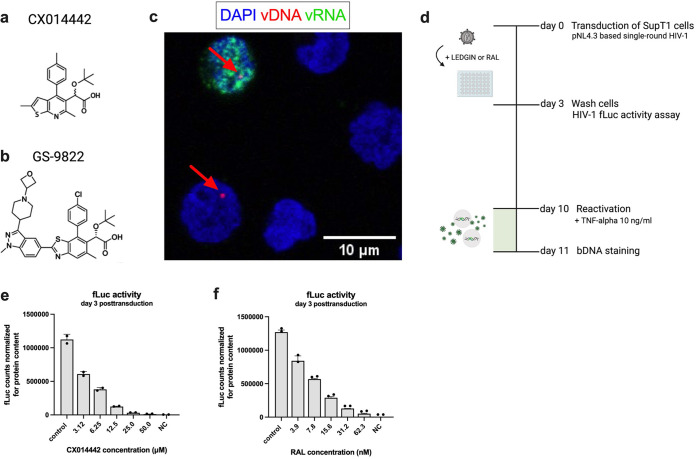
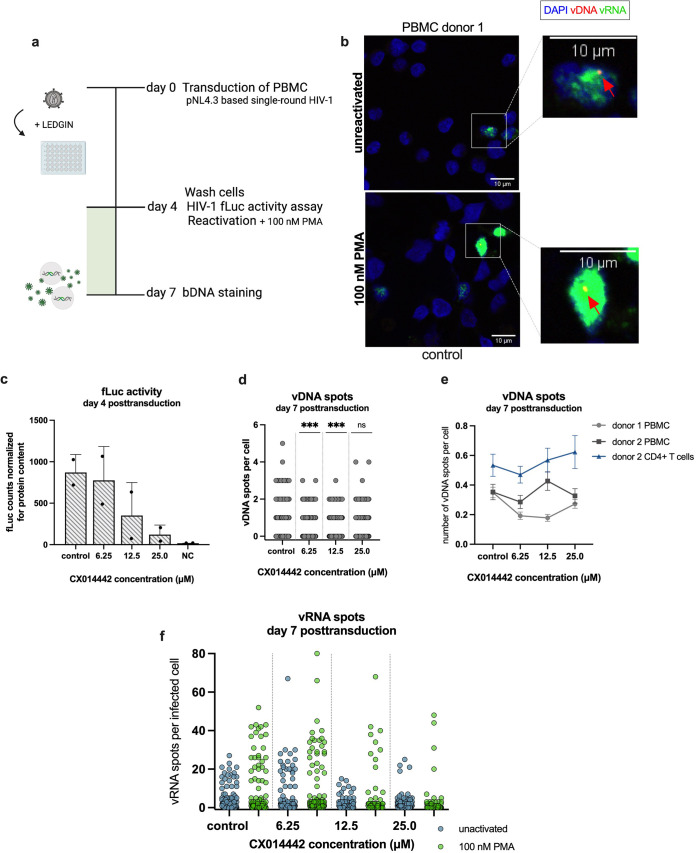
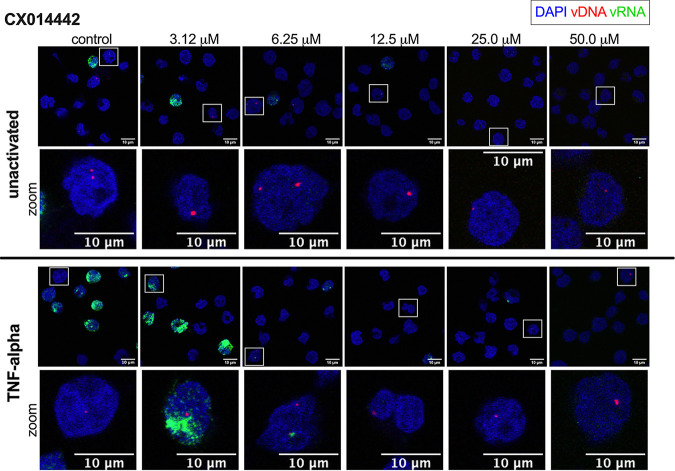
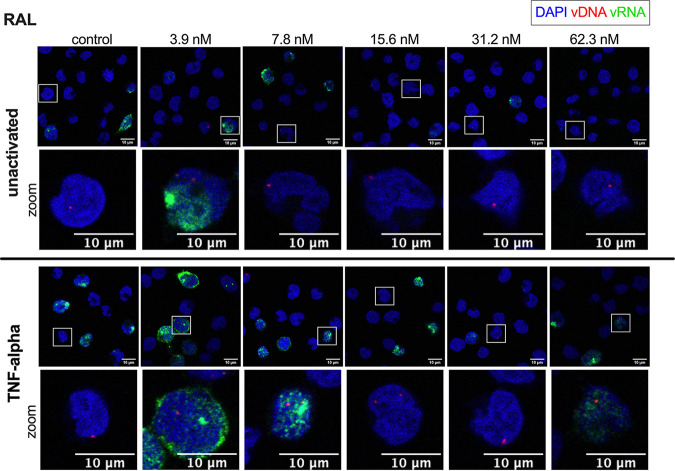
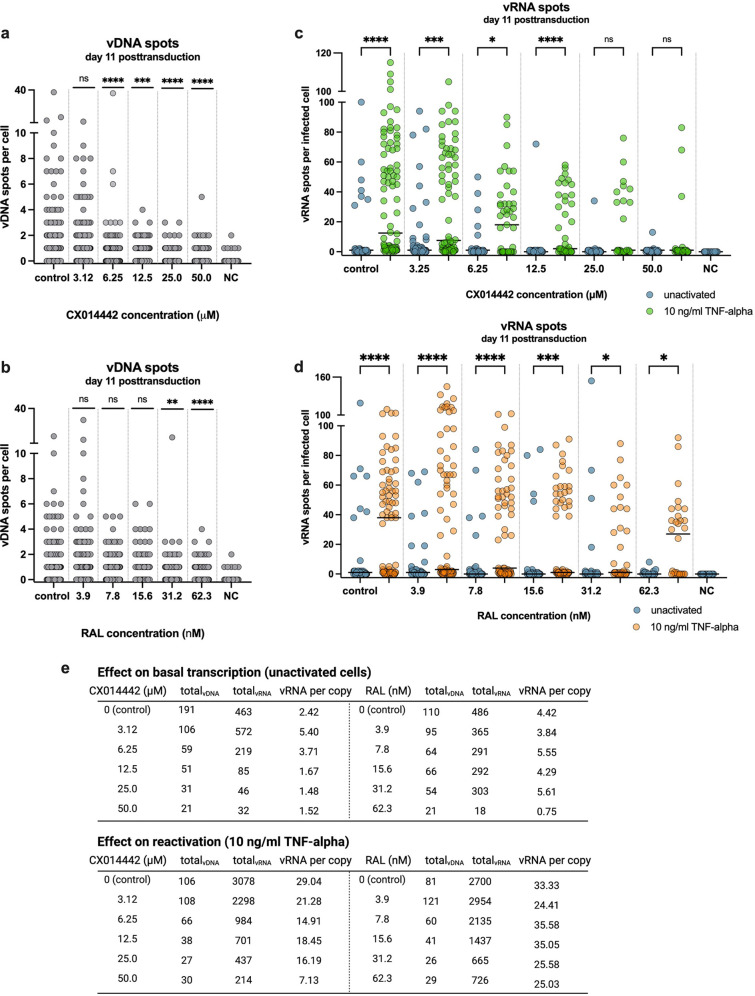
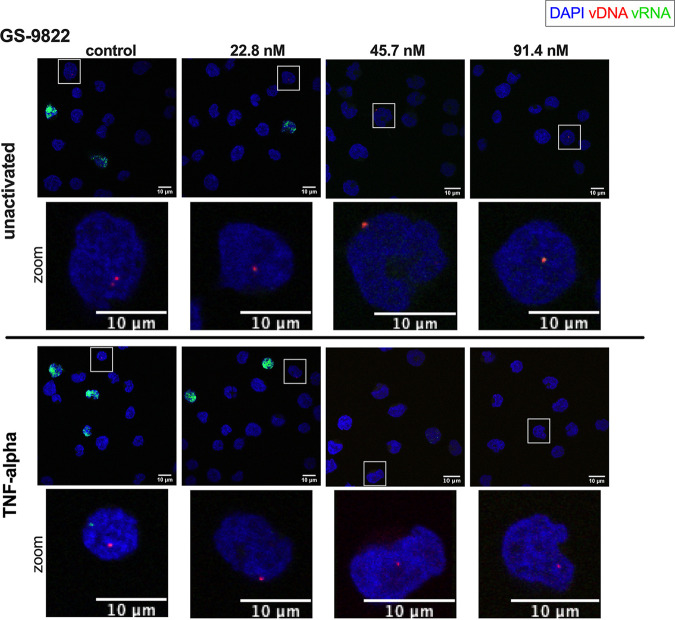
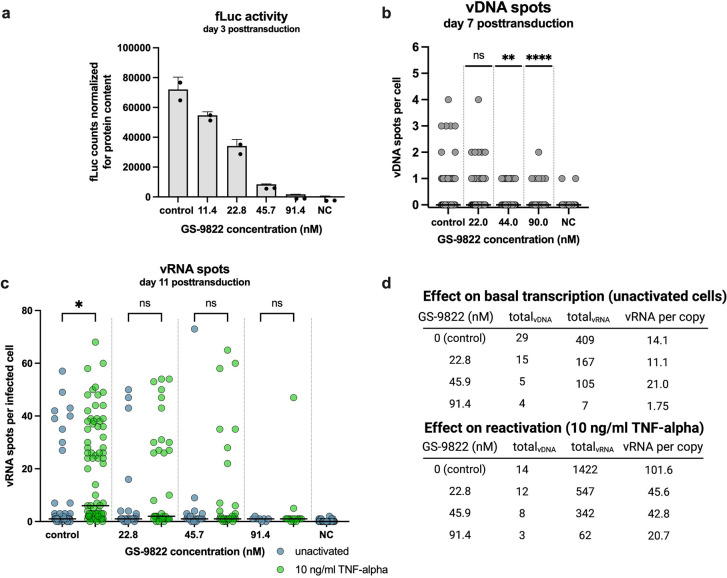
Current antiretroviral treatment fails to cure HIV-1 infection since latent provirus resides in long-lived cellular reservoirs, rebounding whenever therapy is discontinued. The molecular mechanisms underlying HIV-1 latency are complex where the possible link between integration and transcription is poorly understood. HIV-1 integration is targeted toward active chromatin by the direct interaction with a host protein, lens epithelium-derived growth factor (LEDGF/p75). LEDGINs are small-molecule inhibitors of the LEDGF/p75-integrase (IN) interaction that effectively inhibit and retarget HIV-1 integration out of preferred integration sites, resulting in residual provirus that is more latent. Here, we describe a single-cell branched DNA imaging method for simultaneous detection of viral DNA and RNA. We investigated how treatment with LEDGINs affects the location, transcription, and reactivation of HIV-1 in both cell lines and primary cells. This approach demonstrated that LEDGIN-mediated retargeting hampered the baseline transcriptional state and the transcriptional reactivation of the provirus, evidenced by the reduction in viral RNA expression per residual copy. Moreover, treatment of primary cells with LEDGINs induced an enrichment of provirus in deep latency. These results corroborate the impact of integration site selection for the HIV-1 transcriptional state and support block-and-lock functional cure strategies in which the latent reservoir is permanently silenced after retargeting. A longstanding question exists on the impact of the HIV-1 integration site on viral gene expression. This unsolved question has significant implications for the search toward an HIV-1 cure, as eradication strategies set up to reactivate and eliminate HIV-1 depend on the site where the provirus is integrated. The main determinant for integration site selection is the interaction of the HIV-1 integrase (IN) and the host chromatin targeting factor, LEDGF/p75. LEDGINs are small-molecule inhibitors of the LEDGF/p75-IN interaction that inhibit and retarget HIV-1 integration out of preferred integration sites. Using both LEDGINs and branched DNA (bDNA) imaging, we now investigated, in much detail, the impact of integration site selection on the three-dimensional location of the provirus, HIV-1 transcription, and reactivation. Our results provide evidence for a "block-and-lock" functional cure strategy that aims to permanently silence HIV-1 by LEDGIN-mediated retargeting to sites that are less susceptible to reactivation after treatment interruption.
目前的抗逆转录病毒治疗未能治愈 HIV-1 感染,因为潜伏的前病毒存在于长寿的细胞储库中,只要治疗停止就会反弹。HIV-1 潜伏期的分子机制很复杂,整合和转录之间的可能联系还不太清楚。HIV-1 整合通过与宿主蛋白 lens epithelium-derived growth factor (LEDGF/p75) 的直接相互作用靶向活性染色质。LEDGINs 是 LEDGF/p75-整合酶 (IN) 相互作用的小分子抑制剂,可有效抑制并将 HIV-1 整合重新靶向出首选整合位点,从而导致潜伏性更强的残留前病毒。在这里,我们描述了一种用于同时检测病毒 DNA 和 RNA 的单细胞分支 DNA 成像方法。我们研究了 LEDGIN 治疗如何影响细胞系和原代细胞中 HIV-1 的位置、转录和重新激活。这种方法表明,LEDGIN 介导的重新靶向阻碍了前病毒的基础转录状态和转录重新激活,这表现在每个残留拷贝的病毒 RNA 表达减少。此外,用 LEDGIN 处理原代细胞会导致前病毒在深度潜伏中富集。这些结果证实了整合位点选择对 HIV-1 转录状态的影响,并支持阻断和锁定功能治愈策略,即在重新靶向后,潜伏储库被永久沉默。
HIV-1 整合位点对病毒基因表达的影响一直是一个悬而未决的问题。这个未解决的问题对 HIV-1 治愈的研究有重大影响,因为旨在激活和消除 HIV-1 的根除策略取决于前病毒整合的位置。整合位点选择的主要决定因素是 HIV-1 整合酶 (IN) 和宿主染色质靶向因子 LEDGF/p75 的相互作用。LEDGINs 是 LEDGF/p75-IN 相互作用的小分子抑制剂,可抑制并将 HIV-1 整合重新靶向出首选整合位点。使用 LEDGIN 和分支 DNA (bDNA) 成像,我们现在详细研究了整合位点选择对前病毒的三维位置、HIV-1 转录和重新激活的影响。我们的结果为“阻断和锁定”功能治愈策略提供了证据,该策略旨在通过 LEDGIN 介导的重新靶向,将前病毒永久沉默在治疗中断后不易重新激活的部位。