
儿童期麻醉暴露与神经发育结局:系统评价和荟萃分析。
Anesthetic Exposure During Childhood and Neurodevelopmental Outcomes: A Systematic Review and Meta-analysis.
机构信息
Department of Anesthesiology, Columbia University Vagelos College of Physicians and Surgeons, New York, New York.
Faculty of Education, Victoria University of Wellington, Wellington, New Zealand.
出版信息
JAMA Netw Open. 2022 Jun 1;5(6):e2217427. doi: 10.1001/jamanetworkopen.2022.17427.
IMPORTANCE
Clinical studies of neurodevelopmental outcomes after anesthetic exposure have evaluated a range of outcomes with mixed results.
OBJECTIVE
To examine via meta-analyses the associations between exposure to general anesthesia and domain-specific neurodevelopmental outcomes in children.
DATA SOURCES
PubMed/MEDLINE, Embase, CINAHL, Web of Science and the Cochrane Library were searched from inception to August 31, 2021.
STUDY SELECTION
Inclusion criteria were exposures to procedures requiring general anesthesia at younger than 18 years and evaluation of long-term neurodevelopmental function after exposure. Studies lacking unexposed controls or focused on children with major underlying comorbidities were excluded.
DATA EXTRACTION AND SYNTHESIS
Extracted variables included effect size; hazard, risk, or odds ratio; number of exposures; procedure type; major comorbidities; age of exposure and assessment; presence of unexposed controls; and study design. Studies were independently reviewed by 2 coders, and review was conducted in accordance with the Preferred Reporting Items for Systematic Reviews and Meta-Analyses guidelines. Data were pooled using a random-effects model.
MAIN OUTCOMES AND MEASURES
The main outcomes were standardized mean differences (SMD) for scores in the neurodevelopmental domains of academics, behavioral problems, cognition, executive function, general development, language, motor function, nonverbal reasoning, social cognition, and hazard and risk of neurodevelopmental disorder diagnoses.
RESULTS
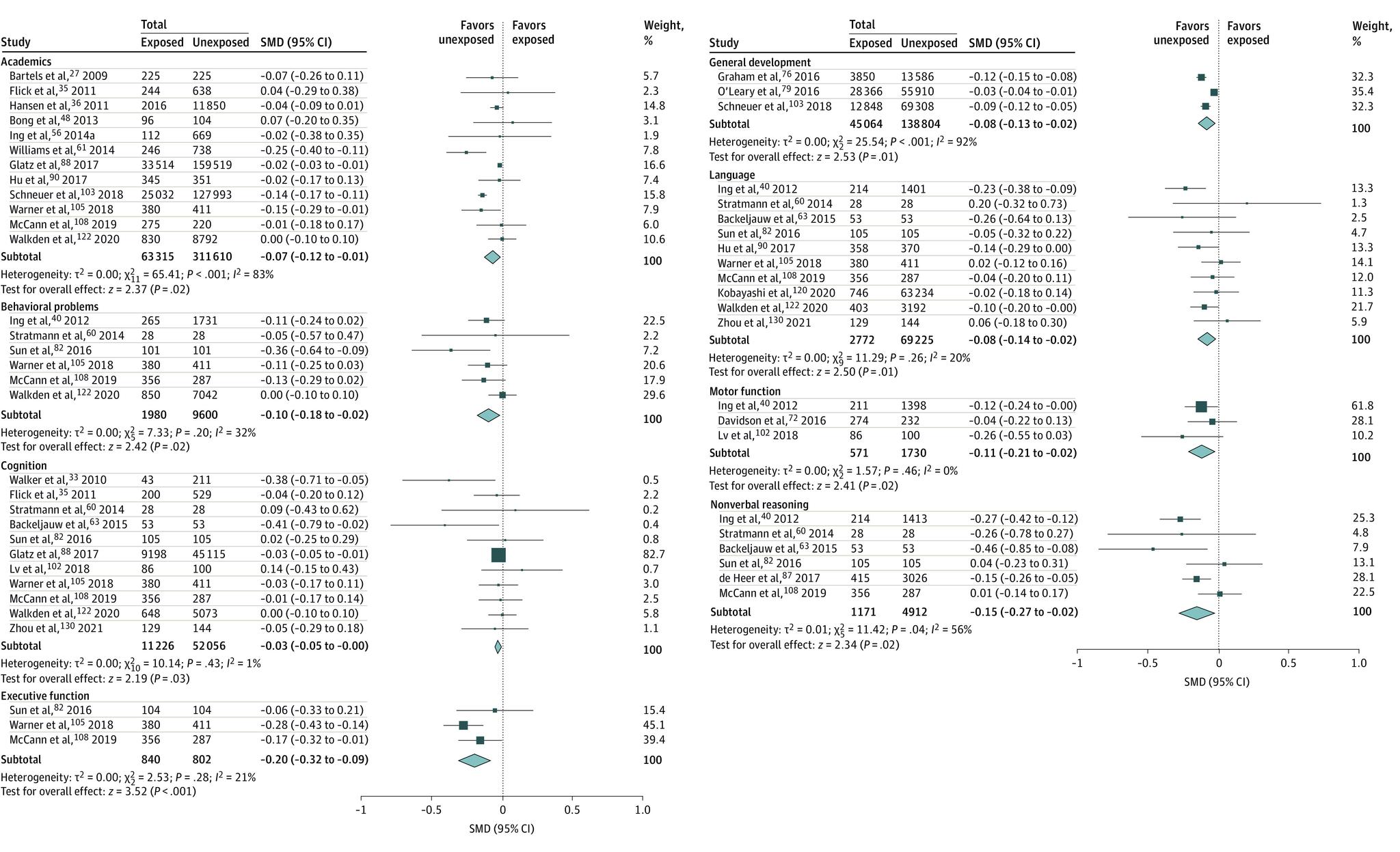
A total of 31 studies contributed data for meta-analysis. For each of the assessed neurodevelopmental domains, the numbers of children evaluated ranged from 571 to 63 315 exposed and 802 to 311 610 unexposed. Children with any exposure (single or multiple) had significantly worse behavioral problems scores, indicating more behavioral problems (SMD, -0.10; 95% CI, -0.18 to -0.02; P = .02), and worse scores in academics (SMD, -0.07; 95% CI -0.12 to -0.01; P = .02), cognition (SMD, -0.03; 95% CI, -0.05 to 0.00; P = .03), executive function (SMD, -0.20; 95% CI, -0.32 to -0.09; P < .001), general development (SMD, -0.08; 95% CI, -0.13 to -0.02; P = .01), language (SMD, -0.08; 95% CI, -0.14 to -0.02; P = .01), motor function (SMD, -0.11; 95% CI, -0.21 to -0.02; P = .02), and nonverbal reasoning (SMD, -0.15; 95% CI, -0.27 to -0.02; P = .02). Higher incidences of neurodevelopmental disorder diagnoses were also reported (hazard ratio, 1.19; 95% CI, 1.09 to 1.30; P < .001; risk ratio, 1.81; 95% CI, 1.25 to 2.61; P = .002).
CONCLUSIONS AND RELEVANCE
These findings support the hypothesis that associations between anesthetic exposure during childhood and subsequent neurodevelopmental deficits differ based on neurodevelopmental domain.
重要性
对麻醉暴露后神经发育结果的临床研究评估了一系列结果,结果不一。
目的
通过荟萃分析来研究全身麻醉暴露与儿童特定领域神经发育结果之间的关联。
数据来源
从建立到 2021 年 8 月 31 日,PubMed/MEDLINE、Embase、CINAHL、Web of Science 和 Cochrane Library 进行了检索。
研究选择
纳入标准为在 18 岁之前接受需要全身麻醉的程序暴露,并在暴露后评估长期神经发育功能。排除缺乏未暴露对照或专注于患有主要潜在合并症的儿童的研究。
数据提取和综合
提取的变量包括效应大小;危险、风险或优势比;暴露数量;手术类型;主要合并症;暴露和评估年龄;是否存在未暴露对照;以及研究设计。研究由 2 位编码员独立审查,审查符合系统评价和荟萃分析的首选报告项目指南进行。使用随机效应模型对数据进行汇总。
主要结果和测量
主要结果是学术、行为问题、认知、执行功能、总体发育、语言、运动功能、非语言推理、社会认知、神经发育障碍诊断风险和危险的神经发育领域的标准化均数差(SMD)。
结果
共有 31 项研究为荟萃分析提供了数据。在评估的每个神经发育领域中,暴露的儿童数量从 571 到 63315 人不等,未暴露的儿童数量从 802 到 311610 人不等。任何暴露(单次或多次)的儿童行为问题评分显著更差,表明行为问题更多(SMD,-0.10;95%CI,-0.18 至 -0.02;P=0.02),且学术(SMD,-0.07;95%CI,-0.12 至 -0.01;P=0.02)、认知(SMD,-0.03;95%CI,-0.05 至 0.00;P=0.03)、执行功能(SMD,-0.20;95%CI,-0.32 至 -0.09;P<0.001)、总体发育(SMD,-0.08;95%CI,-0.13 至 -0.02;P=0.01)、语言(SMD,-0.08;95%CI,-0.14 至 -0.02;P=0.01)、运动功能(SMD,-0.11;95%CI,-0.21 至 -0.02;P=0.02)和非语言推理(SMD,-0.15;95%CI,-0.27 至 -0.02;P=0.02)评分更差。也报告了更高的神经发育障碍诊断发生率(危险比,1.19;95%CI,1.09 至 1.30;P<0.001;风险比,1.81;95%CI,1.25 至 2.61;P=0.002)。
结论和相关性
这些发现支持了这样的假设,即儿童期麻醉暴露与随后的神经发育缺陷之间的关联因神经发育域而异。



 Zotero 插件