Gebreyohanes Axumawi, Erotocritou Marios, Choi David
Victor Horsley Department of Neurosurgery, 98546The National Hospital for Neurology and Neurosurgery, UK.
University College London (UCL) Medical School, UK.
Global Spine J. 2023 Mar;13(2):547-562. doi: 10.1177/21925682221109562. Epub 2022 Jun 16.
Systematic review.
Understanding the prevalence and outcome of motor deficits in degenerative cervical radiculopathy is important to guide management. We compared motor radiculopathy outcomes after conservative and surgical management, a particular focus being painful vs painless radiculopathy.
MEDLINE and EMBASE databases were searched. We stratified each study cohort into 1 of 6 groups, I-VI, based on whether radiculopathy was painful, painless or unspecified, and whether interventions were surgical or non-surgical.
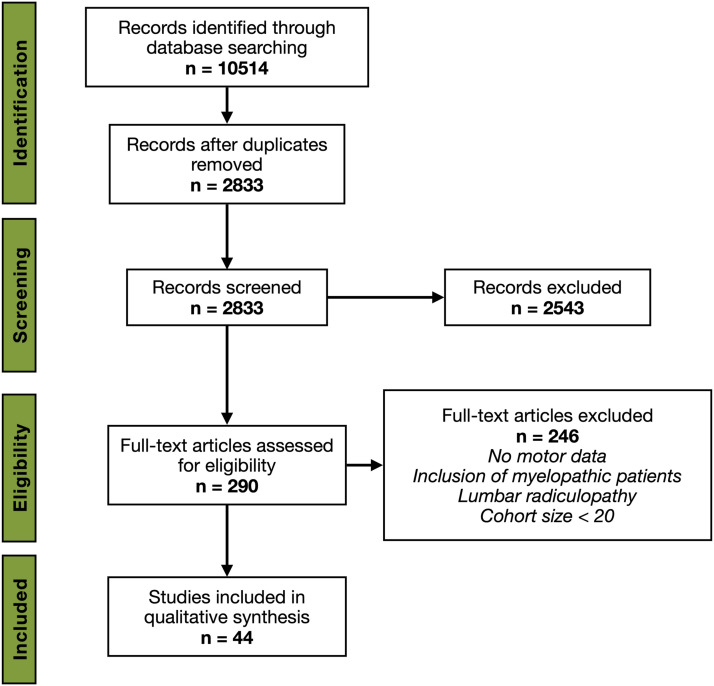
Of 10 514 initial studies, 44 matched the selection criteria. Whilst 42 (95.5%) provided baseline motor radiculopathy data, only 22 (50.0%) provided follow-up motor outcomes. Mean baseline prevalence of motor deficits was 39.1% (9.2%-73.3%) in conservative cohorts and 60.5% (18.5%-94.1%) in surgical cohorts. Group VI, 'surgically-managed motor radiculopathy with unclear pain status' had the largest number of cohorts. Conversely, no cohorts were found in Group III, 'conservatively-managed painless motor radiculopathy'. Large disparities in data quality made direct comparison of conservative vs operative management difficult.
Overall pre-intervention prevalence of motor deficits in degenerative cervical radiculopathy is 56.4%. Many studies fail to report motor outcomes after intervention, meaning statistical evidence to guide optimal management of motor radiculopathy is currently lacking. Our study highlights the need for more evidence, preferably from a prospective long-term study, to allow direct comparisons of motor outcomes after conservative and surgical management.
系统评价。
了解退行性颈椎神经根病中运动功能障碍的患病率和转归对于指导治疗很重要。我们比较了保守治疗和手术治疗后运动性神经根病的转归,特别关注疼痛性与无痛性神经根病。
检索MEDLINE和EMBASE数据库。我们根据神经根病是疼痛性、无痛性还是未明确说明,以及干预措施是手术还是非手术,将每个研究队列分为6组(I - VI)中的1组。
在10514项初始研究中,44项符合入选标准。虽然42项(95.5%)提供了运动性神经根病的基线数据,但只有22项(50.0%)提供了随访时的运动功能结果。保守治疗队列中运动功能障碍的平均基线患病率为39.1%(9.2% - 73.3%),手术治疗队列中为60.5%(18.5% - 94.1%)。第六组“手术治疗的运动性神经根病,疼痛状态不明”的队列数量最多。相反,在第三组“保守治疗的无痛性运动性神经根病”中未发现队列。数据质量的巨大差异使得难以直接比较保守治疗与手术治疗。
退行性颈椎神经根病干预前运动功能障碍的总体患病率为56.4%。许多研究未报告干预后的运动功能结果,这意味着目前缺乏指导运动性神经根病最佳治疗的统计学证据。我们的研究强调需要更多证据,最好来自前瞻性长期研究,以便直接比较保守治疗和手术治疗后的运动功能结果。