Wang Hao, Liu Dong, Liang Hanyang, Ba Zhengqing, Ma Yue, Xu Haobo, Wang Juan, Wang Tianjie, Tian Tao, Yang Jingang, Gao Xiaojin, Qiao Shubin, Qu Yanling, Yang Zhuoxuan, Guo Wei, Zhao Min, Ao Huiping, Zheng Xiaodong, Yuan Jiansong, Yang Weixian
Chinese Academy of Medical Sciences and Peking Union Medical College, Fuwai Hospital, National Center for Cardiovascular Diseases, Beijing, China.
Department of Cardiology, Yuncheng Central Hospital, Shanxi Medical University, Yuncheng, China.
Front Cardiovasc Med. 2022 May 27;9:875560. doi: 10.3389/fcvm.2022.875560. eCollection 2022.
Cardiovascular comorbidities (CVCs) affect the overall survival (OS) of patients with colorectal cancer (CRC). However, a prognostic evaluation system for these patients is currently lacking.
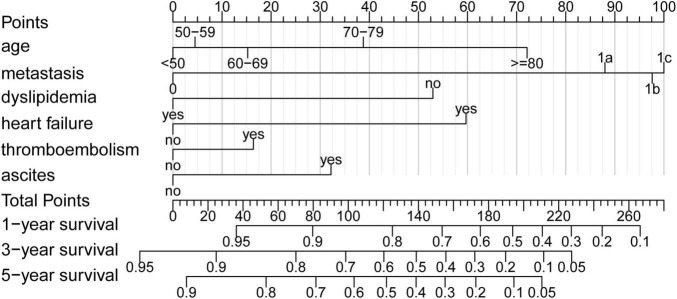
This study aimed to develop and validate a nomogram, which takes CVCs into account, for predicting the survival of patients with CRC.
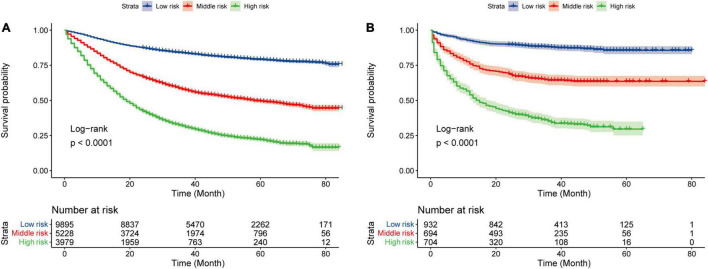
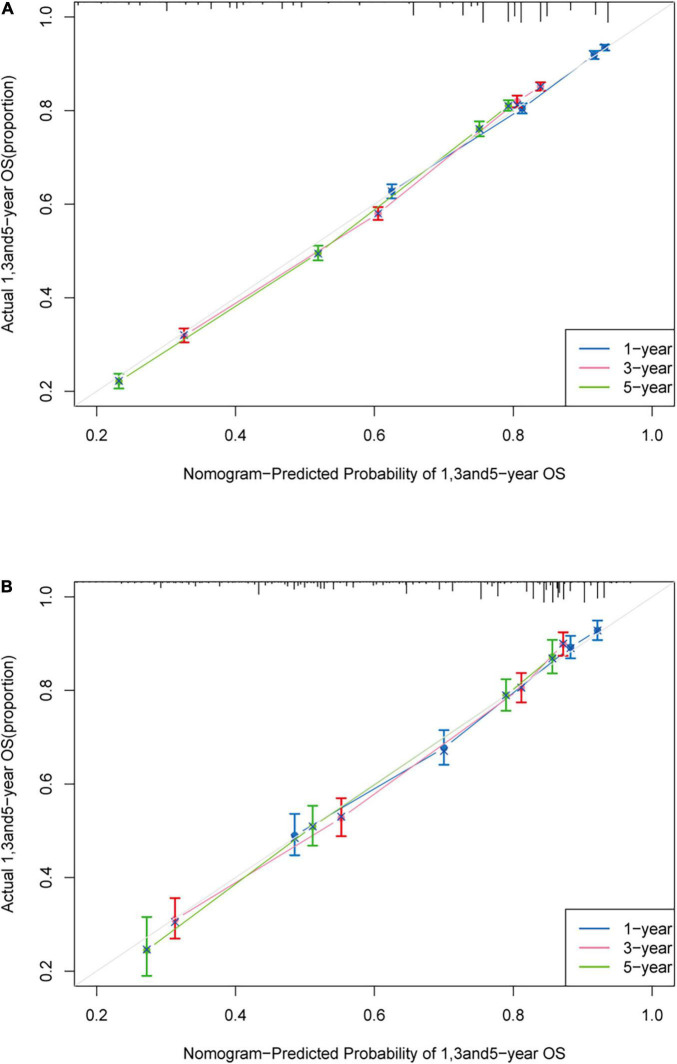
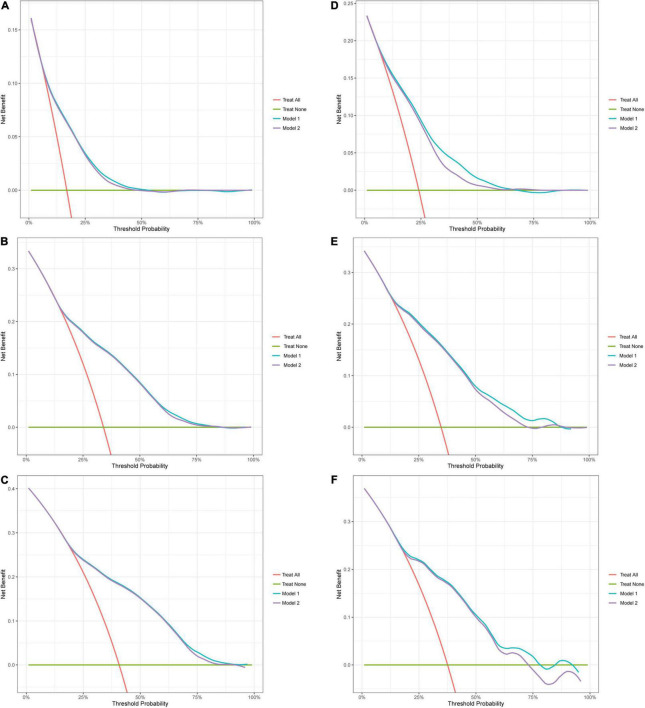
In total, 21,432 patients with CRC were recruited from four centers in China between January 2011 and December 2017. The nomogram was constructed, based on Cox regression, using a training cohort (19,102 patients), and validated using a validation cohort (2,330 patients). The discrimination and calibration of the model were assessed by the concordance index and calibration curve. The clinical utility of the model was measured by decision curve analysis (DCA). Based on the nomogram, we divided patients into three groups: low, middle, and high risk.
Independent risk factors selected into our nomogram for OS included age, metastasis, malignant ascites, heart failure, and venous thromboembolism, whereas dyslipidemia was found to be a protective factor. The c-index of our nomogram was 0.714 (95% : 0.708-0.720) in the training cohort and 0.742 (95% : 0.725-0.759) in the validation cohort. The calibration curve and DCA showed the reliability of the model. The cutoff values of the three groups were 68.19 and 145.44, which were also significant in the validation cohort ( < 0.001).
Taking CVCs into account, an easy-to-use nomogram was provided to estimate OS for patients with CRC, improving the prognostic evaluation ability.
心血管合并症(CVCs)影响结直肠癌(CRC)患者的总生存期(OS)。然而,目前缺乏针对这些患者的预后评估系统。
本研究旨在开发并验证一种纳入CVCs的列线图,用于预测CRC患者的生存期。
2011年1月至2017年12月期间,从中国四个中心共招募了21432例CRC患者。基于Cox回归,使用训练队列(19102例患者)构建列线图,并使用验证队列(2330例患者)进行验证。通过一致性指数和校准曲线评估模型的区分度和校准度。通过决策曲线分析(DCA)衡量模型的临床实用性。基于列线图,我们将患者分为低、中、高风险三组。
纳入我们的OS列线图的独立危险因素包括年龄、转移、恶性腹水、心力衰竭和静脉血栓栓塞,而血脂异常是一个保护因素。我们的列线图在训练队列中的c指数为0.714(95%:0.708 - 0.720),在验证队列中的c指数为0.742(95%:0.725 - 0.759)。校准曲线和DCA显示了模型的可靠性。三组的截断值分别为68.19和145.44,在验证队列中也具有显著性(<0.001)。
纳入CVCs后,提供了一种易于使用的列线图来估计CRC患者的OS,提高了预后评估能力。