Durham Sierra D, Lemay Danielle G, Wei Zhe, Kalscheur Kenneth F, Finley John W, Fukagawa Naomi K, Barile Daniela
Department of Food Science and Technology, University of California, Davis, CA, USA.
Agricultural Research Service, USDA, Western Human Nutrition Research Center, Davis, CA, USA.
Curr Dev Nutr. 2022 Mar 7;6(6):nzac033. doi: 10.1093/cdn/nzac033. eCollection 2022 Jun.
Bovine milk oligosaccharides (BMOs) have several demonstrated and hypothesized benefits including roles in cognitive development and antipathogenic activities, making them promising ingredients for infant formulas and nutraceutical applications. BMO extraction from bovine milk is challenged by low concentrations relative to nonbioactive simple sugars like lactose. BMO abundances are known to vary with a cow's lactation stage, breed, and parity, but these characteristics are difficult to modify in existing dairy herds. In contrast, diet modification is an accessible target, and is already known to influence milk yield, lipid content, protein levels, and monosaccharide compositions.
To determine the impact of a low starch high fiber versus a high starch low fiber diet on overall BMO profiles and individual BMO abundances in Holstein dairy cattle.
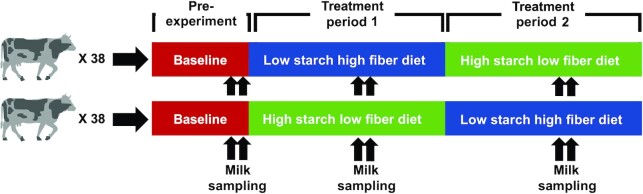
Milk samples were collected from 59 midlactation Holsteins in a crossover study featuring dietary modification with either a low starch high fiber or high starch low fiber feed. BMO profiles were evaluated by nano-LC quadrupole time-of-flight tandem MS, and differences in BMO abundances between diets were evaluated using linear mixed effects modeling.
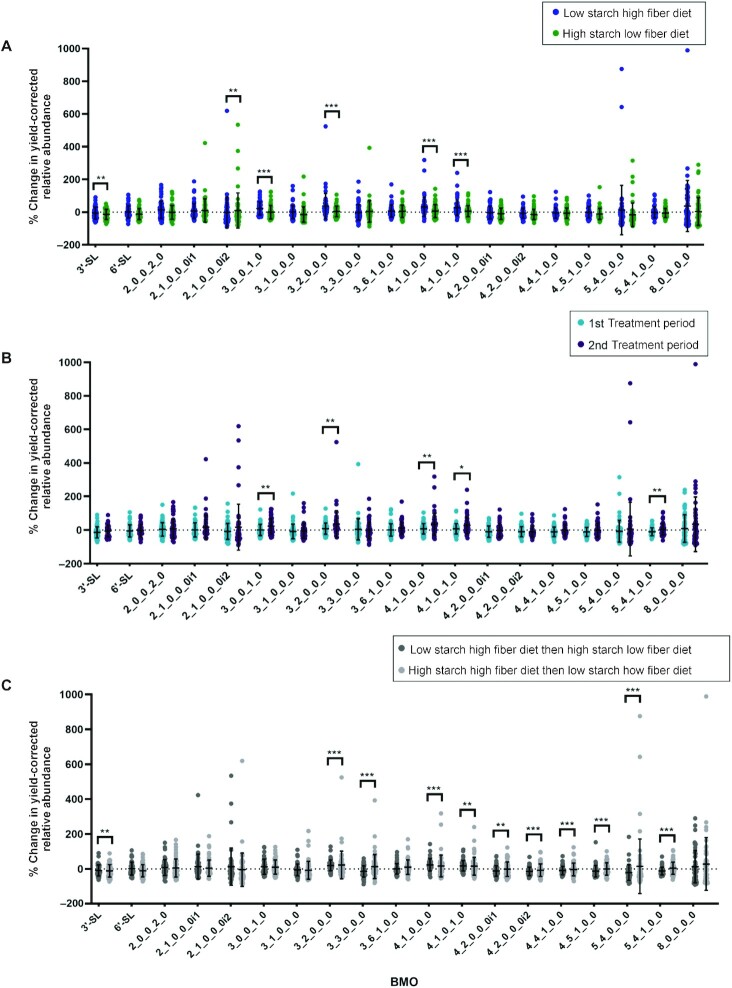
A total of 19 BMOs were identified across the sample set, including 4 large fucosylated compounds. Seven BMOs were found to have significantly more positive percent changes in yield-adjusted abundance from the pre-experiment baseline period for milk samples collected during feeding with the low starch high fiber diet compared with the high starch low fiber diet.
Consuming the low starch high fiber diet promoted greater overall BMO production than the high starch low fiber diet in a population of midlactation Holsteins. Additionally, this study afforded the opportunity to investigate the impact of other factors potentially influencing BMO abundances, furthering understanding of how dairy herd management practices can positively impact milk composition and support the potential use of BMOs as functional ingredients.
牛乳寡糖(BMOs)已被证实具有多种益处,并被推测有其他作用,包括在认知发育和抗病原体活性方面发挥作用,这使其成为婴儿配方奶粉和营养保健品应用中很有前景的成分。相对于乳糖等非生物活性单糖,牛乳中BMO的浓度较低,这给从牛乳中提取BMO带来了挑战。已知BMO的丰度会因奶牛的泌乳阶段、品种和胎次而有所不同,但在现有的奶牛群中,这些特征很难改变。相比之下,饮食调整是一个可操作的目标,并且已知它会影响产奶量、脂质含量、蛋白质水平和单糖组成。
确定低淀粉高纤维饮食与高淀粉低纤维饮食对荷斯坦奶牛总体BMO谱和单个BMO丰度的影响。
在一项交叉研究中,从59头处于泌乳中期的荷斯坦奶牛采集牛奶样本,该研究采用低淀粉高纤维或高淀粉低纤维饲料进行饮食调整。通过纳升液相色谱四极杆飞行时间串联质谱对BMO谱进行评估,并使用线性混合效应模型评估不同饮食之间BMO丰度的差异。
在整个样本集中共鉴定出19种BMO,包括4种大的岩藻糖基化化合物。与高淀粉低纤维饮食相比,在喂食低淀粉高纤维饮食期间采集的牛奶样本中,发现有7种BMO的产量调整丰度相对于实验前基线期的正变化百分比显著更高。
在一群处于泌乳中期的荷斯坦奶牛中,食用低淀粉高纤维饮食比高淀粉低纤维饮食能促进更多的总体BMO产生。此外,本研究提供了一个机会来研究其他可能影响BMO丰度的因素的影响,进一步加深了对奶牛群管理实践如何积极影响牛奶成分以及支持将BMO用作功能成分的潜在用途的理解。