Watanabe Yu, Tanaka Akihito, Furuhashi Kazuhiro, Saito Shoji, Maruyama Shoichi
Department of Nephrology, Nagoya University Graduate School of Medicine, Nagoya, Japan.
Department of Nephrology, Nagoya University Hospital, Nagoya, Japan.
Front Med (Lausanne). 2022 May 31;9:899359. doi: 10.3389/fmed.2022.899359. eCollection 2022.
The incidence of sleep apnea syndrome (SAS) is reported to be markedly high in patients with chronic kidney disease (CKD). Therefore, it is extremely important to know whether SAS affects prognosis in patients with CKD. Further, it is imperative to understand the prognostic impact of home continuous positive airway pressure (CPAP) therapy, which is one of the most common treatments for SAS.
We used a clinical database to identify patients with CKD using diagnosis codes. We included patients with CKD aged 20 years or more, not on renal replacement therapy, with a known change in renal function for at least 1 year. The propensity score was used to compare event rates for patients with SAS and those without SAS. In addition, the prognostic impact of CPAP therapy was investigated. The primary outcome is a composite of death, initiation of renal replacement therapy, hospitalization for heart failure, ischemic heart disease, and cerebrovascular disease.
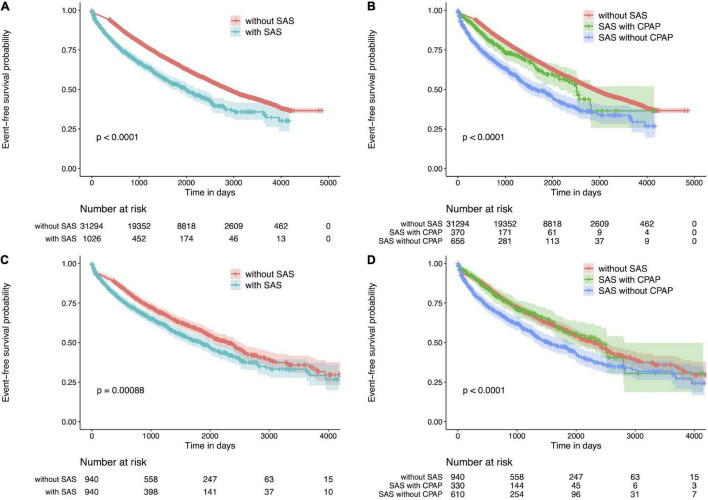
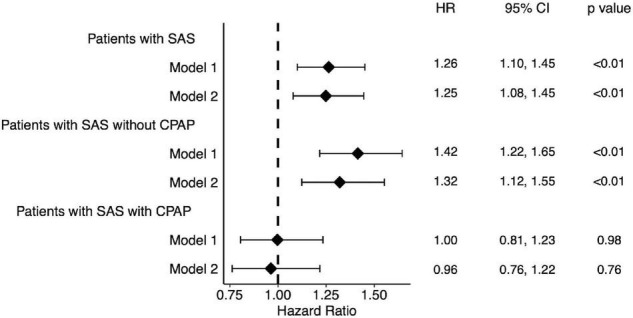
From the database, 31,294 patients with CKD without SAS and 1,026 with SAS were found to be eligible. Of these, 419 (41%) patients with SAS and 10,713 (34%) patients without SAS ( < 0.01) reached the primary outcome. After adjustment with the propensity score, the SAS group was found to have a similarly poor prognosis ( < 0.01): the hazard ratio for the primary outcome was 1.26 (95% CI, 1.08-1.45, < 0.01) in the group with SAS compared with the group without SAS. Conversely, in patients with SAS and using CPAP, the hazard ratio was lower and did not differ significantly (HR 0.96, 95% CI: 0.76-1.22, = 0.76).
In patients with CKD and SAS, the risk of death and cardiovascular disease is high. In addition, patients treated with CPAP may have improved life expectancy.
据报道,慢性肾脏病(CKD)患者中睡眠呼吸暂停综合征(SAS)的发病率显著较高。因此,了解SAS是否会影响CKD患者的预后极为重要。此外,必须了解家庭持续气道正压通气(CPAP)治疗的预后影响,这是SAS最常见的治疗方法之一。
我们使用临床数据库,通过诊断编码识别CKD患者。我们纳入了年龄在20岁及以上、未接受肾脏替代治疗、已知肾功能变化至少1年的CKD患者。倾向评分用于比较有SAS和无SAS患者的事件发生率。此外,还研究了CPAP治疗的预后影响。主要结局是死亡、开始肾脏替代治疗、因心力衰竭、缺血性心脏病和脑血管疾病住院的综合情况。
从数据库中发现,31294例无SAS的CKD患者和1026例有SAS的患者符合条件。其中,419例(41%)有SAS的患者和10713例(34%)无SAS的患者(P<0.01)达到主要结局。在进行倾向评分调整后,发现SAS组的预后同样较差(P<0.01):与无SAS组相比,有SAS组主要结局的风险比为1.26(95%CI,1.08 - 1.45,P<0.01)。相反,在使用CPAP的SAS患者中,风险比更低且无显著差异(HR 0.96,95%CI:0.76 - 1.22,P = 0.76)。
在患有CKD和SAS的患者中,死亡和心血管疾病的风险很高。此外,接受CPAP治疗的患者可能预期寿命会有所改善。