Department of Internal Medicine, Section Pharmacotherapy, Amsterdam UMC location Vrije Universiteit Amsterdam, Amsterdam, The Netherlands.
Research and Expertise Centre in Pharmacotherapy Education (RECIPE), Amsterdam, The Netherlands.
Br J Clin Pharmacol. 2022 Dec;88(12):5218-5226. doi: 10.1111/bcp.15443. Epub 2022 Jul 5.
The aim of this study was to investigate how the prescribing knowledge and skills of junior doctors in the Netherlands and Belgium develop in the year after graduation. We also analysed differences in knowledge and skills between surgical and nonsurgical junior doctors.
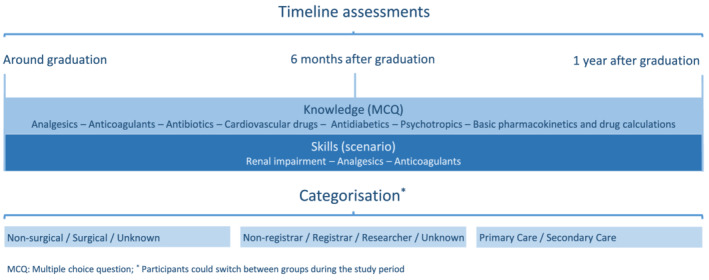
This international, multicentre (n = 11), longitudinal study analysed the learning curves of junior doctors working in various specialties via three validated assessments at about the time of graduation, and 6 months and 1 year after graduation. Each assessment contained 35 multiple choice questions (MCQs) on medication safety (passing grade ≥85%) and three clinical scenarios.
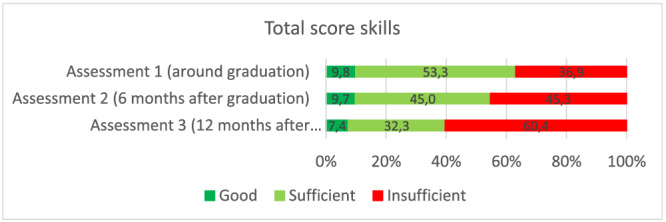
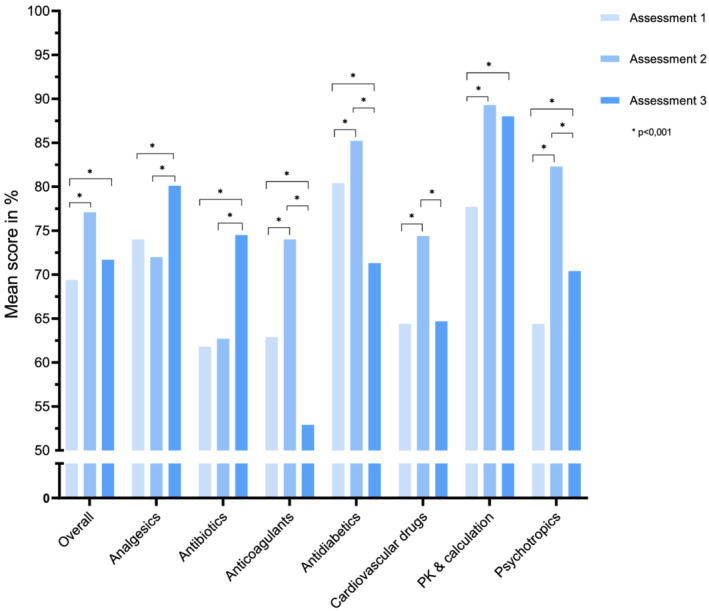
In total, 556 junior doctors participated, 326 (58.6%) of whom completed the MCQs and 325 (58.5%) the clinical case scenarios of all three assessments. Mean prescribing knowledge was stable in the year after graduation, with 69% (SD 13) correctly answering questions at assessment 1 and 71% (SD 14) at assessment 3, whereas prescribing skills decreased: 63% of treatment plans were considered adequate at assessment 1 but only 40% at assessment 3 (P < .001). While nonsurgical doctors had similar learning curves for knowledge and skills as surgical doctors (P = .53 and P = .56 respectively), their overall level was higher at all three assessments (all P < .05).
These results show that junior doctors' prescribing knowledge and skills did not improve while they were working in clinical practice. Moreover, their level was under the predefined passing grade. As this might adversely affect patient safety, educational interventions should be introduced to improve the prescribing competence of junior doctors.
本研究旨在调查荷兰和比利时的初级医生在毕业后的一年里,其处方知识和技能是如何发展的。我们还分析了外科和非外科初级医生之间知识和技能的差异。
这是一项国际性、多中心(n=11)的纵向研究,通过在毕业后、6 个月和 1 年后进行三次验证评估,分析了在不同专业工作的初级医生的学习曲线。每次评估都包含 35 道关于药物安全的多项选择题(及格分数≥85%)和三个临床情景。
共有 556 名初级医生参与了研究,其中 326 名(58.6%)完成了 MCQs 测试,325 名(58.5%)完成了所有三次评估的临床病例情景。毕业后一年内,处方知识的平均水平保持稳定,有 69%(SD 13)的人在第一次评估中答对了问题,而在第三次评估中有 71%(SD 14)的人答对了问题,而处方技能则有所下降:第一次评估中有 63%的治疗计划被认为是合适的,但第三次评估中只有 40%(P<.001)。虽然非外科医生的知识和技能学习曲线与外科医生相似(P=.53 和 P=.56),但他们在所有三次评估中的整体水平都更高(均 P<.05)。
这些结果表明,初级医生在临床实践中工作时,其处方知识和技能并没有提高。此外,他们的水平低于预设的及格分数。由于这可能对患者安全产生不利影响,应该引入教育干预措施来提高初级医生的处方能力。