Kahn Doron J, Perkins Beckett S, Barrette Claire E, Godin Robert
Division of Neonatology, Joe DiMaggio Children's Hospital, Hollywood, FL.
Mednax Services, Inc., Sunrise, FL.
Pediatr Qual Saf. 2022 Jun 14;7(3):e555. doi: 10.1097/pq9.0000000000000555. eCollection 2022 May-Jun.
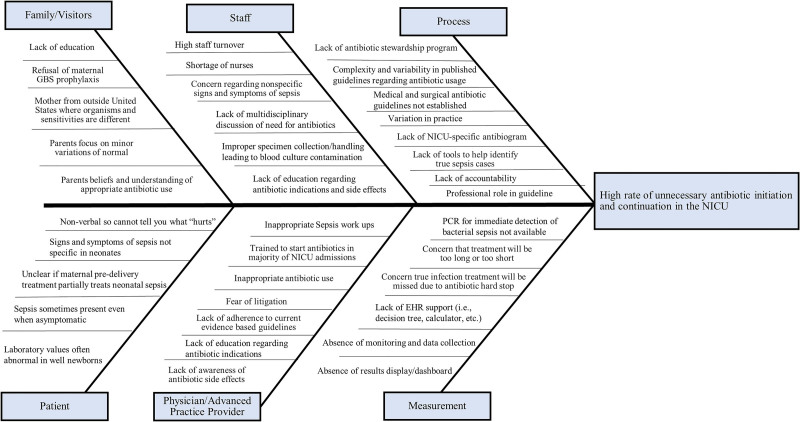
Variation in antibiotic (ATB) use exists between neonatal intensive care units (NICUs) without demonstrated benefit to outcomes tested. Studies show that early-onset sepsis occurs in up to 2% of NICU patients, yet antibiotics (ABX) were started in over 50% of neonates admitted to our NICUs. An internal audit identified variations in prescribing practices and excessive use of ABX. As a result, we introduced ATB stewardship to our NICUs in 2015 to reduce unnecessary usage of these medications.
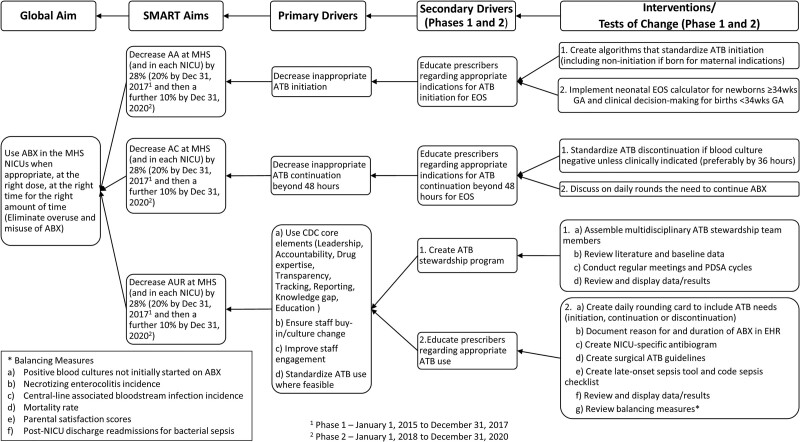
We used standard quality improvement methodology utilizing multiple iterative plan-do-study-act cycles during a 6-year project to test various interventions aimed at using ABX wisely. Specifically, our goals were to reduce ABX on admission (AA), percent of patients who continued on ABX beyond 72 hours of life (AC), and ATB utilization rate in our 3 NICUs by 28% for each metric. Interventions implemented included the development of an ATB stewardship program consisting of a multidisciplinary team that met regularly, creation of tools and guidelines for evaluations of sepsis and ATB use, universal use of the neonatal early-onset sepsis calculator for all newborns 34 weeks and older gestational age, education regarding noninitiation of ABX for maternal indications in clinically well newborns, and discontinuation within 48 hours for asymptomatic newborns with negative blood cultures.
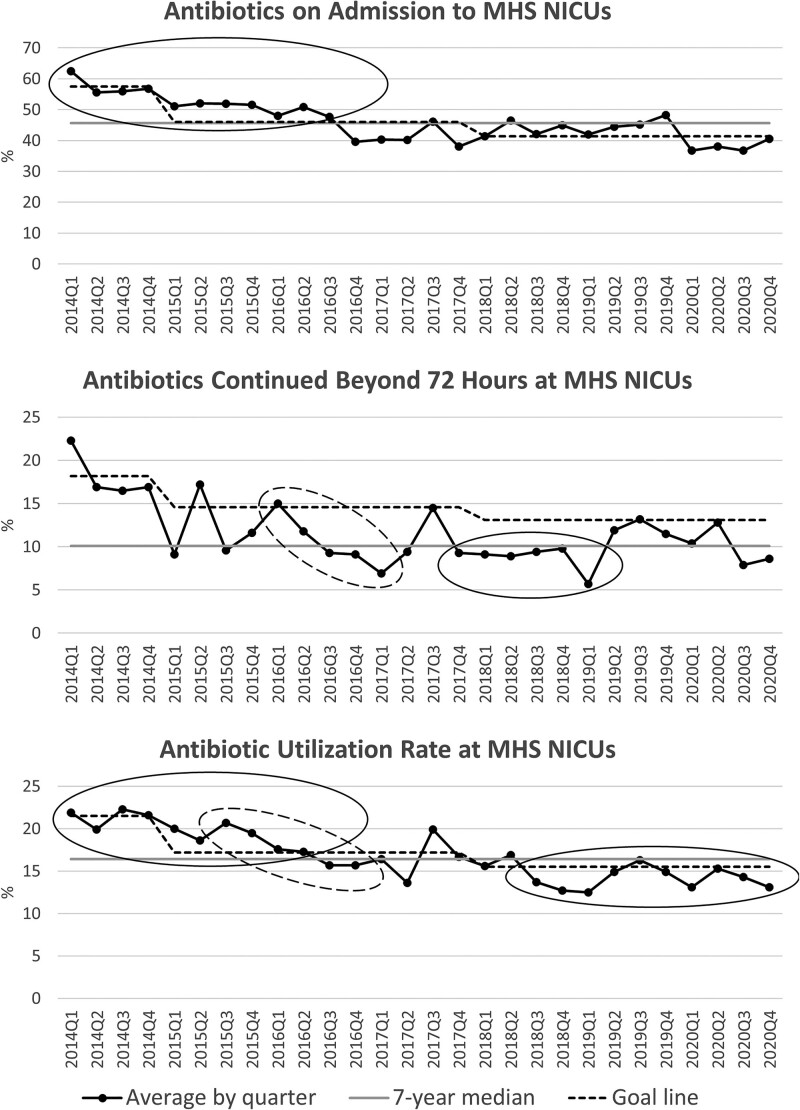
AA, AC, and ATB utilization rate decreased by 34.1%, 45.3%, and 34.9%, respectively, in our 3 NICUs.
By introducing ATB stewardship in our NICUs, we exceeded our predetermined goal of significantly reducing ATB usage.
新生儿重症监护病房(NICU)之间存在抗生素使用差异,且未证明对所测试的结果有益处。研究表明,高达2%的NICU患者会发生早发性败血症,但在我们NICU收治的新生儿中,超过50%开始使用了抗生素。一次内部审计发现了处方行为的差异以及抗生素的过度使用。因此,我们于2015年在我们的NICU引入了抗生素管理措施,以减少这些药物的不必要使用。
在一个为期6年的项目中,我们使用标准质量改进方法,通过多个迭代的计划-执行-研究-行动循环来测试各种旨在明智使用抗生素的干预措施。具体而言,我们的目标是将入院时抗生素使用(AA)、出生后72小时以上仍继续使用抗生素的患者百分比(AC)以及我们3个NICU的抗生素使用率每项指标降低28%。实施的干预措施包括制定一个由多学科团队组成的抗生素管理计划,该团队定期开会;创建用于评估败血症和抗生素使用的工具及指南;对孕周34周及以上的所有新生儿普遍使用新生儿早发性败血症计算器;对临床状况良好的新生儿因母体指征而不开始使用抗生素进行教育;以及对血培养阴性的无症状新生儿在48小时内停用抗生素。
我们3个NICU的AA、AC和抗生素使用率分别下降了34.1%、45.3%和34.9%。
通过在我们的NICU引入抗生素管理措施,我们超出了大幅减少抗生素使用的预定目标。